Olight makes some of the lights discussed here. Specs and regular prices come from makers' pages and manuals as of September 2026; OSHA rules are quoted from the eCFR. All calculations use published ratings, not measurements.
⚡ TL;DR
A lineman flashlight is the smallest piece of storm restoration lighting. Put task light on the bucket, below and beside the work, use ground lights for the area, and keep head-worn and handheld lights for patrol and close checks. No flashlight is an insulating tool, and none of the Olight lights here carries an electrical insulation or intrinsic-safety rating.
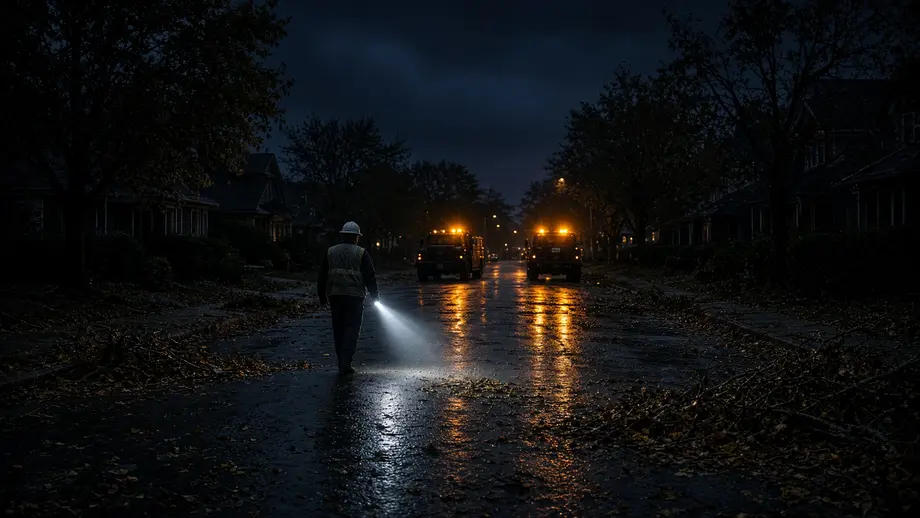
The call comes after the wind drops. You are 40 feet up, both hands in rubber gloves, the crossarm wet and the hardware shining back at you. A headlamp points wherever you look, so your hands and tools sit in its beam and every wet insulator throws it back into your eyes. On the ground, someone aims a spotlight that lights your face better than the work.
This table lists each job on a storm call, the lineman flashlight or work light type that suits it, the minimum spec to look for and an example.
| Job on a storm call | Recommended type | Minimum spec | Example (regular price, September 2026) |
|---|---|---|---|
| Task light at the crossarm | Bucket-lip work light | Clamp made for bucket lips, flood mode, swappable battery | Milwaukee M18 Utility Bucket Light, 2,500 / 2,200 / 800 lm; Olight makes no bucket light |
| Patrolling a damaged line from the road | Long-throw flashlight | 600 m rated beam, a sustained step near 1,000 lm | Olight Warrior X 4: 630 m; 1,000 lm for 140 min after 3 min ($129.99) |
| Ground and truck tasks | Holstered handheld with auto-lockout | 300 lm for 10+ hours | Olight Seeker Ultra: Med 300 lm for 12.5 h ($169.99) |
| Staging yard and walk-down | High-capacity flood light | 150 to 300 lm of flood all night | Olight Marauder Mini 2: floodlight 150 lm for 27 h ($219.99) |
| Truck bins, maps, right-of-way | Headlamp with red mode | 120 lm for a full shift | Olight Perun 3: Med 120 lm for 25 h ($89.99) |
| Within reaching distance of exposed energized parts | No flashlight by default | Only what your employer allows under OSHA 1910.269(l)(7) | See the insulation section |
📋 Table of Contents
- 1. Quick Answer: Light the Work From Below or the Side, Not Only From Your Head
- 2. What Light Do Linemen Use?
- 3. Bucket Truck vs Pole Climbing: How the Work Position Changes the Light
- 4. Ground Lighting: Where It Goes and the Glare It Must Not Cause
- 5. How Do Utility Crews Work at Night?
- 6. Insulation Rules: What Must Stay Out of Reach of Energized Parts?
- 7. Is It Safe to Work on Lines in the Rain?
- 8. Rain and Wind: Keeping Lights Fixed, Tethered and Locked
- 9. Crew Communication and Light Signals
- 10. Downed Lines: What the Public Should Do Near a Storm Crew
- 11. Where Olight Lights Fit in a Storm Kit, and Where They Don't
- 12. This Guide Covers Lighting Only, Not Line Work Procedures
- 13. A Pre-Storm Lineman Flashlight Checklist for Line Crews
- 14. FAQ
Quick Answer: Light the Work From Below or the Side, Not Only From Your Head
For line work after a storm, light the crossarm from a bucket-mounted light set below and to the side of the work, and save the headlamp for close checks and moving around. A light on your head sits behind your hands and tools and bounces off wet hardware into your eyes. A side light reaches around your hands and sends reflections past you.
OSHA sets the requirement, not the method. 29 CFR 1910.269(w)(4)(4)) says: "The employer shall provide sufficient illumination to enable the employee to perform the work safely." The construction rule, 1926.967(d)), repeats it and notes: "See § 1926.56, which requires specific levels of illumination."
Handheld lights stay as the access layer: a pocket light from Olight's EDC flashlights for tags and bins, one of its headlamps for walking a right-of-way.
What Light Do Linemen Use?
Linemen use layers of light, not one light. OSHA asks for sufficient illumination, and each utility decides how to provide it: truck and boom lights for the area, bucket-lip lights for the crossarm, head-worn lights for close checks, and long-throw handheld lights for patrolling a damaged line from the road before anyone goes up.
Piedmont Electric describes linemen working "40 feet or more in the air wearing sturdy, thick rubber gloves and sleeves," and its safety director says in its lineman safety article: "They must work in and around high-voltage power lines in extreme weather conditions and often in the dark to restore power to their neighbors' homes."
Some lights are built for the bucket. Milwaukee says its M18 Utility Bucket Light has a "patented spring-loaded clamp" that "fits all size bucket lips." Its spec table lists 2,500, 2,200 and 800 lumens, 4, 4 and 6 hours on an XC5.0 pack, and IP56; its overview ties those run times to an HD9.0 pack. Milwaukee cites "high voltage durability," but the page lists no insulation rating.
Bucket Truck vs Pole Climbing: How the Work Position Changes the Light
In a bucket, light can sit on the bucket lip below the work and aim up across the crossarm, so your hands never block it. On a pole there is no lip, so hands-free light comes from your head or from the ground, and neither matches a lip light for the task.
Bucket truck lighting
A lip light sits low and to one side, which controls glare. The Canadian Centre for Occupational Health and Safety's lighting ergonomics guide says "Glare is what happens when a bright light source or reflection interferes with how you are 'seeing' an object," and names "Light reflected from polished, shiny or glossy surfaces" as a cause. Wet insulators and new hardware are those surfaces. A headlamp sits almost on your line of sight, so reflections come straight back.
A magnet needs steel, so the Perun 3's magnetic tail will not hold on a nonmetallic surface; use a clamp made for the bucket.
Pole-top lighting
On a pole, the only hands-free light that moves with you is on your head. The Perun 3 ships with a headband; Olight lists no hard hat mount or electrical rating for it, so how it is worn with a hard hat is your employer's call.
This table sets utility restoration lighting targets for each sub-scene: where the light sits, the output that works, the runtime and the water rating.
| Sub-scene | Where the light sits | Output | Runtime | Water rating | Olight fit |
|---|---|---|---|---|---|
| Bucket, crossarm task | Bucket lip, below and beside the work | Flood at close range | Most of a shift | IP56 or better | None |
| Pole top | Head | 100 to 300 lm | A full shift | IPX7 or better | Perun 3, Med 120 lm |
| Patrol from the road | Hand, aimed at spans | Sustained throw near 1,000 lm | 2+ hours | IPX8 | Warrior X 4, High 1,000 lm for 140 min |
| Ground tasks | Holster or hand | 50 to 300 lm | A full shift | IPX8 | Seeker Ultra, Med 300 lm or Low 50 lm |
| Staging area | Propped or on a tall stand | 150 to 600 lm flood | All night | IPX8 | Marauder Mini 2, floodlight 150 lm for 27 h |
Ground Lighting: Where It Goes and the Glare It Must Not Cause
Ground lighting belongs off to the side of the pole or bucket, outside the drop zone, aimed at the work and not at the worker. Distance works against it: at a 40-foot work point, even a 4,800-lumen flashlight meets OSHA's 5 foot-candle construction benchmark only in its 2.5-minute Turbo burst. Ground lights serve inspection and the area, not the crossarm.
Standing off is required anyway: under 1910.269(q)(4)(i)(4)(i)), "The employer shall ensure that no employee is under a tower or structure while work is in progress, except when the employer can demonstrate that such a working position is necessary to assist employees working above."
How much light reaches 40 feet up from the ground?
OSHA's 1926.56(a) Table D-3) sets 5 foot-candles for "General construction area lighting." Five foot-candles is 5 × 10.764 = 53.8 lux. Lux on a surface facing the light equals candela divided by distance squared. The work point is 40 ft (12.19 m) up, Piedmont's figure. Below peak output, candela is scaled with lumens, assuming the beam keeps its shape.
This table estimates the light an Olight Seeker Ultra puts on that work point from straight below and from 10 m (33 ft) out, based on Olight's rated 17,600 candela at 4,800 lumens, not measured.
| Seeker Ultra mode (Olight rating) | Estimated candela | Lux from straight below (12.19 m) | Lux from 10 m out (15.77 m slant) | Meets 5 fc? |
|---|---|---|---|---|
| Turbo, 4,800 lm for 2.5 min | 17,600 (rated) | 17,600 ÷ 148.6 = 118.4 (11.0 fc) | 17,600 ÷ 248.6 = 70.8 (6.6 fc) | Yes, for 2.5 min |
| High, 1,200 lm for 23 min | 17,600 × 1,200 ÷ 4,800 = 4,400 | 29.6 (2.8 fc) | 17.7 (1.6 fc) | No |
| Turbo second step, 1,000 lm for 150 min | 3,667 | 24.7 (2.3 fc) | 14.7 (1.4 fc) | No |
| Med, 300 lm for 12.5 h | 1,100 | 7.4 (0.7 fc) | 4.4 (0.4 fc) | No |
From 10 m out, the slant distance is √(12.19² + 10²) = 15.77 m. Turbo's 17,600 candela holds 53.8 lux out to √(17,600 ÷ 53.8) = 18.1 m of slant, a standoff of about 13.4 m (44 ft). Every sustained mode falls short even from directly below, where no one should stand.
Area lights need height as well as lumens. Our work light stand guide covers tripod height, tip-over and beam spread. Olight's Light Stand ($27.99 regular price, September 2026) is a short stand with a round base that sets to 200 or 312 mm, and its listed compatible products are lanterns such as the Olantern Classic Mini, not the flashlights here.
To keep ground light out of the bucket, CCOHS suggests "Using several small low-intensity light fixtures rather than one large high-intensity light fixture." Two modest area lights beat one blinding one, and a patrol beam swings to the span, never across the bucket. The Seeker Ultra manual says: "Do not stare directly at the operating light source."
How Do Utility Crews Work at Night?
Utility crews work at night during major storm restoration, usually with fewer crews than by day. Southside Electric Cooperative says most resources are "strategically dispatched during daylight hours for more efficient restoration," while "a select number of crews continue working overnight." Night crews work long shifts under lighting their employer must provide, so every light has to last the shift.
For shift length, the American Public Power Association reported Nashville Electric Service saying during Winter Storm Fern, "Our lineworkers continue to work around the clock on 14-16 hour shifts." Olight rates all four lights here for 0 to 40 °C, so in an ice storm, expect less runtime than the tables show and keep spares in the cab.
Power line night work: charges per shift
A 16-hour shift leaves 24 − 16 = 8 hours for travel, sleep and charging. This table works out full charges per shift at a working mode, based on Olight's rated runtimes and manual charge times, not measured.
| Light and working mode | Rated runtime | Charges per 14 h shift | Charges per 16 h shift | Full charge (Olight manual) |
|---|---|---|---|---|
| Seeker Ultra, Med 300 lm | 12.5 h | 14 ÷ 12.5 = 1.12 | 16 ÷ 12.5 = 1.28 | About 4.1 h (USB-C); 5.3 h (optional MCC3) |
| Warrior X 4, Regular Low 300 lm | 8 h | 1.75 | 16 ÷ 8 = 2.00 | About 3.5 h (USB-C); 5 h (optional MCC) |
| Marauder Mini 2, Level 1-2 floodlight 150 lm | 27 h | 0.52 | 16 ÷ 27 = 0.59 | About 3.5 h (USB-C); 6.5 h (optional MCC3) |
| Marauder Mini 2, Level 2-1 floodlight 300~150 lm | 13 + 3 h | 13 h at 300 lm, 1 h at 150 lm | 16 ÷ 16 = 1.00, ending at 150 lm | Same |
The Seeker Ultra needs a top-up or a switch to Low late in the shift, and the Warrior X 4 needs a second light or truck charging. The Marauder Mini 2 on Level 1-2 uses about 59% of a charge. Every charge time fits the 8-hour gap only if lights charge while the crew sleeps.
Insulation Rules: What Must Stay Out of Reach of Energized Parts?
A flashlight is a conductive article, not an insulating tool. OSHA's power line rules make the employer remove or render nonconductive exposed conductive articles when you work within reaching distance of exposed energized parts, and count any conductive object you hold toward the minimum approach distance. Every Olight light here has an aluminum alloy body and no insulation rating.
1910.269(l)(7)(7)) reads: "When an employee performs work within reaching distance of exposed energized parts of equipment, the employer shall ensure that the employee removes or renders nonconductive all exposed conductive articles, such as keychains or watch chains, rings, or wrist watches or bands, unless such articles do not increase the hazards associated with contact with the energized parts." The construction rule, 1926.960(f)), uses the same words.
1910.269(l)(3)(iii)(3)(iii)) adds: "The employer shall ensure that no employee approaches or takes any conductive object closer to exposed energized parts than the employer's established minimum approach distance, unless:" the employee or the part is insulated as the rule describes. A metal flashlight in your hand is a conductive object.
How much reach does a handheld light add?
OSHA's Table R-6 lists alternative minimum approach distances (MAD) for 72.5 kV and less, at sites 900 m (3,000 ft) or lower. This table shows how much of each phase-to-ground MAD a light uses if pointed at the part, from Olight's lengths: Warrior X 4 149 mm, Perun 3 116.8 mm.
| Voltage, phase to phase | MAD, phase to ground | Warrior X 4 share | Perun 3 share | Hand-to-part distance, Warrior X 4 pointed at the part |
|---|---|---|---|---|
| 0.301 to 0.750 kV | 0.33 m (1.09 ft) | 0.149 ÷ 0.33 = 45% | 0.1168 ÷ 0.33 = 35% | 0.33 + 0.149 = 0.48 m (1.57 ft) |
| 0.751 to 5.0 kV | 0.63 m (2.07 ft) | 24% | 19% | 0.78 m (2.56 ft) |
| 5.1 to 15.0 kV | 0.65 m (2.14 ft) | 23% | 18% | 0.80 m (2.62 ft) |
| 15.1 to 36.0 kV | 0.77 m (2.53 ft) | 19% | 15% | 0.92 m (3.02 ft) |
This is arithmetic, not a work method. Your employer sets the actual distances, and glove, tool and barehand work follow its program. For panel wiring under OSHA 1910.333, see our electrician flashlight guide.
Lights do not change your clothing duty. 1910.269(l)(8)(iii)(8)(iii)) says: "The employer shall ensure that each employee who is exposed to hazards from flames or electric arcs does not wear clothing that could melt onto his or her skin or that could ignite and continue to burn when exposed to flames or the heat energy estimated under paragraph (l)(8)(ii) of this section." No light here is arc-rated or hazardous-location listed; our firefighter flashlight guide explains intrinsically safe markings.
Warning: A flashlight is not an insulated tool and does not replace rubber insulating gloves, sleeves, insulated tools, arc-rated clothing or any other protective equipment your work rules require. Olight lists no electrical insulation, arc rating or hazardous-location certification for any light in this guide.
This table turns the OSHA paragraphs quoted here into what each means for lights.
| Rule (29 CFR) | What the text requires | What it means for lights |
|---|---|---|
| 1910.269(w)(4); 1926.967(d) | Sufficient illumination | The employer picks the method |
| 1910.269(l)(7); 1926.960(f) | Remove or render nonconductive exposed conductive articles | Metal lights count |
| 1910.269(l)(3)(iii) | No conductive object inside the MAD, with exceptions | A light adds its length to your reach |
| 1910.269(q)(3)(vi), (q)(4)(iv), (r)(1)(vi); 1926.964(c)(5), (d)(4) | Stop barehand, tower and tree trimming work in hazardous weather; only tower work excepts emergency restoration | Weather calls belong to the employer |
| 1910.269(c)(2) | Job briefing on hazards, procedures and PPE | Agree on lights and signals there |
Is It Safe to Work on Lines in the Rain?
OSHA's power line rules do not name rain. Their weather clauses cover three kinds of work: live-line barehand work, towers and structures, and line-clearance tree trimming. Each stops the work when weather makes it hazardous despite the required practices, with thunderstorms, high winds, snow storms and ice storms as examples. Only the tower clause excepts emergency restoration. The call belongs to your employer, not your light.
The tower rule, 1910.269(q)(4)(iv)(4)(iv)), says: "The employer shall ensure that, except during emergency restoration procedures, employees discontinue work when adverse weather conditions would make the work hazardous in spite of the work practices required by this section." The barehand rule, 1910.269(q)(3)(vi)(3)(vi)), also stops work when wind pushes clearances below the minimum approach distance, unless insulating guards cover the nearby objects. The tree trimming rule, 1910.269(r)(1)(vi)(1)(vi)), adds: "Each employee performing line-clearance tree trimming in the aftermath of a storm or under similar emergency conditions shall be trained in the special hazards related to this type of work." The construction versions are 1926.964(c)(5) and (d)(4)(5)).
The Warrior X 4, Seeker Ultra and Marauder Mini 2 are rated IPX8 and the Perun 3 IP68. A water rating says how a light keeps water out, not whether it insulates, and a wet aluminum flashlight is still a conductive article.
Rain and Wind: Keeping Lights Fixed, Tethered and Locked
In rain and wind, a light that moves is a light that falls. Keep lights aloft in a holster, on a lanyard or on a clamp made for the bucket, lock them when stowed, and follow your employer's dropped-object rules.
This table estimates each light's energy after a 40-foot (12.19 m) fall, using E = m × g × h with g = 9.81 m/s², Olight's published weights and no air drag, based on Olight's ratings, not measured.
| Light (Olight weight) | Energy at impact | Olight impact rating | Fall height vs rating |
|---|---|---|---|
| Perun 3 (150 g) | 0.150 × 9.81 × 12.19 = 17.9 J | 1.5 m (manual) | 12.19 ÷ 1.5 = 8.1 times |
| Seeker Ultra (220 g) | 26.3 J | 1.5 m (manual) | 8.1 times |
| Warrior X 4 (249 g) | 29.8 J | 2 m (manual) | 12.19 ÷ 2 = 6.1 times |
| Marauder Mini 2 (465 g) | 55.6 J | Not listed on the product page | Not applicable |
Every light lands at about √(2 × 9.81 × 12.19) = 15.5 m/s (35 mph), so the 465 g Marauder Mini 2 stays on the ground. For the three rated lights, a bucket drop is 6 to 8 times Olight's rated height.
Locking matters as much as tethering. The Seeker Ultra locks itself 10 seconds after its indicators go off, and its manual says: "When the flashlight is off, it will be locked if put back to the holster." The Perun 3 locks when you press and hold the switch from off for about 2 seconds. The Warrior X 4 manual lists no lockout, and a tap of the tail switch turns it on, so keep it in its holster.
Tip: On the ground, carry the Seeker Ultra in its holster. The manual says drawing it unlocks it, and a single press turns it on until 10 seconds after the indicators go dark, so gloved hands skip the unlock step. Any light that goes aloft follows your employer's conductive-article rules.
Crew Communication and Light Signals
OSHA does not define flashlight signals for line crews. It requires a job briefing before each job, and another when conditions change. Any light signal your crew uses belongs in that briefing, agreed in advance, and it never replaces the voice or radio contact your employer requires.
1910.269(c)(2)(2)) says: "The briefing shall cover at least the following subjects: hazards associated with the job, work procedures involved, special precautions, energy-source controls, and personal protective equipment requirements."
Dim any light that faces a person; the Perun 3 and Marauder Mini 2 manuals say "Do not stare at operating light source." Mark positions in red: the Perun 3 runs red at 15 lumens for 70 hours. Keep the Warrior X 4 in Regular mode, since in Tactical mode a press starts a 13 Hz strobe at 2,600 lumens.
Downed Lines: What the Public Should Do Near a Storm Crew
If you are not on the crew, stay well back from downed lines and from the work. CenterPoint Energy tells customers to "Stay at least 35 feet away from downed power lines or fallen wires" and to assume a downed wire is live. OSHA's storm guidance tells workers to assume lines are energized until proven otherwise, including through backfeed from portable generators.
This table collects the distances and rules the utilities and agencies quoted here publish.
| Situation | Distance or rule | Source |
|---|---|---|
| Downed power line or fallen wire | "Stay at least 35 feet away" | CenterPoint Energy |
| A vehicle touching a power line | "Warn others to stay at least 30 feet away." | FirstEnergy insert |
| Unqualified worker working elevated near an overhead line, 50 kV or less to ground | 10 ft (305 cm), including the longest conductive object | OSHA 1910.333(c)(3)(i)(A)(1)(3)(i)(A)(1)) |
| Floodwater | "Underground or downed power lines can electrically charge the water." | Ready.gov floods |
| Home generator | "outdoors and at least 20 feet away from windows" | Ready.gov power outages |
The 30- and 35-foot figures come from different utilities and situations, so follow your own utility's number. OSHA's Hurricane eMatrix electrical sheet tells workers: "Assume that electrical lines are energized until proven otherwise; lines may become energized as a result of backfeed from portable generator use, circuit ties/switch point, lightning, or other downstream events." For lights to keep at home through storm season, see our guide to hurricane supplies storage.
Safety note: A flashlight lets you see a downed line from a distance; it cannot tell you whether the line is energized. Treat it as live, call 911 if someone is hurt, and report it to your utility.
Where Olight Lights Fit in a Storm Kit, and Where They Don't
Olight's lights fit the patrol, ground, staging and headlamp layers of a storm kit, used away from exposed energized parts: Warrior X 4 for spans, Seeker Ultra for the truck, Marauder Mini 2 for the staging area and Perun 3 for walking and close checks. None is a bucket light, an insulated tool or a hazardous-location light.
Buying for a whole crew? Our group flashlight purchase guide covers battery platforms and spares.
Patrol light: Olight Warrior X 4
The Olight Warrior X 4 tactical flashlight ($129.99 regular price, September 2026, Matte Black) is rated at 2,600 lumens, 99,310 candela and 630 m. Regular High runs 2,600~1,000~300 lumens for 3 + 140 + 20 minutes, Regular Low 300 lumens for 8 hours, Tactical Med 1,000~300 lumens for 150 + 20 minutes. It weighs 249 g, is IPX8 and ships with a holster and USB-C cable. Limits: an 8-hour sustained mode, no lockout, and a strobe to keep off.
Ground and truck light: Olight Seeker Ultra
The Olight Seeker Ultra flashlight ($169.99 regular price, September 2026, Olive Green) is rated at 4,800 lumens, 17,600 candela and 265 m. Turbo runs 4,800~1,000~600 lumens for 2.5 + 150 + 70 minutes, High 1,200~1,000~600~300 lumens for 23 + 140 + 65 + 15 minutes, Med 300 lumens for 12.5 hours, Low 50 lumens for 69 hours and Moon 5 lumens for 17 days. It weighs 220 g, is IPX8 and comes with a vertical holster, fixing bracket and USB-C cable. Limit: its 265 m reach is less than half the Warrior X 4's.
Staging-area flood: Olight Marauder Mini 2
The Olight Marauder Mini 2 flashlight ($219.99 regular price, September 2026, Stonewashed Stars and Stripes) is rated at 10,000 lumens of floodlight and a 750 m spotlight at 140,000 candela. For area work, Level 1-2 floodlight gives 150 lumens for 27 hours and Level 2-1 gives 300~150 lumens for 13 + 3 hours. It weighs 465 g, and Olight says its lanyard doubles as a USB-C cable. Limit: it floods from wherever you prop it, not from mast height.
Headlamp: Olight Perun 3
The Olight Perun 3 headlamp ($89.99 regular price, September 2026, Black) is rated at 3,000 lumens, 160 m and IP68. Turbo runs 3,000~800~600 lumens for 2 + 180 + 30 minutes, High 600~120 lumens for 300 + 30 minutes, Med 120 lumens for 25 hours, Low 30 lumens for 89 hours, Moon 5 lumens for 20 days, and red 60 lumens for 14 hours or 15 lumens for 70 hours. It weighs 150 g and ships with a headband, MCC3 cable and lanyard. Limits: no hard hat mount listed, an aluminum body, and no electrical rating.
This Guide Covers Lighting Only, Not Line Work Procedures
This guide covers the lighting side of storm restoration. It does not describe how to perform line work, set minimum approach distances, choose arc-rated clothing or decide when weather stops a job. Those decisions come from OSHA 1910.269 or 1926 Subpart V, your employer's safety program and the qualified employee in charge.
A Pre-Storm Lineman Flashlight Checklist for Line Crews
Run this lineman flashlight checklist when a storm is forecast, before crews stage. Each step ties back to a number or rule above, so a crew lead can issue kits that are charged, locked and matched to each job.
- Count charges per 16-hour shift: 2 for a Warrior X 4 on Low, 1.28 for a Seeker Ultra on Med.
- Set up charging at the lodging; the 8-hour gap is also sleep time.
- Holster or tether anything that goes aloft; a 249 g light falling 40 feet carries about 30 J.
- Keep metal lights out of reaching distance of exposed energized parts unless your employer allows them.
- Put lighting, standoff positions and light signals in the job briefing.
- In ice storms, keep spares warm in the cab; these lights are rated 0 to 40 °C.
- Set the Warrior X 4 to Regular mode and lock the Perun 3 before packing.
FAQ
Changelog
- September 25, 2026: First published.