Olight sells the OSelect TS004 thermal monocular and the Seeker 4 Pro flashlight discussed here. Their specs and regular prices come from Olight's US product pages and user manuals as of October 2026. Distances, seconds and percentages below are calculations from published ratings and agency figures, not road measurements.
⚡ TL;DR
Night vision for cars works in two very different ways. A factory thermal display watches the road while you drive and puts the image where you already look. A handheld thermal scanner, such as the $499.00 TS004, is for a stopped car. On dark rural roads at 45 mph or faster, a factory system is the better tool; once you pull over, the handheld wins.
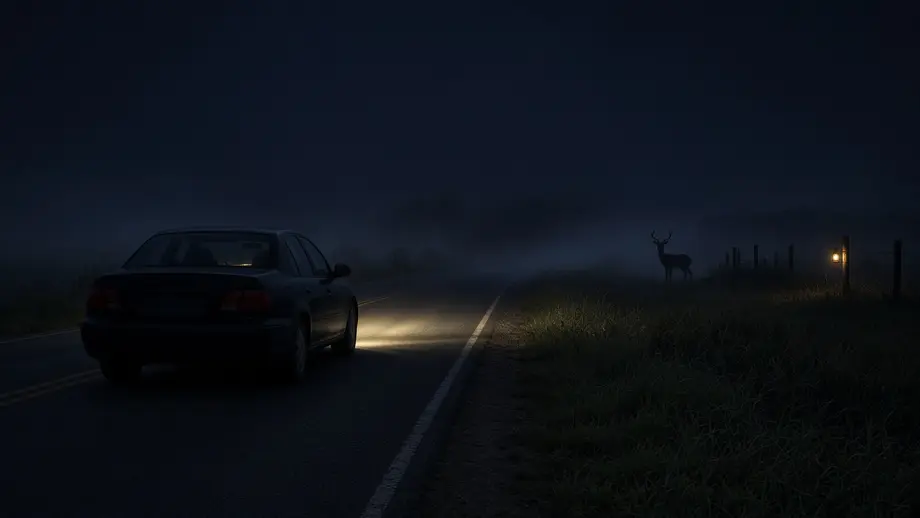
The worry is simple. You drive an unlit county road, the shoulder is grass and brush, and a deer can step out where your headlights never reach. Would a thermal camera show it sooner, can you hold one in the car, and is that legal? This guide answers all three with numbers.
This table sums up how night vision for cars compares in its two main forms, using published ratings and the sources cited below.
| Dimension | Factory thermal display | Handheld thermal (TS004) | Better | By how much |
|---|---|---|---|---|
| Use while the car is moving | Built for it; image shown in the cluster or center screen | No; the driver must not hold it or look into it | Factory | Only one is designed for a moving car |
| Sees through the windshield | Camera sits outside the glass, in the grille | No; glass blocks long-wave infrared | Factory | A handheld needs an open window or a parked car |
| Rated reach | BMW system: people at about 300 m | 410m detection, 91m identification | Depends | 410 m is 1.37 times 300 m, but neither maker states its target size |
| Warnings | Systems detect pedestrians, cyclists and animals | AI listed for "people and vehicles" only | Factory | The TS004 lists no animal alert |
| Cost | Factory option on mostly luxury models | $499.00 regular price | Handheld | No add-on package or new car needed |
| Uses outside the car | None | Yard, trail, roadside after a stop | Handheld | Works anywhere you can stand still |
📋 Table of Contents
- 1. Quick Answer: Can You Use Night Vision for Cars in a Handheld Form?
- 2. Factory Night Vision vs Aftermarket Displays vs Handheld Thermal: Comparison
- 3. How Far Do Headlights Reach Compared With Stopping Distance?
- 4. What Is the Range of a Thermal Camera on a Dark Road?
- 5. Is It Illegal to Drive With Night Vision?
- 6. Why Do Factory Thermal Cameras Sit in the Grille, Not Behind the Windshield?
- 7. Common Mistake: Thinking Night Vision Lets You Drive Faster
- 8. How Much Does a Night Vision Camera for a Car Cost?
- 9. What Is the Best Car Night Vision System?
- 10. What to Do When a Deer or Other Animal Is in the Road
- 11. A Parked-Car Thermal Check You Can Run Yourself
- 12. Your Night Driving Action Checklist
- 13. FAQ
Quick Answer: Can You Use Night Vision for Cars in a Handheld Form?
Not while you drive. A driver should never hold a thermal monocular or watch a loose screen while the car moves. Night vision for cars that you use in motion means a factory system or a properly installed display that does not block your view. A handheld thermal fits a parked car, a shoulder stop, or a passenger scanning only when it is safe. It never replaces headlights and slower speed.
The factory system answers "is something warm ahead?" while your eyes stay near the road; the handheld answers "what is in that ditch?" after you stop. Olight sells handheld tools among its flashlights and thermal imagers, not car-mounted systems.
Factory Night Vision vs Aftermarket Displays vs Handheld Thermal: Comparison
Factory systems mount a thermal camera in the grille and show the image in the dash, often with pedestrian and animal detection. Aftermarket kits copy that layout with a grille camera and a separate screen, usually for $300 to more than $1,000. A handheld thermal monocular has no mount, no car power and no alerts. Pick by whether you need the image while moving.
This table compares the three ways to add night vision for cars.
| Feature | Factory thermal system | Aftermarket thermal kit | Handheld thermal (TS004) |
|---|---|---|---|
| Camera position | Front grille, outside the glass | Usually grille or bumper | In your hand or on a tripod |
| Where you look | Instrument cluster or center screen | Separate monitor you mount | 0.32 inch 800x600 OLED eyepiece |
| Alerts | Pedestrians, cyclists and animals on some systems | Varies by kit | None for animals |
| Use while driving | Yes, as designed | Only if the screen is installed legally and safely | No |
| Typical cost | Option or package on a new car | About $300 to more than $1,000 (KBB) | $499.00 |
| Moves to another car | No | Rarely | Yes |
Kelley Blue Book's guide to night vision in vehicles says "BMW, Cadillac, Volkswagen, and Audi use passive night vision systems," while "Toyota, Lexus, and Mercedes-Benz use active night vision systems." Passive systems read heat; active ones use near-infrared light.
FLIR Systems (now Teledyne FLIR) said in a February 2021 news release on Veoneer's night vision that the fourth-generation system debuted as an option on the 2021 Cadillac Escalade, with a camera "integrated into the front grille." The release says the FLIR and Veoneer work, begun in 2003, has brought thermal sensing to "nearly one million vehicles."
The handheld option sits in Olight's OSelect thermal imaging cameras range. The TS004 thermal monocular ($499.00, regular price, October 2026) has a 256 x 192 sensor, a 13mm lens with a 13.5° x 10.10° field of view, a 50Hz frame rate, IP67 and a 5000mAh battery rated for 11 hours. Olight lists its AI algorithm as able to "identify people and vehicles." It weighs 330g (0.728lbs).
How Far Do Headlights Reach Compared With Stopping Distance?
Halogen low beams let you see a dark, non-reflective object at about 300 feet, according to AAA's engineering tests. A car at 55 mph needs about 495 feet to see a hazard, react and stop on a level road, by highway design standards. That leaves a 195-foot gap your low beams never show in time.
AAA's headlamp test fact sheet states that low beams "provide enough illumination to perceive a non-reflective object at 300 feet (halogen reflector), 400 feet (halogen projector/HID) and 450 feet (LED)." Based on AASHTO guidelines, it says that distance is "insufficient at speeds above 39 mph (halogen reflector), 45 mph (halogen projector/HID) and 52 mph (LED)" on roads without overhead lighting. AAA's high-beam press release adds that HID and LED high beams reached "lighting distances of up to 500 feet (equal to 55 mph)."
Stopping sight distance is the road-design figure for how far ahead you must see to stop. The Texas Department of Transportation's Roadway Design Manual defines it as brake reaction distance plus braking distance. It assumes a 2.5-second brake reaction time and an 11.2 ft/s² deceleration: SSD = 1.47 x V x t + 1.075 x V² ÷ a. At 55 mph that is 202.1 + 290.3 = 492.4 feet, rounded to 495 for design.
This table subtracts the design stopping sight distance from each AAA headlight reach. A negative number means the beam shows a hazard later than you would need to stop, based on AAA's figures, not measured on your car.
| Speed | Design stopping sight distance (TxDOT) | Halogen low beam, 300 ft | LED low beam, 450 ft | HID or LED high beam, 500 ft |
|---|---|---|---|---|
| 35 mph | 250 ft | +50 ft | +200 ft | +250 ft |
| 45 mph | 360 ft | -60 ft | +90 ft | +140 ft |
| 55 mph | 495 ft | -195 ft | -45 ft | +5 ft |
| 65 mph | 645 ft | -345 ft | -195 ft | -145 ft |
On halogen low beams the margin turns negative between 35 and 45 mph, matching AAA's 39 mph line, and even the best high beams only break even at 55 mph. That gap is the space night vision for cars tries to fill.
What Is the Range of a Thermal Camera on a Dark Road?
The range of a thermal camera depends on whether you need to notice something warm or to know what it is. The TS004 is rated at 410m for detection and 91m for identification. On a road, detection is the number that matters: at 55 mph, 410 m gives about 16.7 seconds of warning, while 91 m gives about 3.7 seconds, the same as halogen low beams.
Thermal shows animals before your headlights do because body heat stands out against cool grass; our guide to a thermal imaging camera for wildlife covers how big an animal looks at each distance. For a driver, thermal notices a warm shape early, but naming it takes far longer.
A Teledyne FLIR article on BMW's thermal cameras quotes a Mr. Russ: "With a thermal imaging camera, people can be detected at a range of about 300m." Olight does not say what target sits behind the TS004's 410m and 91m figures, so treat both as best-case ratings. Our thermal monocular under $500 guide explains why detection, recognition and identification fall at different distances.
This table turns each rated distance into seconds of travel and compares it with the time you need to cover the design stopping sight distance. It is based on rated distances, not measured.
| Speed (feet per second) | Time to cover stopping sight distance | Halogen low beam, 300 ft | TS004 identification, 91 m (299 ft) | BMW people detection, about 300 m (984 ft) | TS004 detection, 410 m (1,345 ft) |
|---|---|---|---|---|---|
| 35 mph (51.3) | 4.9 s | 5.8 s | 5.8 s | 19.2 s | 26.2 s |
| 45 mph (66.0) | 5.5 s | 4.5 s | 4.5 s | 14.9 s | 20.4 s |
| 55 mph (80.7) | 6.1 s | 3.7 s | 3.7 s | 12.2 s | 16.7 s |
| 65 mph (95.3) | 6.8 s | 3.1 s | 3.1 s | 10.3 s | 14.1 s |
Seconds are distance divided by speed, with mph converted at 1.467 feet per second; 410 m is 1,345 feet and 91 m is 299 feet. The TS004's identification distance adds almost nothing over halogen low beams, while its detection distance is 1,345 ÷ 495 = 2.7 times the 55 mph stopping sight distance.
That is why factory systems pair early detection with an alert. You do not need to know whether the shape is a doe or a dog; you need to ease off while it is still about 12 to 17 seconds away. A handheld cannot do that safely from the driver's seat.
Is It Illegal to Drive With Night Vision?
Driving with a factory night vision system is generally legal; it is built into the car, and California, for one, exempts installed displays used to "enhance or supplement the driver’s view forward." Using a handheld thermal monocular while you drive is a different matter. It takes your eyes and at least one hand off the job, and state distraction and screen laws can apply. Rules vary by state, so read your own state's current text. This section is general information, not legal advice.
This table shows how three states' current laws read for in-car screens and handheld devices, checked on each legislature's official site in October 2026.
| State and law | What the official text says | What it means for night vision |
|---|---|---|
| California, Vehicle Code 27602 | Bars driving while a screen showing a broadcast or video signal "that produces entertainment or business applications" sits ahead of the back of the driver's seat or is visible to the driver; exempts installed vehicle information, GPS and mapping displays and "A visual display used to enhance or supplement the driver’s view forward, behind, or to the sides of a motor vehicle for the purpose of maneuvering the vehicle" | An installed forward-view display matches the exemption's wording; a loose phone or tablet feed in the driver's view does not |
| Florida, Statute 316.303(1) | "A motor vehicle may not be operated on the highways of this state if the vehicle is actively displaying moving television broadcast or pre-recorded video entertainment content that is visible from the driver’s seat while the vehicle is in motion" | Aimed at entertainment video; it does not name thermal, so keep any extra screen out of the driver's sight |
| Washington, RCW 46.61.672 and 46.61.673 | "Personal electronic device" covers "any portable electronic device that is capable of wireless communication or electronic data retrieval and is not manufactured primarily for hands-free use in a motor vehicle"; "Use" includes "Holding a personal electronic device in either hand or both hands" | The statute does not name thermal devices, so whether a Wi-Fi monocular counts is for Washington officials and courts; the safe reading is not to hold one while driving. RCW 46.61.673 also makes driving "dangerously distracted" an infraction |
Sources: California Vehicle Code 27602, Florida Statute 316.303, RCW 46.61.672 and RCW 46.61.673.
Washington's law says "Driving" does not include when the vehicle "has pulled over to the side of, or off of, an active roadway and has stopped in a location where it can safely remain stationary." That matches the safe pattern for a handheld: stop first, then scan.
Federal guidance points the same way. NHTSA's 2013 visual-manual distraction guidelines (78 FR 24818) recommend that in-car devices let a driver finish a task with glances away from the road of 2 seconds or less and 12 seconds or less in total. NHTSA calls the guidelines "voluntary and nonbinding," but they show how short a glance it considers acceptable.
This table shows how far a car travels during a 2-second glance and a 5-second look, compared with the stopping sight distance. It is based on speed alone, not measured.
| Speed | Distance in a 2-second glance | Share of stopping sight distance | Distance in a 5-second look |
|---|---|---|---|
| 35 mph | 102.7 ft | 41% of 250 ft | 256.7 ft |
| 45 mph | 132.0 ft | 37% of 360 ft | 330.0 ft |
| 55 mph | 161.3 ft | 33% of 495 ft | 403.3 ft |
| 65 mph | 190.7 ft | 30% of 645 ft | 476.7 ft |
A monocular is worse than a glance at a dash screen, because its image sits in an eyepiece held to your face. A 5-second look at 55 mph covers 403 feet, most of the 495-foot stopping distance, with your attention on the eyepiece instead of the road.
Warning: A driver should never hold or look into a thermal monocular while the car moves. Pull fully off the road and stop where the car "can safely remain stationary," in the words of Washington's statute, before you or a passenger pick one up.
Why Do Factory Thermal Cameras Sit in the Grille, Not Behind the Windshield?
Factory thermal cameras sit in the grille because ordinary glass blocks the long-wave infrared they read. A visible-light camera can work behind the windshield, but a thermal camera there would see only the warm or cool glass. So automakers put the thermal camera outside the cabin, behind its own infrared window, at the front of the car.
IDTechEx analyst John Li wrote in a 2024 article for the Edge AI and Vision Alliance that "All current LWIR camera technologies are currently installed in the front grille of the vehicle," because "LWIR light does not pass through glass." He notes the grille spot needs a heating ring for frost, washer jets and a replaceable protective window. Teledyne FLIR's automotive camera page lists "heated-window support" for its Tura production camera.
Glass makers are working on a fix: AGC describes an FIR sensor-enabled windshield with a section that passes far-infrared light, marked "(Under development)."
The same physics limits a handheld. Asked in its manual whether it can detect objects through glass, the TS004's answer is "No," because its detectors "can only be used to measure surface temperature." Inside a closed car you would see the windshield, not the road, so use it outside or at an open window while parked.
Common Mistake: Thinking Night Vision Lets You Drive Faster
Night vision for cars gives earlier warning, not shorter stopping. Your brakes, tires and reaction time stay the same, so stopping from 55 mph still takes about 495 feet on a level road. Treat a thermal alert as a reason to lift off the gas, not as permission to keep the speed.
Braking distance grows with the square of speed. In the TxDOT figures, braking takes 194.4 feet at 45 mph and 405.5 feet at 65 mph: about 2.1 times the distance for a 44% rise in speed.
Thermal has blind spots too. Teledyne FLIR says performance "varies with weather severity, temperature contrast, lens condition, mounting, and system design." A system built to flag people and animals may say nothing about a cold rock in your lane.
How Much Does a Night Vision Camera for a Car Cost?
Aftermarket night vision cameras for cars run from about $300 to more than $1,000, according to Kelley Blue Book, with some advertised as low as $99. Factory systems, found in some luxury vehicles, "may be installed as expensive add-ons," KBB says, so check the window sticker or the maker's build tool. A handheld thermal monocular such as the TS004 costs $499.00 and works in and out of the car.
This table compares what each price point buys, using the costs above and the features listed in this guide.
| Option | Price (source) | You get | You give up |
|---|---|---|---|
| Factory thermal system | Option or package price on a new car (KBB: "expensive add-ons") | Grille camera, dash image, alerts, warranty with the car | Only on certain models; stays with that car |
| Aftermarket thermal kit | About $300 to more than $1,000 (KBB) | Grille camera and a monitor | Install work, screen placement and wiring you must get right |
| Handheld thermal monocular | $499.00 regular price (TS004, Olight, October 2026) | Use at roadside stops, in the yard and on trails | No use while driving; no animal alerts |
Note: Kelley Blue Book says active night vision "uses image enhancement technology," unlike passive thermal. Before you buy a low-priced kit, check the listing for a thermal spectral range in microns; the TS004, for example, lists 7.5~14 μm.
What Is the Best Car Night Vision System?
The best car night vision system is a factory thermal system on a car you are already buying, because it is mounted, aimed and integrated with the dash and alerts. If your car lacks one, a properly installed aftermarket thermal kit is next. A handheld thermal is best only for scanning after you stop and for use away from the car.
This table matches each type of driver to a setup, based on the comparison above.
| Driver | Best fit | Why |
|---|---|---|
| Shopping for a new car and driving rural roads nightly | Factory thermal system | Designed for use in motion, with alerts and a grille camera |
| Keeping your current car and driving dark highways often | Aftermarket thermal kit, installed with the screen out of the way | Adds early detection without holding anything |
| Occasional night drives; often stop to check fields, livestock or the roadside | Handheld thermal monocular (TS004) | Stopped-car scanning plus yard and trail use |
| Low budget; mostly under 40 mph | Better headlight habits and a strong flashlight | AAA's low-beam limit starts at 39 mph for halogen reflectors |
The TS004 has clear limits here: it cannot see through glass, it has no car mount, and its AI lists "people and vehicles" but not animals. It earns its price at the stop. Once the car is fully off the road, open the window and sweep the ditch and field edge. Olight says the TopInfrared app connects it to a phone for "live monitoring," so a passenger can watch too; keep that screen out of the driver's sight.
Tip: Keep the TS004 in its carrying bag on the passenger side, not on the dash. The manual warns, "Do not point the thermal monocular at the sun or other strong energy sources for a long period of time," which a dash spot can do on a sunny day.
What to Do When a Deer or Other Animal Is in the Road
Slow down, brake firmly in your lane, and do not swerve. Virginia's wildlife agency and State Farm both warn against swerving, which can put you into another vehicle or a tree, often worse than hitting the animal. Watch for more animals after the first one, wear your seat belt, and report a crash to law enforcement.
Virginia's Department of Wildlife Resources, in its deer driving advice, says: "Apply brakes, even stop if necessary, to avoid hitting a deer, but never swerve out of the lane to miss a deer." It also says, "If you see one deer, watch out for others."
State Farm's animal collision data estimates "over 1.6 million animal collision insurance claims in the U.S." between July 1, 2025 and June 30, 2026, and puts the average U.S. driver's odds at "1 in 145." It lists "November, October and December," in that order, as the months a large-animal collision is most likely. Its advice: "Don't swerve," and if a crash cannot be avoided, "maintain control of your vehicle and stay on the road."
Deaths follow a different calendar. IIHS reports in its fatality facts on animal collisions that crash deaths in collisions with animals "increased from 89 in 1975 to 210 in 2024," and that in 2024 the most occurred "during July-September." A review of 147 fatal animal crashes in nine states from 2000 to 2002 found that "77% of the struck animals were deer."
This table puts those sources into a short sequence for the moment an animal appears.
| Moment | What to do | Source |
|---|---|---|
| Driving at dusk or after dark | Slow down; scan the shoulders; use high beams when no one is ahead | Virginia DWR; State Farm; AAA |
| An animal in your headlights | Brake firmly; stay in your lane | Virginia DWR; State Farm |
| You see one deer | Expect more to follow | Virginia DWR |
| After a hit | Pull off safely; in Virginia, report it to a Conservation Police Officer or other law enforcement officer | Virginia DWR |
Safety note: Virginia DWR's tips include "Always wear a seat belt!" and add, "Even if a collision is unavoidable, you are more likely to avoid injury or death if you are wearing a seat belt."
A Parked-Car Thermal Check You Can Run Yourself
You can see what night vision for cars adds on your own roads without driving while you look. Park on a private lane or a safe pull-off, engine off. Compare how far you see a known object with low beams, high beams and a thermal monocular, and log the distances. No one has published these readings for your car.
This table is a blank log to fill in on your own; it is a self-test plan, not measured data.
| Condition | Target | First noticed at | Named at | Notes |
|---|---|---|---|---|
| Low beams | Fence post or reflector at a known distance | Your reading | Your reading | Halogen, HID or LED |
| High beams | Same target | Your reading | Your reading | No traffic ahead |
| TS004 through the closed windshield | Same target | Your reading | Your reading | Expect only the glass, per the manual |
| TS004 at the open window or outside | Same target, plus any warm animal | Your reading | Your reading | Palette and zoom used |
Measure distances in daylight first. A car's trip odometer reads 0.1 mile, which is 528 feet, so mark one post at that point and estimate others from it.
Stepping out to check a ditch also takes far-reaching light. The Olight Seeker 4 Pro flashlight ($139.99, regular price, October 2026, the same for every listed color) is rated at 4,600 lumens, 16,895 candela and 260 m. Its Turbo runs 4600~1200~600 lumens for 2.5 + 122 + 35 minutes, and Med gives 300 lumens for 11 hours.
It suits a car: the vertical holster has a USB-C charging port, and Olight's page lists "Charge in the car" among its uses. The manual says to stick the fixing bracket on "a flat and smooth wall or car panel." And Olight's page says, "When the flashlight is inserted in the holster, it intelligently lowers the brightness to below 600 lumens." It weighs 205 g in most colors and 350 g in silver-plated bronze.
Its limit: it is a flashlight, not night vision, so it does nothing for the road ahead while you drive. Its manual lists a working temperature of 0-40°C (32 to 104°F), so don't leave it in a hot or freezing car. For other picks, see our guide to the best car flashlight.
Your Night Driving Action Checklist
Use this list to decide on night vision for cars and to drive dark roads more safely tonight. Steps 1 to 3 cost nothing and still shrink the gap between what your headlights show and what you need to stop.
- Find your headlight type in the owner's manual. Halogen reflector low beams run short above 39 mph, according to AAA.
- Match speed to your beam. At 55 mph you need about 495 feet to stop; halogen low beams show about 300 feet.
- Use high beams whenever no traffic is ahead or coming toward you.
- Shopping for a car? Ask whether the trim offers a thermal night vision system, and try the display on a night drive.
- Adding a kit? Mount the camera outside the glass and the screen where it does not block your view; check your state's screen law.
- Keeping a handheld? Use the TS004 only after you stop fully off the road, at an open window or outside the car.
- If an animal appears, brake firmly in your lane and do not swerve.
FAQ
Changelog
- October 1, 2026: First published.