Olight makes the flashlights and the bike mount discussed here. Olight specs and regular prices come from its US product pages and user manuals as of October 2026. The aiming, road-light, slip and step-down figures are calculations from Olight's rated numbers and stated geometry, not measurements on a bike.
⚡ TL;DR
In the bike light vs flashlight question, a dedicated bike light wins for road riding and commuting, because it is built to stay aimed and to light the road without dazzling oncoming traffic. A flashlight wins as a backup, a trail light with no oncoming traffic, or a light you also use off the bike, as long as it sits in a mount that cannot rotate.
You already own a good flashlight, so a bike light feels like paying twice. Then you strap the flashlight to the bar and three problems show up: it creeps downward over bumps, the round hotspot makes the driver ahead flash their high beams, and you cannot find the right button with gloves on. This guide shows why each happens and what fixes it.
This table sums up the bike light vs flashlight differences that matter on a handlebar.
| Dimension | Dedicated bike light | Handlebar flashlight | Who wins | By how much |
|---|---|---|---|---|
| Beam shape | In Germany, a type-approved low-beam lamp aimed not to dazzle (StVZO §67) | Round hotspot from a TIR optic | Bike light, on roads | A 5.7° half-angle beam (example) must aim 10 m ahead from 1.0 m to keep its top edge level |
| Mount | Bar mount designed for the light | Separate holder; Olight's TTA mount does not list compatible flashlights | Bike light | 0.5 mm of slip on a 31.8 mm bar tilts the beam 1.8° |
| Sustained output | Depends on the model | Baton 4 Pro: 1,600 lumens for 2 minutes, then 600 for 198 | Depends on the model | Turbo ends after about 0.5 miles at 15 mph |
| Controls | Varies by model | Press-and-hold side switch; tail switch for momentary Turbo | Tie, once learned | Warrior 3S tail gives Medium or Turbo by pressure alone |
| Use off the bike | Usually stays on the bike | Pocket carry, camp, power outage | Flashlight | Baton 4 Pro runs Moon mode for 100 days |
| Added cost if you own the light | Full price of a new light | A holder or mount only | Flashlight | $39.99 for the Olight TTA Out-Front Bike Mount, plus any adapter your light needs |
📋 Table of Contents
- 1. Quick Answer: Can a Flashlight Replace a Bike Light?
- 2. Bike Light vs Flashlight: Beam, Mount, Runtime and Controls
- 3. Why Does a Round Flashlight Beam Dazzle Oncoming Riders?
- 4. How Far Ahead Does a Handlebar Flashlight Light the Road?
- 5. Out-Front Mount, Rubber Strap or Action-Camera Adapter: How Each Holds Up
- 6. How Does Flashlight Step-Down Affect Night Riding Safety?
- 7. What Makes an LED Flashlight Good for Bike Handlebar Mounting?
- 8. Who Should Use a Bike Light, a Flashlight, or Both?
- 9. How Much Should a Decent Bike Cost?
- 10. What Is a Synonym for Bike?
- 11. Do You Say Bike or Bicycle?
- 12. Your Handlebar Flashlight Checklist
- 13. FAQ
Quick Answer: Can a Flashlight Replace a Bike Light?
A flashlight can work as a bike light if three conditions hold: its mount cannot rotate, you aim the hotspot down until its top edge stays below oncoming eyes, and you plan around its sustained mode, not its peak. For daily road commuting a dedicated bike light is still the better tool, and you also need a rear light and reflectors.
Both flashlights in this guide use a TIR optic that throws a round hotspot, and neither ships with a bar mount or a road-beam approval. Olight's flashlights are built to be held, pointed and put away. That makes a flashlight the right second light: a backup when the bike light dies, a trail light with no oncoming cars, and a hand light for a roadside flat. If your rides just moved into the dark, our guide to daylight saving time ends covers the rest of a dark-commute kit.
Safety note: A handlebar flashlight does not replace a rear light or reflectors. Follow your state's rules and don't rely on a flashlight alone on roads at night.
Bike Light vs Flashlight: Beam, Mount, Runtime and Controls
The bike light vs flashlight gap comes down to four things: a road bike light shapes its beam to keep light out of other people's eyes, it ships with a bar mount, its runtime is planned around riding, and its buttons sit under a rider's thumb. A flashlight was built for hands and pockets, so each of those four needs a workaround on a bike.
Germany's road rules show what a bike light is held to. StVZO §67 allows bikes on public roads only with "bauartgenehmigten" (type-approved) lighting, which must be "fest angebracht, gegen unabsichtliches Verstellen unter normalen Betriebsbedingungen gesichert" (firmly attached and secured against unintended adjustment under normal operating conditions). The front lamp is a white low-beam ("Abblendlicht") headlamp, and "Der Scheinwerfer muss so eingestellt sein, dass er andere Verkehrsteilnehmer nicht blendet" (the headlamp must be set so that it does not dazzle other road users). Flashing headlamps are not allowed.
Type approval shows as a test mark. Under FzTV §7, the mark is a wavy line of three periods, one or two code letters and a number, assigned by the Federal Motor Transport Authority, with "K für lichttechnische Einrichtungen" (K for lighting equipment). That is the "K-mark" on German-market bike lights. Neither Olight flashlight here lists one.
US rules are set state by state; our guide to bike light laws compares nine state statutes. At the federal level, the CPSC bicycle rule at 16 CFR 1512.16 requires "an essentially colorless front-facing reflector, essentially colorless or amber pedal reflectors, and a red rear-facing reflector." Keep them on the bike.
Why Does a Round Flashlight Beam Dazzle Oncoming Riders?
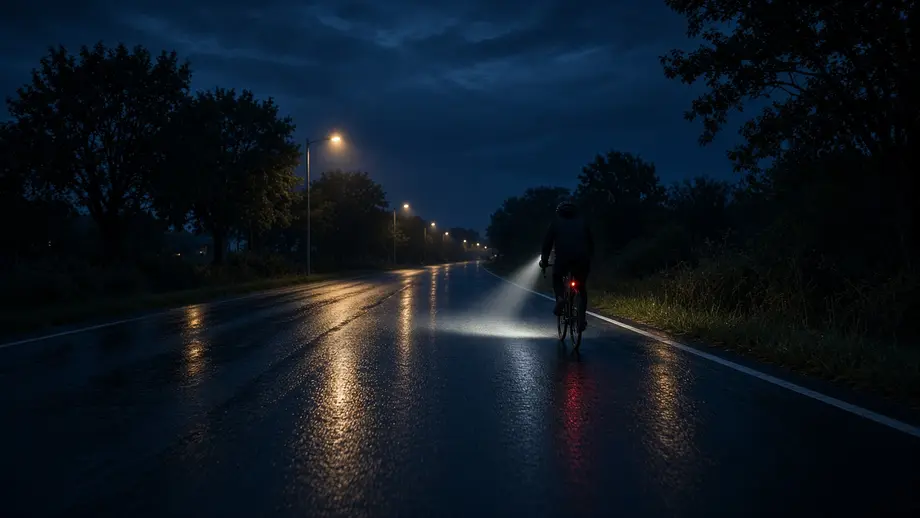
A round flashlight beam dazzles because half of its hotspot sits above the beam's center line. If you aim the center 2° down from a handlebar 1.0 m high, a hotspot with a 5.7° half-angle still points 3.7° above level at its top edge. At 10 m that edge is already 1.65 m off the ground, and it keeps climbing, so an oncoming face sits in the hotspot at some distance.
With the light at height h and its center tilted down by θ, the hotspot center reaches the road at d = h ÷ tan(θ). If the hotspot's half-angle α is larger than θ, its top edge climbs with distance x to a height of h + x × tan(α − θ). Olight does not publish beam angles for the Baton 4 Pro or Warrior 3S, so measure yours (steps below). As a worked example, a hotspot 1.0 m wide on a wall 5 m away has a half-angle of atan(0.5 ÷ 5) = 5.7°. With h = 1.0 m and θ = 2°, that edge is 2.30 m high at 20 m and 4.24 m at 50 m.
This table shows where the hotspot center lands for three light heights and five downward tilts, using d = h ÷ tan(θ). StVZO §67(8) sets 400 to 1,200 mm as the mounting height range for a bike's low-beam headlamp, so the rows stay inside it.
| Light height | 1° down | 2° down | 3° down | 4° down | 5° down |
|---|---|---|---|---|---|
| 0.8 m | 45.8 m | 22.9 m | 15.3 m | 11.4 m | 9.1 m |
| 1.0 m | 57.3 m | 28.6 m | 19.1 m | 14.3 m | 11.4 m |
| 1.2 m | 68.7 m | 34.4 m | 22.9 m | 17.2 m | 13.7 m |
To keep the top edge of that 5.7° example beam level, you must tilt the center down 5.7°, which puts it only 10.0 m ahead at 1.0 m height. At 15 mph (6.71 m/s) you cover 10 m in 1.5 seconds. A light with a cutoff can light far ahead without sending light above the line; a round beam cannot do both.
Warning: The Baton 4 Pro manual warns: "Do not look directly at the light source or shine it in eyes, as this may cause temporary blindness and serious retinal damage." On a shared path, drop to a low mode or cover the beam with your hand when someone approaches.
How to find your flashlight's hotspot angle
- Set the light level, exactly 5 m from a flat wall, in the mode you will ride in.
- Tape the left and right edges of the bright hotspot and measure the width D in meters.
- Your half-angle is α = atan(D ÷ 2 ÷ 5).
- On shared roads, tilt down by at least α, then check the landing distance in the table above.
How Far Ahead Does a Handlebar Flashlight Light the Road?
A handlebar flashlight lights the road far less than its beam distance suggests, because the road meets the beam at a grazing angle. Aimed 2° down from 1.0 m, the Baton 4 Pro's center lands 28.6 m ahead, but after its first step-down it puts about 0.16 lux on the road there, an estimate from Olight's rated candela. Aim it 4° down and the road at 14.3 m gets about 1.27 lux.
The calculation starts with the inverse square law: HyperPhysics at Georgia State University explains that light "per unit area reaching 1 meter" will be "one fourth as much at 2 meters". A beam distance rating uses a target facing the light. The road meets the beam at a shallow angle, so the light on the pavement is E = candela × h ÷ r³, where r is the straight-line distance to the spot. At a 2° tilt and 1.0 m height, r is 28.65 m and h ÷ r is 0.035: the road gets 3.5% of what a wall at the same distance would get.
Olight lists only peak candela. For later stages, this table assumes candela falls in step with lumens while the beam keeps its shape, for example 10,000 × 600 ÷ 1,600 = 3,750 candela. That is an assumption, so those rows are estimates.
| Light and stage (Olight rating) | Candela used | Lux on a wall at 28.65 m | Lux on the road at 28.6 m (2° tilt) | Lux on the road at 14.3 m (4° tilt) |
|---|---|---|---|---|
| Baton 4 Pro Turbo, 1,600 lumens (first 2 minutes) | 10,000 (rated) | 12.18 | 0.43 | 3.39 |
| Baton 4 Pro Turbo, 600 lumens (next 198 minutes) | 3,750 (assumed scaling) | 4.57 | 0.16 | 1.27 |
| Warrior 3S Turbo, 2,300 lumens (first 2.5 minutes) | 23,000 (rated) | 28.01 | 0.98 | 7.81 |
| Warrior 3S Turbo, 805 lumens (next 160 minutes) | 8,050 (assumed scaling) | 9.80 | 0.34 | 2.73 |
| Warrior 3S Turbo, 253 lumens (last 39 minutes) | 2,530 (assumed scaling) | 3.08 | 0.11 | 0.86 |
Two lessons follow. Halving the distance to the hotspot multiplies the light on the road by about 8, because r is cubed: (28.65 ÷ 14.34)³ = 7.99. And the brightest flashlight is not the best bike light: the Baton 4 Pro's 600-lumen stage aimed 4° down (about 1.27 lux) puts more light on the road than the Warrior 3S at 2,300 lumens aimed 2° down (about 0.98 lux). Our explainer on beam distance shows how that wall-based rating is built, and our guide to flashlight throw vs flood shows why a tight hotspot lights only a narrow strip.
Out-Front Mount, Rubber Strap or Action-Camera Adapter: How Each Holds Up
None of the three mounting options below was ridden or measured for this guide, so read this as an engineering checklist, not a review. All three fail the same way: the light rotates around the bar a little at a time. On a 31.8 mm bar, half a millimeter of slip at the bar's surface turns the beam 1.8°, enough to bring a 2° aim almost level.
A light strapped to a round bar turns around the bar's axis, so a slip of s millimeters at the surface rotates it by s × 360 ÷ (π × D) degrees, where D is the bar diameter. Sheldon Brown's handlebar dimension crib sheet lists 31.8 mm as the "Road oversized" clamp size with a 23.8 mm grip area, and 25.4 mm as the "Standard I.S.O. size" for most upright bars. Bar makers such as Renthal sell bars in 22.2, 31.8 and 35 mm diameters.
This table converts bar size into how much a small slip moves your beam.
| Bar diameter at the mount | Circumference (π × D) | Beam tilt per 1 mm of slip | Effect of 0.5 mm of slip on a 2° aim at 1.0 m |
|---|---|---|---|
| 22.2 mm | 69.74 mm | 5.16° | Up: passes level; down: 4.6°, center 12.5 m away |
| 23.8 mm | 74.77 mm | 4.81° | Up: passes level; down: 4.4°, center 13.0 m away |
| 25.4 mm | 79.80 mm | 4.51° | Up: passes level; down: 4.3°, center 13.4 m away |
| 31.8 mm | 99.90 mm | 3.60° | Up: 0.2°, center 289 m away; down: 3.8°, center 15.0 m away |
| 35 mm | 109.96 mm | 3.27° | Up: 0.4°, center about 160 m away; down: 3.6°, center 15.7 m away |
On drop bars, the 31.8 mm section is only the center bulge; move a strap out to the 23.8 mm grip area and each millimeter of slip costs 4.81°. Weight adds load: at the same offset, the 176 g Warrior 3S puts 1.54 times the turning load of the 114 g Baton 4 Pro on the same strap.
Out-front mount
An out-front mount bolts to the bar and holds the device ahead of the stem. Olight describes the Olight TTA Out-Front Bike Mount ($39.99, regular price, October 2026) as "A multifunctional bicycle stand made of aluminum alloy, compatible with various devices." The page does not list which flashlights fit it, so do not assume a Baton 4 Pro or Warrior 3S clips straight on. Ask Olight which holder or adapter your flashlight needs, and browse its flashlight accessories for current options.
Rubber strap or action-camera adapter
A rubber or silicone strap fits many bar sizes but holds by friction alone, so it creeps most; stretch it tight and use two on a long light. An action-camera adapter adds a hinge you can lock at one angle; its weak points are the hinge bolt and the body clamp (the Baton 4 Pro is 23 mm across, the Warrior 3S 29.5 mm).
A self-test for your mount (not measured here)
This table is a log you fill in yourself, in place of field data this guide does not have.
| Check | How to do it | Pass mark | What to record |
|---|---|---|---|
| Slip mark | Draw a line across the strap or clamp and the bar with a paint pen | Line still unbroken after the ride | Gap in mm, then × 3.6° on a 31.8 mm bar |
| Wall aim | Mark the hotspot center on a wall at 5 m before and after the ride | Center moved less than 9 cm (about 1°) | Movement in cm |
| Bump test | Ride a rough 10-minute loop, stop and push the light up and down by hand | No movement | Pass or fail |
| Rain check | Ride or spray with water for 10 minutes | No slip after the strap gets wet | Pass or fail |
Tip: Tighten, ride the loop, retighten. Most straps settle in the first few minutes, and the slip mark tells you whether yours did.
How Does Flashlight Step-Down Affect Night Riding Safety?
Flashlight step-down affects night riding because the bright first stage ends early in the ride. Olight rates the Baton 4 Pro's Turbo at 1,600~600 lumens for 2 + 198 minutes and the Warrior 3S at 2,300~805~253 lumens for 2.5 + 160 + 39 minutes. At 15 mph, the Baton 4 Pro reaches its 600-lumen stage after about half a mile, so plan your aim around that level.
This table converts each stage into distance at three speeds from Olight's rated times, not measured on a bike. Those are lab figures: the Warrior 3S manual says its specs "are test results based on ANSI/NEMA FL1-2009 Standard," and Olight publishes nothing on how moving air changes the stages.
| Stage (Olight rating) | Minutes | At 10 mph (16.1 km/h) | At 15 mph (24.1 km/h) | At 20 mph (32.2 km/h) |
|---|---|---|---|---|
| Baton 4 Pro, 1,600 lumens | 2 | 0.33 mi (0.54 km) | 0.50 mi (0.80 km) | 0.67 mi (1.07 km) |
| Baton 4 Pro, 600 lumens | 198 | 33.0 mi (53.1 km) | 49.5 mi (79.7 km) | 66.0 mi (106.2 km) |
| Warrior 3S, 2,300 lumens | 2.5 | 0.42 mi (0.67 km) | 0.63 mi (1.01 km) | 0.83 mi (1.34 km) |
| Warrior 3S, 805 lumens | 160 | 26.7 mi (42.9 km) | 40.0 mi (64.4 km) | 53.3 mi (85.8 km) |
| Warrior 3S, 253 lumens | 39 | 6.5 mi (10.5 km) | 9.8 mi (15.7 km) | 13.0 mi (20.9 km) |
The risk is setting your aim and speed by the first-minute picture, which is gone a few blocks later. Set the aim on the sustained stage. Our guide to flashlight runtime explains why rated and real runtimes drift apart in the cold and with older cells.
On a slow climb, mind the heat. The Baton 4 Pro manual says: "If the surface temperature of the flashlight is too high, switch to low brightness or temporarily turn off the flashlight." The Warrior 3S manual warns: "DO NOT activate turbo mode repeatedly under high temperature to prevent the flashlight body from overheating and hurting the user's hand."
What Makes an LED Flashlight Good for Bike Handlebar Mounting?
A good LED flashlight for bike use is light enough not to drag its mount down, has a body diameter your holder can grip, puts a switch where your thumb lands, and has a sustained mode that lasts your whole ride. The Baton 4 Pro meets most of these; the Warrior 3S trades weight for reach.
This table checks the two Olight lights against those points.
| Feature | Olight Baton 4 Pro | Olight Warrior 3S |
|---|---|---|
| Regular price (October 2026) | $69.99, all listed colors | $119.95 (Black, OD Green); Dream Blue listed at $119.99 |
| Weight with battery | 114 g | 176 g |
| Size | 111 × 23 mm | 139 mm long, 29.5 mm body diameter |
| Max output and intensity | 1,600 lumens, 10,000 candela, 200 m | 2,300 lumens, 23,000 candela, 300 m |
| Turbo | 1,600~600 lumens, 2 + 198 minutes | 2,300~805~253 lumens, 2.5 + 160 + 39 minutes |
| High | 600~120 lumens, 200 + 20 minutes | 800~248 lumens, 166 + 39 minutes |
| Med | 120 lumens, 18 hours 30 minutes | 200 lumens, 13 hours |
| Low and Moon | 15 lumens, 155 hours; under 1 lumen, 100 days | 15 lumens, 130 hours; 1 lumen, 55 days |
| Switches | Side and tail | Side and two-stage tail |
| Charging and water rating | USB-C and MCC; IPX8 | MCC3 magnetic cable only; IPX8 |
| In the box | Flashlight with battery, MCC3 cable, L stand, manual | Flashlight with battery, MCC3 cable, holster, pocket clip, manual |
The Olight Baton 4 Pro ($69.99, regular price, October 2026) is the better handlebar candidate of the two. Its 114 g is easier for a strap to hold, its 600-lumen stage lasts 198 minutes, and it charges by USB-C as well as MCC; the package list includes an MCC3 cable. The limits: a round TIR beam with no cutoff, a Turbo that lasts 2 minutes, and no bar mount in the box. IPX8 covers rain, but the manual says: "Do not immerse the flashlight in seawater or other corrosive media as it will damage the product." It also warns: "Do not store, charge, or use this light in a car where the temperature inside may exceed 60°C or in similar environments." On a road trip, keep it out of a hot trunk.
The Olight Warrior 3S ($119.95, regular price, October 2026, Black and OD Green) is the light for unlit trail sections and for walking out after a mechanical. Its 23,000 candela reaches 300 m, which is exactly why it is the wrong light to point down a city bike lane, and at 176 g it is harder to keep aimed on a strap.
Changing modes on the move: which switches work with gloves?
A switch that needs one action and no timing is easiest with gloves on. The Warrior 3S manual gives its default tail setting as "Half press for Medium, hard press for Turbo," and says to "Press and hold the tail switch for momentary on. Release to turn off." Holding its side switch cycles "Low, Medium, and High mode." The Baton 4 Pro manual lists Change Brightness as "When on, press and hold the side switch," which is harder to time on rough ground, and its tail button's Momentary-On as "Press and hold the tail button to keep Turbo; release to turn it off." Practice both at home.
One Warrior 3S feature behaves differently on a bike. Its manual says that at level 3 or higher, "if the front lens proximity sensor detects an obstruction nearby, the brightness will automatically reduce," and "The light will turn off directly if the blockage continues for more than 1 minute." A bar bag, cable or bell in front of the lens could trigger it, and the manual adds that scratches can leave the output "automatically dimmed by mistake." Keep the lens clear; to switch the sensor off, double-click the side switch within 5 seconds after it dims.
Note: Lock the light when it is in a bag. The Baton 4 Pro manual says: "When carrying or transporting, ensure the flashlight is locked to prevent accidental activation that could lead to fire hazards." The Warrior 3S locks with a press and hold of the side switch for about 2 seconds from off.
Who Should Use a Bike Light, a Flashlight, or Both?
In the bike light vs flashlight choice, most riders who ride on roads after dark should use a dedicated bike light as the main front light and keep a flashlight as a backup or trail light. A flashlight alone makes sense only for short, slow, low-traffic rides, or as a stopgap. Riders on unlit trails with no oncoming traffic get the most from a flashlight on the bar.
This table matches common riders to a setup.
| Rider | Main front light | Role of a flashlight | Why |
|---|---|---|---|
| Daily road commuter | Dedicated bike light with a road-friendly beam | Backup in the bag (Baton 4 Pro) | Oncoming traffic makes a round beam a glare problem |
| Occasional rider, short lit streets | Dedicated bike light, even a small one | Hand light for locks and flats | Six of the nine statutes in our state-law guide put the front lamp on the bike itself |
| Gravel or trail rider, no oncoming cars | Bike light or a well-mounted flashlight | Second beam or main beam on trails | Glare matters less; aim and mount matter more |
| Rider who already owns a Baton 4 Pro | Add a dedicated bike light when you ride often | Bar light for occasional rides with a secure holder | Cheapest start, but not a road solution for nightly use |
If you ride trails at night, our older guide to mountain bike lights covers what to look for in a dedicated light.
How Much Should a Decent Bike Cost?
A decent bike costs enough to get four things: the right type for your riding, a frame in your size, brakes that stop well in the wet and gears that shift cleanly. No single dollar figure fits every rider, so compare two or three bikes of the same type at one shop on those four points, then pick the cheapest one that passes.
Leave room in the budget for a front light, a rear light, a lock and a helmet. If you already own a flashlight, a bar mount such as the $39.99 Olight TTA is a cheap start, but check which holder your light needs and buy a rear light too.
What Is a Synonym for Bike?
The most common synonym for bike is bicycle, and cycle also works. The American Heritage Dictionary defines bike first as "A bicycle," then as a motorcycle or motorbike, and lists cycle as "A bicycle, motorcycle, or similar vehicle." Because cycle also covers motorcycles, check that a "cycle light" is built for a pedal bike's bar.
Do You Say Bike or Bicycle?
You can say either. Bike is the everyday short form, and bicycle is the full word. The American Heritage Dictionary marks bike as a "Shortening and alteration of BICYCLE," and Vocabulary.com notes that the word, "as a nickname for bicycle, first appeared in American English in 1882." Rules such as the federal reflector standard say bicycle, while riders say bike. Whichever word you use, your light must meet the rules written for bicycles where you ride.
Your Handlebar Flashlight Checklist
Use this checklist before your first ride with a flashlight on the bar, and run it again after any crash or mount change. The goal is a light that stays aimed, does not dazzle, and still lights the road after its first step-down.
- Keep a rear light and the factory reflectors on the bike.
- Measure your light's height and its hotspot width at 5 m; work out the half-angle.
- Tilt the center down by at least that half-angle on shared roads; check the landing distance in the aim table.
- Mount on the largest bar diameter you can reach and paint-mark the clamp.
- Plan on the sustained stage: 600 lumens on the Baton 4 Pro, 805 then 253 on the Warrior 3S.
- Learn the switches with gloves and lock the light in your bag.
- If you ride roads most nights, buy a dedicated bike light and keep the flashlight as backup.
FAQ
Changelog
- October 1, 2026: First published.