Olight makes some of the optics discussed here. Olight specs and prices come from its product pages as of September 2026; timing and accuracy figures come from the published sources linked in each section.
⚡ TL;DR
Red dot vs iron sights for concealed carry comes down to practice. A red dot is the better choice if you will train your draw until you find the dot as fast as your front sight, because both studies cited here found better accuracy with the dot. Iron sights stay better if you won't practice, or if your holster, gun or eyes can't work with an optic.
This table sums up how the two sighting systems compare on a carry gun.
| Dimension | Red dot | Iron sights | Who is better | How big the gap is |
|---|---|---|---|---|
| Accuracy | Target-focused aim, no sight alignment | Front sight, rear sight and target must line up | Red dot | 10-yard groups 39% smaller in one published comparison |
| Draw and two shots up close (5 yards) | Slower until the draw is trained | Fast for shooters raised on irons | Iron sights, for most new dot users | 0.26 s in the same comparison |
| Draw and two shots at 25 yards | Faster and more precise | Harder to hold a fine sight picture | Red dot | 0.93 s in the same comparison |
| Concealment and printing | Adds height and about 1 oz to the slide | Nothing added | Iron sights | About 4% to 6% more weight on a subcompact |
| Batteries | Needs a coin cell and a replacement routine | None | Iron sights | A battery change on a fixed schedule |
| Holster choice | Needs an optic-cut holster | Fits almost any holster for the gun | Iron sights | Often a new holster purchase |
| Aging eyes (presbyopia) | Keeps your focus on the target | Needs a sharp front sight at arm's length | Red dot | Depends on your eyes; try both |
Many carriers switch to a dot and then hit the same wall: on the first range day, the draw brings the gun up and the dot is nowhere in the window. The shot comes later than it did with irons, and the old holster no longer fits. The sections below deal with each of those problems in order, using published data and Olight's official specs.
📋 Table of Contents
- 1. Is a Red Dot Faster Than Iron Sights for Concealed Carry?
- 2. Why Does a New Red Dot Feel Slower at First?
- 3. Red Dot vs Iron Sights for Concealed Carry: Holsters, Printing and Weight
- 4. Do Red Dots Help Shooters With Presbyopia or Astigmatism?
- 5. What Happens if a Red Dot Battery Dies?
- 6. Is an Enclosed or Open Emitter Red Dot Better for Concealed Carry?
- 7. Which Holsters Work With a Red Dot for Concealed Carry?
- 8. How Long Does It Take to Get Used to a Pistol Red Dot?
- 9. Common Mistakes When Switching to a Red Dot
- 10. Osight K, Osight C or Osight SE: Which Fits Your Carry Gun?
- 11. Who Should Choose a Red Dot, and Who Should Stay With Iron Sights?
- 12. FAQ
Is a Red Dot Faster Than Iron Sights for Concealed Carry?
A red dot is not automatically faster for concealed carry. In a published Gun Digest comparison, three shooters averaged faster times with iron sights at 5 to 15 yards and faster times with a red dot at 25 yards. In the slow-fire group test, which two of the shooters completed, groups with the dot were 39 percent smaller. At typical defensive distances, speed depends on how well you have trained your draw to the dot.
That comparison, published by writer Richard A. Mann in Gun Digest's irons vs red dots test, used the same Wilson Combat eXperior Elite pistol with either a fixed rear sight or a Trijicon RMR HD 2 with a 3.25 MOA dot. Draws came from a Galco Yaqui Slide holster. The three shooters had different backgrounds: one used both systems equally, one carried a dot on duty and one had limited red dot experience.
This table reproduces the averages from that article, in seconds unless noted, with the difference calculated for this guide. Each Step Back stage is a draw and two shots on an 8-inch steel plate, timed separately.
| Drill (same pistol, averages as published) | Iron sights | Red dot | Difference (dot minus irons) |
|---|---|---|---|
| Step Back Drill, 5 yards (3 shooters) | 1.75 | 2.01 | +0.26 s (dot slower) |
| Step Back Drill, 10 yards (3 shooters) | 2.40 | 2.59 | +0.19 s (dot slower) |
| Step Back Drill, 15 yards (3 shooters) | 3.02 | 3.85 | +0.83 s (dot slower) |
| Step Back Drill, 20 yards (3 shooters) | 4.19 | 4.14 | -0.05 s (about even) |
| Step Back Drill, 25 yards (3 shooters) | 4.91 | 3.98 | -0.93 s (dot faster) |
| Multi-target drill, first shot from holster, 15 yards (3 shooters) | 1.85 | 2.14 | +0.29 s (dot slower) |
| Multi-target drill, total time for six shots, 15 yards (3 shooters) | 3.91 | 4.80 | +0.89 s (dot slower) |
| Five-shot groups from a rest, 10 yards, in inches (2 shooters) | 0.91 | 0.55 | Dot groups 39% smaller |
Read the table as a trend rather than a verdict. The dot's speed deficit shrank as distance grew and flipped to an advantage at 25 yards. Mann himself calls it "a very limited test," and the shooters were not allowed much familiarization with either setup before timing.
Accuracy data points the same way. A 2011 Norwich University comparative pistol study split 27 criminal justice students into an iron sight group of 13 and a Trijicon RMR group of 14, all shooting Glock 19 pistols. At 15 yards, slow fire, the iron sight group hit the target 75 percent of the time and the RMR group 98 percent. The RMR group also put a larger share of hits in center mass at every stage.
Note: Trijicon provided the three instructors for the Norwich study, and the authors did little analysis of shot times because individual shots could not be matched to recorded times. The study tells you about accuracy for new shooters, not draw speed.
Why Does a New Red Dot Feel Slower at First?
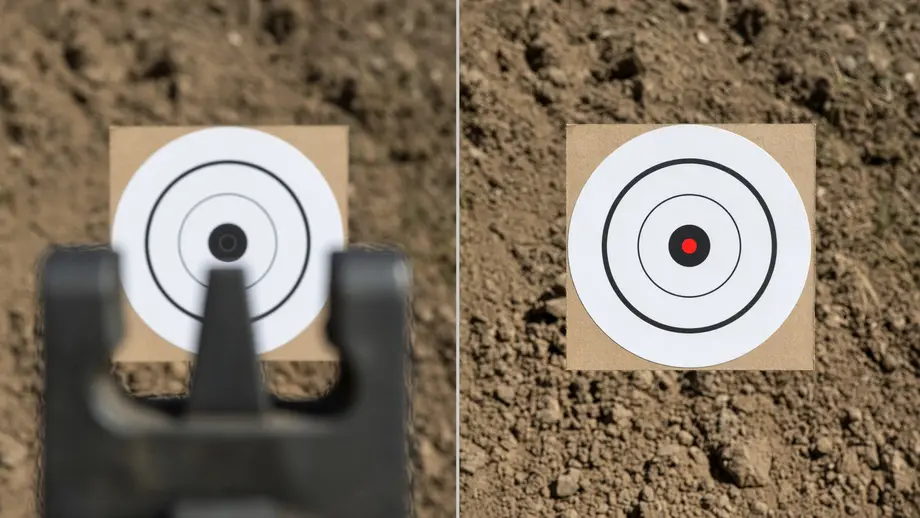
A new red dot feels slower because an iron sight draw teaches you to look for the front sight, while a dot rewards the opposite: eyes locked on the target and a gun that arrives already aligned. If your presentation brings the muzzle up high or low, the dot sits outside the window and you waste time hunting for it.
Vortex instructor Peter Schreier describes the fix in Vortex's tips for moving from irons to a pistol red dot: "You have to make sure you keep consistent target focus on what you are aiming at with both eyes open." He also warns against using your irons to find the dot, because that throws away the main advantage of being target focused.
The "lost dot" problem usually comes from one of four habits. This checklist pairs each habit with a correction you can drill at home with an unloaded gun.
- Wrist tipped up or down at the end of the draw. Grip the gun the same way every time and push it out toward the target in a straight line, so the slide arrives level.
- Eyes dropping to the gun. Pick a small spot on the target and keep looking at it. The dot should appear over that spot, not the other way around.
- Fishing for the dot by waving the muzzle. If the dot is missing, bring the gun back toward your chest and present again. Your index of where the gun points gets better with repetition.
- Too much brightness. A setting that looked right indoors can bloom into a blur at the range. Start at the lowest setting you can still see clearly against your target.
Tip: Schreier suggests covering the front of the optic with tape. If you stay target focused with both eyes open, your brain blends the two images and you still see the dot on the target. If you can't see the target, you are focused on the optic.
Red Dot vs Iron Sights for Concealed Carry: Holsters, Printing and Weight
A red dot adds height and about an ounce to the top of your slide, and it needs a holster cut to clear it. On a slim carry gun like the Glock G43X MOS, the Osight K adds about 4.4 percent to the loaded weight and is still narrower than the gun's widest point, so printing comes mostly from height, not width.
Concealment is where iron sights keep a real edge. A writer for Remington's guide to iron sights vs optics for concealed carry puts it plainly: "a compact gun with iron sights is going to be a lot easier to conceal." The optic becomes the tallest point on the slide, and in an inside-the-waistband holster that is the part most likely to press against your shirt.
The math below uses Glock's published specs for the optic-ready Glock G43X MOS (22.96 oz loaded, 1.10 in overall width, 0.87 in slide width) and Olight's specs for three optics. It is a worked example, not a fit guarantee; check your own pistol's footprint before you buy.
| Carry factor | Osight K | Osight SE | Osight C |
|---|---|---|---|
| Optic weight (Olight spec) | 1.02 oz (29 g) | 0.97 oz (27.5 g) | 1.48 oz (42 g) |
| Weight added to a 22.96 oz loaded G43X MOS | 4.4% | 4.2% | 6.4% |
| Optic width (Olight spec) | 0.98 in | 0.98 in | 1.18 in |
| Width vs the G43X MOS slide (0.87 in) | 0.11 in wider | 0.11 in wider | 0.31 in wider |
| Width vs the G43X MOS at its widest (1.10 in) | 0.12 in narrower | 0.12 in narrower | 0.08 in wider |
| Footprint (Olight) | RMSc | RMSc | RMR (407c/507c) |
The takeaway: an RMSc-footprint optic on a slimline pistol barely changes how wide the gun is, so fix printing with holster ride height, a claw or wing that tucks the grip, and your belt. A larger RMR-footprint optic like the Osight C is sized for compact and full-size pistols, where the extra window is worth the bulk.
This table compares carry conditions where the two systems behave differently, from the holster to the weather.
| Carry condition | Red dot | Iron sights |
|---|---|---|
| Appendix IWB under a T-shirt | Optic is the high point; needs a holster with good cant and a claw | Lowest profile the gun allows |
| Sitting in a car or at a desk | Optic can catch on a seat belt or chair back | Less to snag |
| Rain or snow on the lens | An open emitter can blur the dot; an enclosed emitter keeps water off the emitter | Sights still visible, though wet |
| Lint and sweat from daily carry | Lint can block the emitter window on open designs | Little effect |
| Bright sun | Needs a daylight brightness setting | Visible without power, though black sights can blend into dark targets |
| Dim light | Dot stays bright on a dim setting | Needs night sights or a light to see alignment |
Do Red Dots Help Shooters With Presbyopia or Astigmatism?
A red dot often helps shooters with presbyopia, because you focus on the target instead of a front sight at arm's length. Astigmatism is different: it can make the dot itself look smeared or starred. A larger dot, a lower brightness setting, a green dot or corrective lenses may help, so try an optic before you commit.
The American Academy of Ophthalmology explains that with presbyopia, "your eyes gradually lose the ability to see things clearly up close," and that you "may start to notice presbyopia shortly after age 40." A front sight sits at arm's length, so it can get harder to see sharply after 40. The dot sits on the same focal plane as the target you are already looking at.
Astigmatism is caused by a cornea or lens with an irregular shape, and the AAO notes that close and distant objects both appear blurry. Optic maker Meprolight writes in its online guide to shooting with astigmatism that "even shooters with 20/20 vision may see red dots as indistinct, smeared, starburst, or warped during aiming." It suggests a dot of 4 MOA or larger, a lower brightness setting and a green reticle.
Dot size is easy to picture once you convert it to inches. One minute of angle (MOA) covers about 1.047 inches at 100 yards, so at a 7-yard range distance it covers about 0.07 inch. This table converts the reticles on three Olight optics.
| Reticle (Olight spec) | Size at 7 yards | Size at 15 yards | What it means for aging or astigmatic eyes |
|---|---|---|---|
| 2 MOA dot (Osight SE) | 0.15 in | 0.31 in | Precise, but may be harder to see crisply |
| 3 MOA dot (Osight C) | 0.22 in | 0.47 in | Middle ground |
| 6 MOA dot (Osight K) | 0.44 in | 0.94 in | Easier to pick up; covers more target at distance |
| 32 MOA circle (Osight C, Osight SE) | 2.35 in | 5.03 in | Large ring that helps you find the center fast |
Tip: Meprolight suggests rotating the optic while you look through it. If the blur stays the same, your eyes are the likely cause; if it moves with the optic, the optic may need service. See an eye care professional before you blame the gear.
What Happens if a Red Dot Battery Dies?
If a red dot battery dies, the pistol still fires normally, but the dot disappears. With backup iron sights you can see through the window, you aim with those. Without them, you are left looking through an empty window. That is why a battery schedule and, where the slide allows it, visible iron sights matter on a carry gun.
Power is the one failure iron sights cannot have. The Remington writer who argues for irons puts it this way: "you'll never have to change the batteries in your iron sight," and adds, "I've seen a lot of shooters over the years have their red dot sight die in the middle of a match or a stage." Iron sights that sit tall enough to show through the optic window, often called co-witness or suppressor-height sights, give you a second way to aim if the dot goes dark. Check whether your slide and optic allow them before you rely on them.
Olight's rated runtimes look huge, so it helps to translate them. The table below divides each rated runtime by the hours in a year and by the battery's typical capacity from Energizer's data sheets for the CR1620 (81 mAh) and CR1632 (130 mAh). The current figure is an implied average, not a measurement.
| Optic | Battery (Olight) | Rated max runtime (Olight) | Years at that rating | Implied average draw |
|---|---|---|---|---|
| Osight K | CR1620 | 71,000 H (Mode 3) | About 8.1 | About 1.1 microamps |
| Osight SE | CR1620 | 100,000 H (Mode 3 Dot-only) | About 11.4 | About 0.8 microamps |
| Osight C (green) | CR1632 | 130,000 H (Mode 3 Dot-only) | About 14.8 | About 1.0 microamps |
Those ratings are all for Mode 3, and the product pages do not list runtimes for the other brightness settings. A brighter daylight setting draws more power, so plan around a date, not the headline number. The pro-dot writer in the same Remington guide suggests changing the battery "when you change the batteries in your smoke detector."
Olight adds three features that shrink the risk. All three list a motion sensor function, and Olight says the Osight K and Osight C power on at the slightest movement and down after 3 minutes of inactivity. The Osight K flashes the reticle three times once per minute when battery voltage drops below 2.2V. All three load the battery from the side, which Olight says lets you replace it without removing the optic.
Warning: Keep spare coin cells away from children. Energizer's CR1620 data sheet warns that swallowing one "may lead to serious injury or death in as little as 2 hours" and says to see a doctor immediately.
Is an Enclosed or Open Emitter Red Dot Better for Concealed Carry?
An enclosed emitter is the better pick if you carry in rain, snow, dust or sweat, because it seals the space between the LED and the lens. An open emitter like the Osight K leaves that space exposed, so debris can block the dot until you clear it. Under a cover garment, either type works if you inspect it daily.
Shooting Illustrated, an official journal of the NRA, explains the weak point in its guide on why to choose an enclosed emitter red dot sight. On an open design, "dust, dirt, lint, water, mud, snow or any other debris has the potential to accumulate inside these open areas and block the LED." The same guide notes the trade-off: most enclosed designs give you a smaller window. It also says an enclosed optic makes the most sense when the gun rides in an open outside-the-waistband holster or in fields, ranches and backcountry.
The practical routine is the same for both designs: inspect the optic when you dress, keep a lens cloth where you store the gun, and keep a backup sighting plan.
Olight lists different water ratings for the two designs. The Osight K and Osight C are rated IPX6, and the Osight SE is rated IPX7. Olight also lists the working temperature for all three as -22°F to 140°F (-30°C to 60°C), which matches the -30C to 60C operating range on Energizer's CR1620 and CR1632 data sheets.
Note: Loose screws are a common failure point too. Olight's Osight SE page says to apply non-permanent (medium/blue) threadlocker and torque each screw to 15-17 in-lbs. Olight's own guide on how to mount your Osight walks through the steps.
Which Holsters Work With a Red Dot for Concealed Carry?
A red dot needs a holster cut to clear the optic, usually labeled optic-ready or red dot compatible, and molded for your exact pistol. Your old iron sight holster will often not close around the optic or will press on it. For carry, look for a holster that covers the optic and still lets you get a full grip.
A carry gun spends most of its life in the holster, so a shell that rides up over the optic body does two jobs. It keeps knocks off the housing and glass, and it keeps lint and sweat away from an open emitter, the debris the Shooting Illustrated guide above warns can block the LED.
Use this checklist when you choose a carry holster for an optic-equipped pistol.
- Model match. The holster lists your pistol and optic cut, or a family of optics, by name.
- Optic coverage. The shell rises over the optic body without pressing on the lens.
- Full grip on the draw. You can establish your firing grip before the gun clears the holster.
- Concealment hardware. A claw or wing rotates the grip toward your body to cut printing.
- Mounted light fit. If you carry a pistol light, the holster must fit the gun, optic and light together.
- Retention you can adjust. Test the draw with an unloaded gun before you carry it.
If you plan to add a light as well, check fit charts for Olight's PL series weapon lights before you buy a holster, since a mounted light changes which holsters fit. For more on carry holster styles, see the Olight holster guide.
How Long Does It Take to Get Used to a Pistol Red Dot?
There is no published standard for how long it takes to get used to a pistol red dot. It depends on how often you practice your draw. A useful benchmark is to time your first shot from concealment with irons and with the dot, then carry the dot once its time matches or beats your iron sight time.
Even experienced writers describe the switch as a long project. Mann writes that he spent "a good part of the past five years becoming proficient with reflex sight-equipped handguns." You do not need five years to carry a dot safely, but you should expect more than one range trip.
This four-week plan turns that benchmark into steps. The dry-fire sessions assume an unloaded gun and no ammunition in the room.
| Week | Dry fire at home (unloaded) | Range session | Milestone before moving on |
|---|---|---|---|
| 1 | Presentation only: draw and push out to a spot on the wall, 50 slow reps a day | Zero the optic, then slow fire at 5 to 7 yards | The dot appears on the spot almost every time |
| 2 | Add a trigger press at the moment the dot settles | Draw to first shot at 5 yards, timed | You stop searching for the dot |
| 3 | Draw from your real carry holster and clothing | Timed first shots at 5 and 10 yards with irons (on another gun or co-witness) and with the dot | Dot time is close to iron time |
| 4 | Practice with your weak hand and in low light | Repeat week 3, then add 15 and 25 yards | Dot time matches or beats irons at 5 yards |
Your zero comes first. The Olight guide on how to sight in a red dot covers the process. Each Olight optic here adjusts 1 MOA per click, which at 10 yards moves the point of impact about 0.1 inch per click.
Safety note: Carry only where the law allows it. Check your state and local laws on permits, carry and ranges before you carry a new setup, follow your range's rules, and confirm that dry fire is safe for your specific pistol. Never dry fire with ammunition in the same room.
Common Mistakes When Switching to a Red Dot
The most common mistake when switching to a red dot is assuming the optic replaces practice. A dot removes the need to align two sights, but it does not fix a poor grip, a jerked trigger or a draw that points the gun off line. Most of the other mistakes involve setup, batteries and holsters.
Schreier's first tip for Vortex makes the same point: red dots do not fix bad form. The dot is also a good diagnostic tool. As he notes, watching the dot during your follow-through shows whether you are flinching or moving off your point of aim.
This list pairs common mistakes with the fix for each one.
- Carrying before the draw is trained. Fix: use the four-week plan above and a shot timer.
- Buying the optic before the holster. Fix: confirm an optic-cut holster exists for your gun and optic pair before you order.
- Relying on the rated runtime. Fix: change the battery on a set date and note it in your phone.
- Skipping threadlocker or torque specs. Fix: follow the maker's torque values and then add witness marks with a paint pen across each screw head and the optic so you can see if one backs out.
- Leaving brightness on the indoor setting. Fix: check the dot against the brightest background you expect to face.
- Never practicing without the dot. Fix: run a few drills each month with the optic off or covered, so a dead battery is not your first time.
Osight K, Osight C or Osight SE: Which Fits Your Carry Gun?
For a slim concealed carry pistol, look at the Osight K and Osight SE, two compact optics with the RMSc footprint. Pick the Osight K for a big 6 MOA dot at a lower price, and the Osight SE for an enclosed emitter. The Osight C uses the larger RMR footprint and suits compact and full-size pistols, where its bigger window pays off.
This table collects Olight's official specs and prices, checked on September 24, 2026, for the three optics.
| Spec (Olight) | Osight K | Osight SE | Osight C |
|---|---|---|---|
| Emitter type | Open reflex | Enclosed | Open reflex |
| Window size | 0.83 × 0.55 in (21 × 14 mm) | 0.83 x 0.55 in (21 x 14 mm) | 0.95 × 0.75 in (24 × 19 mm) |
| Weight | 1.02 oz (29 g) | 0.97 oz (27.5 g) | 1.48 oz (42 g) |
| Reticle | 6 MOA Dot | 2 MOA Dot & 32 MOA Circle | 3 MOA Dot & 32 MOA Circle |
| Battery and loading | CR1620, side-loading | CR1620, side-loading | CR1632, side-loading |
| Brightness settings | 8 DL & 2 NV | 8 DL & 2 NV | 8 DL & 2 NV |
| Waterproof rating | IPX6 | IPX7 | IPX6 |
| Footprint | RMSc | RMSc | RMR (407c/507c) |
| Price | $169.99 | $219.99 | $199.99 |
Osight K for slim pistols and new dot users. The hard part of the switch is finding the dot on the draw. The Olight Osight K uses a 6 MOA green dot, which Olight says "stands out sharply in bright environments," and it is the lightest open option here at 1.02 oz. It also warns you with a triple-flash when the battery gets low. The limit: it is an open emitter rated IPX6, and the single 6 MOA dot covers about 1.6 inches at 25 yards, which is less precise for long shots. If you carry in wet weather or a sweaty appendix position, look at the SE instead.
Osight SE for weather and lint. Daily carry exposes an optic to sweat, rain and lint. The Olight Osight SE closes the emitter off from all three with an enclosed design, carries an IPX7 rating and weighs 0.97 oz. Its 32 MOA circle helps you find the center fast. The limits: it costs the most of the three, its 2 MOA center dot is small for some aging eyes, and its window is the same 0.83 x 0.55 in size as the K's. It still runs on a battery, so a backup plan still matters.
Osight C for larger carry guns. A bigger gun has room for a bigger window. The Olight Osight C has a 0.95 × 0.75 in window, about 56 percent more area than the K's 0.83 × 0.55 in window, and runs on a larger CR1632 battery. It fits a compact or full-size pistol carried outside the waistband or in a larger IWB holster. The limit is its bulk: at 1.18 in wide, it is wider than a slimline pistol like the G43X MOS, and Olight lists it for duty, competition and personal defense rather than concealed carry. Pick the K or SE for a small carry gun.
Who Should Choose a Red Dot, and Who Should Stay With Iron Sights?
Choose a red dot if you can practice regularly, carry a pistol with an optic cut and want better accuracy at longer distances or with aging eyes. Stay with iron sights if you rarely train, carry a very small gun in deep concealment, or cannot keep up a battery and inspection routine. Both are sound choices when you train with them.
This table matches common carrier profiles to the sighting system that suits them.
| Your situation | Better choice | Why |
|---|---|---|
| New shooter starting from scratch | Red dot | Norwich study shooters with an optic hit center mass more often at every stage |
| Experienced iron sight shooter who trains monthly or more | Red dot, after a timed transition | Accuracy gain, and draw speed can catch up with practice |
| Shooter over 40 who struggles to see the front sight | Red dot | Target focus avoids the arm's-length focus that presbyopia makes hard |
| Shooter with astigmatism who sees a starburst dot | Try both | A larger or green dot may help; irons may still be clearer |
| Pocket or deep-concealment carrier | Iron sights | No optic height, no special holster |
| Carrier who rarely practices | Iron sights | Close-range draws were faster with irons in the Gun Digest comparison |
| Carrier in heavy rain, snow or dusty work | Enclosed-emitter red dot or irons | Open emitters can blur when wet or dirty |
Before you switch, run through this short action list:
- Confirm your pistol is optic-ready and note its footprint.
- Find an optic-cut holster for the exact gun and optic pair.
- Mount with the maker's torque values and threadlocker, then zero.
- Time your first shot with irons and with the dot at 5 yards.
- Set a battery date and keep a spare out of children's reach.
- Carry the dot once its time matches your irons, and keep practicing with both.
FAQ
Changelog
- September 21, 2026: First published. Olight specs and prices checked September 24, 2026.