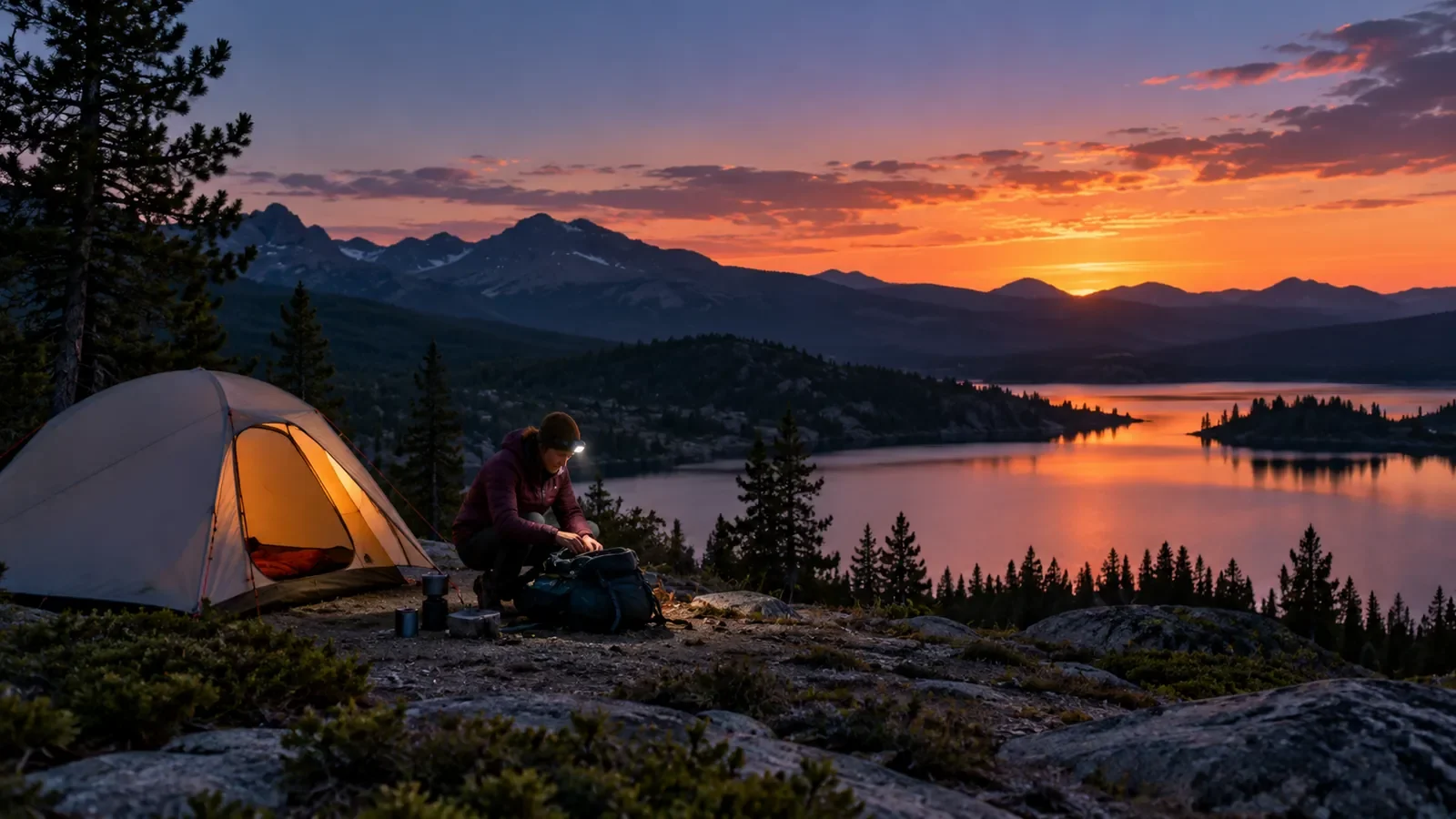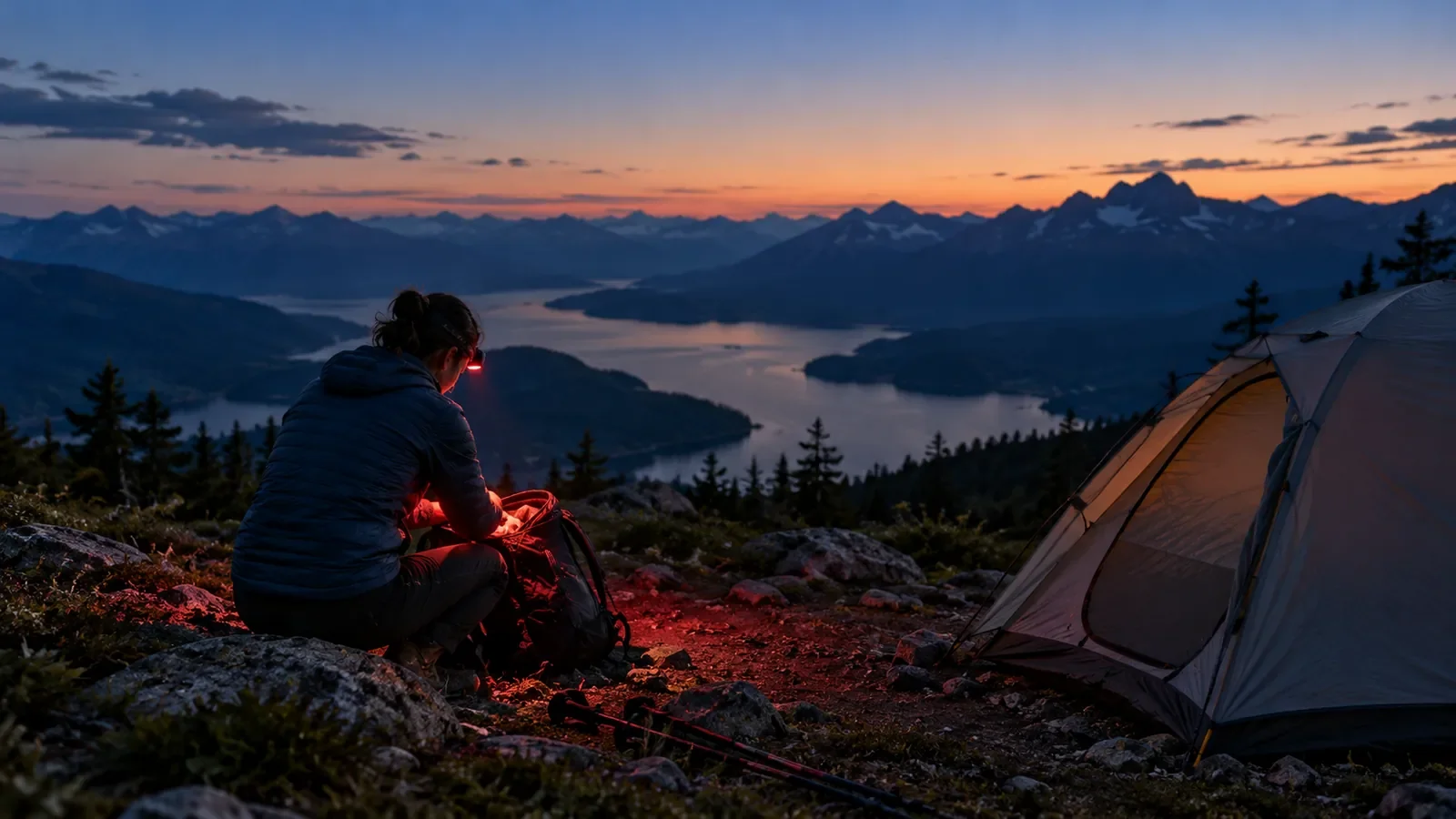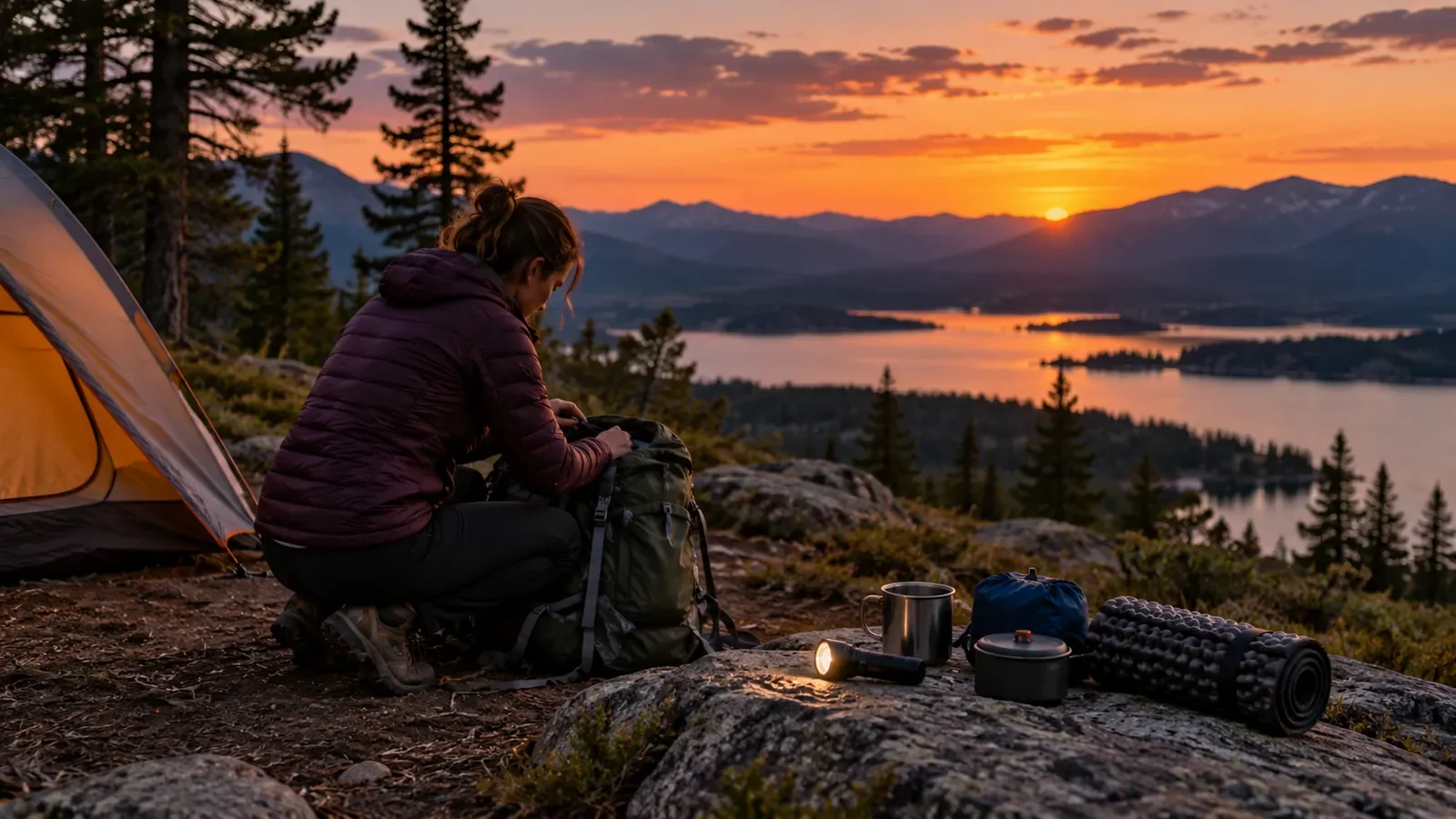
Olight makes the lights discussed here. Specs and regular prices come from Olight's product pages and user manuals as of October 2026. Runtimes, setup counts and weight splits below use Olight's rated figures, not measurements.
⚡ TL;DR
The brightest headlamp for camping is one that gives you a big burst for a late setup, then holds a useful level instead of fading to a glow. On Olight's ratings, the Perun 3 does that: 3,000 lumens for 2 minutes, then 800 lumens for 180 minutes. Hand the rest of the evening to a 55 g clip light so your forehead carries less.
You reach a dispersed site after dark with 15 to 20 minutes of work ahead: find flat ground, clear sticks, pitch the tent. The headlamp you bought for its lumen number drops after two minutes, feels heavy by dinner, and blinds a friend every time you turn to talk. This guide takes those three problems in turn, using Olight's published numbers and manuals.
The gear checklist below pairs each camp job with a light type, a minimum spec and an Olight pick, starting with the brightest headlamp for camping.
| Camp job | Recommended type | Minimum spec to check | Olight pick (Olight ratings) |
|---|---|---|---|
| Arrival and setup, 15 to 20 min | High-output headlamp that also works handheld | 600 lm or more for the whole setup | Olight Perun 3: Turbo 3,000~800~600 lumens, 2 + 180 + 30 minutes; 150 g; IP68; $89.99 |
| The evening on your head | Small clip light on a strap | About 55 g; 100 lm for 3 h or more | Olight Oclip Ultra on the Oclip Series Headlamp Strap: 55 g; floodlight Medium 100 lumens, 3.5 hours; $49.99 + $7.99 |
| Inside the tent | Hung light on its lowest steady level | 10 lm or less for a full night | Oclip Ultra floodlight Low 10 lumens, 27 hours |
| Night trips outside | Steady red light | A low red level | Perun 3 Red Light (Low) 15 lumens, 70 hours |
| Lightest single headlamp | Compact headlamp | Under 60 g with battery | Perun 3 Mini (CW): 1,250~350 lumens, 2 + 60 minutes; 54 g; $64.99 |
Regular prices, October 2026. The Oclip Ultra price is for the Olive Green version.
📋 Table of Contents
- 1. Quick Answer: What Makes the Brightest Headlamp for Camping Worth Carrying?
- 2. When Does a Campsite Actually Need Max Brightness?
- 3. The Setup Window: How Many Step-Downs Hit a 15- to 20-Minute Setup?
- 4. Why Does the Brightest Mode Step Down, and What Can You Do?
- 5. Head Weight: Should the Brightest Light Ride on Your Head All Evening?
- 6. Which Light Setup Fits Car Camping, Backpacking or a Group Site?
- 7. How Do You Keep a Bright Headlamp From Blinding Your Campmates?
- 8. Common Mistakes and Safety Limits With High-Lumen Camping Headlamps
- 9. How Bright Is 4000 Lumens Outdoors?
- 10. Is 1000 Lumens Good for Camping?
- 11. What Is the Best Lighting for a Tent?
- 12. Reader Self-Test: Check Your Own Step-Down Curve and Head Load
- 13. Brightest Headlamp for Camping: Action Checklist
- 14. FAQ
Quick Answer: What Makes the Brightest Headlamp for Camping Worth Carrying?
A bright camping headlamp earns its weight in a few short moments: the arrival setup, a sweep of the site edge, and a look toward a noise at night. The rest of the evening runs on Low or Medium. Judge a high-output lamp by three things: the level it holds after the first step-down, its weight on your head, and whether it comes off the band to work as a handheld.
The Perun 3 does well on all three by its published specs. After Turbo, it holds 800 lumens for 180 minutes, and like Olight's other Perun headlamps, it detaches from the band to work as a handheld. The cost is weight: 150 g including the battery, before the headband.
Our best headlamps comparison named the Perun 3 best overall, and the best camping headlamp guide named it best for multi-night and wet camps. This guide asks how long its peak lasts and what should carry the rest of the night. To compare every model, browse Olight's headlamps.
When Does a Campsite Actually Need Max Brightness?
Max output pays off in short, wide looks: picking a tent spot when you arrive late, checking the site edge for slope, roots and dead limbs overhead, and looking toward a noise past the fire. Each lasts seconds to a few minutes. Cooking, reading and tent chores happen at arm's length, where a low mode is easier on your eyes and on everyone near you.
The scene table splits a camp evening into sub-scenes. Lengths are planning assumptions, not measurements; adjust them to how you camp.
| Sub-scene | Length (assumption) | Burst or hold | Where the light works best | Olight level that fits (rated) |
|---|---|---|---|---|
| Finding a flat, clear spot | 2 to 5 min | Burst, wide | Head, or handheld at waist height | Perun 3 Turbo, 3,000 lm for 2 min |
| Pitching and staking | 10 to 15 min | Hold | Head, tilted down to your hands | Perun 3 800 lm Turbo stage, or High 600 lm |
| Cooking and dishes | 30 to 60 min | Low hold | Head, or hung over the table | Oclip Ultra floodlight Medium 100 lm |
| Inside the tent | Hours | Lowest hold | Hung from a loop | Oclip Ultra floodlight Low 10 lm |
| Checking a noise | Seconds | Burst, reach | In hand, aimed away from camp | Oclip Ultra spotlight 450 lm, 130 m |
| Night trip to the toilet | 5 to 10 min | Low hold | Head | Perun 3 Red Light (Low) 15 lm |
Only two rows need a burst, and both are short, so treat the brightest headlamp as a setup tool first.
The Setup Window: How Many Step-Downs Hit a 15- to 20-Minute Setup?
On Olight's ratings, a Perun 3 left on Turbo steps down once in a 20-minute setup: 3,000 lumens for the first 2 minutes, then 800 lumens for the other 18. Its High mode never steps down inside that window, because the 600-lumen stage is rated for 300 minutes. Smaller lights step down sooner and land lower, so read the minute-5 level, not the peak.
The table reads each rated chain at the minutes that matter during a setup (Olight ratings, not measurement).
| Light and mode | Olight chain | Start | Minute 5 | Minute 20 | Step-downs in 20 min |
|---|---|---|---|---|---|
| Perun 3 Turbo | 3,000~800~600 lm; 2 + 180 + 30 min | 3,000 | 800 | 800 | 1 (minute 2) |
| Perun 3 High | 600~120 lm; 300 + 30 min | 600 | 600 | 600 | 0 |
| Perun 3 Mini CW Turbo | 1,250~350 lm; 2 + 60 min | 1,250 | 350 | 350 | 1 (minute 2) |
| Perun 3 Mini CW High | 500~350 lm; 2 + 75 min | 500 | 350 | 350 | 1 (minute 2) |
| Oclip Ultra flood Turbo | 530~302~100 lm; 1 + 50 + 30 min | 530 | 302 | 302 | 1 (minute 1) |
| Oclip Ultra flood High | 300~180~100 lm; 10 + 80 + 20 min | 300 | 300 | 180 | 1 (minute 10) |
Three decisions fall out of it:
- Perun 3: Turbo is the brighter setup mode. Its second stage, 800 lumens, is higher than High's 600, so start on Turbo and let it step down.
- Perun 3 Mini: use High, not Turbo. Both land at 350 lumens after minute 2, but High holds it for 75 minutes against Turbo's 60.
- Oclip Ultra: setup is not its job. It holds 302 lumens on the Turbo chain, under 40% of the Perun 3's 800 (302 ÷ 800 = 0.38).
How many setups does one charge cover?
Brighter costs battery. Dividing each held stage's rated minutes by the setup length (for example, 180 ÷ 20 = 9) shows how many setups one charge covers at that stage. It slices one rated run into sessions and assumes each setup draws only on the held stage, so read it as a planning ceiling, not a promise of repeat 3,000-lumen bursts. A fresh Turbo burst each time spends extra charge, so expect fewer.
| Light and mode | Held stage | Rated minutes | 20-minute setups | 15-minute setups |
|---|---|---|---|---|
| Perun 3 Turbo | 800 lm | 180 | 9 | 12 |
| Perun 3 High | 600 lm | 300 | 15 | 20 |
| Perun 3 Mini CW High | 350 lm | 75 | 3.75 | 5 |
| Oclip Ultra flood High | 180 lm | 80 | 4 | 5.3 |
On the Perun 3, Turbo gives 800 ÷ 600 = 1.33 times the held light of High but covers 9 setups against 15, which is 40% fewer (1 − 9 ÷ 15 = 0.40). Turbo suits a weekend with one or two late arrivals; for a week without a charger, set High.
Memory rules matter too. The Perun 3 manual says "Turbo is memorized as High; High is memorized as Medium if the interval is over 1 minute." Switch off to carry gear and a Turbo setup resumes on High; wait over a minute after High and it restarts at Medium, 120 lumens.
Why Does the Brightest Mode Step Down, and What Can You Do?
Olight publishes the Perun 3's drop as a timed chain, and its manual does not describe a temperature trigger, so plan your setup around the chain. When the level drops mid-task, use the steps below.
Our thermal step down flashlight explainer covers why lights dim; these steps quote the Perun 3 user manual:
- Choose a level that holds. "When the flashlight is on, press and hold the switch and it will cycle through Low-Medium-High(Moonlight, Turbo, and SOS are not in the cycle)." For pitching a tent, stop on High.
- Call Turbo back for a short look. "When the flashlight is on, quickly double press the switch to access Turbo, and repeat it to revert to the previous brightness level." The manual does not say whether a double press after the automatic drop restarts the full 2-minute stage; the self-test below checks it.
- Watch the proximity sensor. "If the lens is covered either before Turbo is activated or within 0.5 seconds of activation, the flashlight will switch to High. If covered for over 1 minute, the flashlight will turn off." A stuff sack over the lens can trigger this. To override it, "quickly double press the switch within 5 seconds after the flashlight switches to High, and the flashlight will return to Turbo."
- Move the light off your head. Olight says its magnetic tail and clip let you "attach it to any iron surface, clip it on clothes or hang it on hand."
The Oclip Ultra adds rules that look like a step-down at a cold or charging camp. Its user manual says "In 0°C to 10°C conditions, the white light Turbo will be unavailable" and "In environments below 0°C, white light can only be set to low or medium brightness levels." It also notes: "During charging, high output or above brightness level is inactivated." On a 40°F night, (40 − 32) × 5 ÷ 9 = 4.4°C, so a missing Turbo is the rule working, not a fault. It adds "Do not activate the Turbo multiple times in succession to avoid surface overheating," a line the Perun 3 manual does not have.
Head Weight: Should the Brightest Light Ride on Your Head All Evening?
No. The brightest lamp needs to be on your head only for setup. After that, a 55 g Oclip Ultra on its strap puts 95 g less on your forehead than the 150 g Perun 3, about 63% less by Olight's listed weights. The Perun 3 then works as a handheld or clipped work light.
The plan table compares weight on your head before and after setup. Olight lists each light's weight with its battery but not the headband or strap weights, so both bands are left out.
| Plan | On your head during setup | On your head after setup | Total light weight | Regular price |
|---|---|---|---|---|
| One lamp: Perun 3 all evening | 150 g | 150 g | 150 g | $89.99 |
| Split: Perun 3 for setup, Oclip Ultra after | 150 g, or none if handheld | 55 g | 205 g | $89.99 + $49.99 + $7.99 = $147.97 |
| Light single: Perun 3 Mini | 54 g | 54 g | 54 g | $64.99 |
The split costs 55 g and $57.98 more than the Perun 3 alone, and buys a head lighter by 150 − 55 = 95 g (95 ÷ 150 = 0.63) for the hours you spend sitting and cooking. For fit, our headlamp comfort guide covers band position and tension.
Olight Perun 3: the setup headlamp that doubles as a powerful camping flashlight
It solves the dark arrival: the most output here, and an 800-lumen held stage that outlasts any setup. Olight lists a "Large Metal Side Button" that "Enables simple, glove-friendly operation, and is concave to avoid unwanted activation during transit or storage," plus IP68. Skip it if you want one light on your head all evening and dislike front weight. Before swapping it between head and hand nightly, note this page warning: "Headlamp mounting bracket is METAL - it is expected to scratch the body of the torch if taken in / out repeatedly."
Olight Oclip Ultra: the light that takes over after setup
It solves the heavy head and the tent light with one small light. Olight lists a "530-lumen floodlight to light up your entire room or campsite with a wide, even beam" and a "450-lumen spotlight to scan the backyard or path with a focused beam that reaches far." The page adds: "With the new optional head strap, it now also functions as a headlamp," and the strap page lists the Oclip Ultra as compatible. Skip it if you wade or paddle at night: it is IPX6, and its manual says "Do not immerse the product in water or other liquid as it will damage the product."
Safety note: The Oclip Ultra has an N52 neodymium magnet, and its manual says: "If you have an ICD or pacemaker, avoid close or prolonged contact with this product to prevent possible interference." If that applies to you, wear it on the strap or hang it, and don't clip it to a chest strap or shirt pocket.
The lightweight comparison is the Olight Perun 3 Mini headlamp: 54 g with battery, about a third of the Perun 3, holding 350 lumens for 75 minutes on High after minute 2, for $64.99 (Standard version). Skip it as your only light if you often pitch camp in full dark: its 350 lumens is under half the Perun 3's 800.
Which Light Setup Fits Car Camping, Backpacking or a Group Site?
The best headlights for camping depend on how you camp. Car campers can carry the split kit, a Perun 3 for setup plus an Oclip Ultra on its strap, since 55 g extra doesn't matter in a trunk. Backpackers should carry one light: the Perun 3 for late arrivals, or the Perun 3 Mini for daylight setups. A group can share one Perun 3.
The kit table lists one setup per camp type (listed weights, regular prices, bands excluded).
| Camp type | Setup light | Evening light on the head | Tent light | Listed light weight | Regular price |
|---|---|---|---|---|---|
| Car camping, one person | Perun 3 on Turbo | Oclip Ultra on the strap | Oclip Ultra hung, Low 10 lm | 205 g | $147.97 |
| Backpacking, late arrivals | Perun 3, head or hand | Perun 3 on Med 120 lm or Low 30 lm | Perun 3 Moon 5 lm | 150 g | $89.99 |
| Backpacking, daylight arrivals | Perun 3 Mini on High | Perun 3 Mini on Low 10 lm | Perun 3 Mini Moon 2 lm | 54 g | $64.99 |
| Group site, four people | One shared Perun 3 | Four Oclip Ultras on straps | Each person's Oclip Ultra | 150 + 4 × 55 = 370 g | $89.99 + 4 × $57.98 = $321.91 |
Four Perun 3 headlamps cost 4 × $89.99 = $359.96 and put 4 × 150 = 600 g on four heads. The shared plan costs $38.05 less, puts 4 × 55 = 220 g on those heads (380 g less), and leaves one bright beam on the site instead of four. If someone also carries a tactical handheld, our best tactical flashlight for camping guide covers strobe misfires and lockout.
How Do You Keep a Bright Headlamp From Blinding Your Campmates?
Point the beam at the ground before you turn your head, drop to Low or red before you face anyone, and save Turbo for looks aimed away from camp. The Perun 3 manual says "Caution: Do not stare at operating light source," and the Oclip Ultra manual warns that looking into it "may cause temporary blindness or permanent damage to your eyes."
The etiquette table pairs moments at a shared site with an action and the Olight function that helps.
| Moment at camp | What to do | Olight function that helps |
|---|---|---|
| Talking around the fire | Switch off, or to red | Perun 3 red light from off with a double press |
| Walking up to someone's site | Low, aimed at your feet | Perun 3 Low 30 lm in the press-and-hold cycle |
| Late setup near sleeping neighbors | Turbo on your own pad only, then High | Perun 3 Turbo resumes as High after you switch off |
| Looking toward a noise | Handheld, low and away from tents | Oclip Ultra spotlight via the side selector |
Olight says the Perun 3's "Steady red light preserves your night vision and minimizes glare," with Red Light (High) at 60 lumens for 14 hours and Red Light (Low) at 15 lumens for 70 hours. For a whole group site, our guide to the brightest camping lantern works through hang height and glare.
Warning: Never fire Turbo at someone's face to show how bright it is. Both manuals warn against looking into the light.
Common Mistakes and Safety Limits With High-Lumen Camping Headlamps
Most mistakes with a high-output lamp at camp involve heat, cars and water: a lit lamp on a sleeping bag, a hot one in a pack, a charge in a closed car. Each has a direct line in Olight's manuals or pages.
- Covering the lens. The Oclip Ultra manual warns: "Do not obstruct the lens, or else the energy emitted from the light may cause the object to burn." Don't lay a lit light face down on a sleeping bag.
- Packing it hot. "Do not put a hot light into any type of fabric bag or fusible plastic container," says the same manual. Let it cool before it goes in a pack pocket.
- Charging in the car. The Oclip Ultra manual says: "Don't place, charge or use this light in a car where the temperature inside may exceed 60°C or in similar environments." That is 140°F.
- Soaking a rain-rated light. The Perun 3 page says its "IP68 rating guarantees protection against dust and water immersion." The Oclip Ultra is IPX6 and must not be immersed.
- Skipping lockout. The Oclip Ultra manual says: "If the product is carried, transported, please lock the product." The Perun 3 has lockout too (see FAQ).
How Bright Is 4000 Lumens Outdoors?
At a campsite, 4,000 lumens is more than any headlamp in this guide puts out; the Perun 3 peaks at 3,000. Outdoors, the lumen number tells you how much light leaves the lamp, not where it lands. A wide beam spreads it across the site, a narrow one sends it down a trail, and on a headlamp a peak that high is a short stage.
Olight describes the Perun 3's top mode as a "3000-lumen floodlight beam" that "instantly lights up a vast area." That spread is what a late arrival needs: slope, roots and tent spots show up in one sweep. It is also why a wide burst lands on the next site's tents. Before paying for a bigger peak, check the level after the first step-down (the light you pitch the tent by), a low and a red mode, and a way to take the lamp off your head.
Is 1000 Lumens Good for Camping?
Yes, for the first few minutes at a dark site, and rarely after that. A thousand lumens lets you pick a tent spot and check the edge of the site in one sweep. Once the tent is up, it is too much: up close it bounces off tent fabric and pots, and at a group site it lands in other people's eyes. Plan on a short burst at arrival and a much lower level after.
Match the burst to your arrival time. If you reach camp before dark, a lamp that holds 300 to 400 lumens, like the Perun 3 Mini's 350, covers the setup. If you arrive after dark, the setup table above shows why a held 600 to 800 lumens matters more than the peak. At a group site, one person on a bright setup beam is enough; the rest can run their Oclip Ultras at 100 lumens or less.
What Is the Best Lighting for a Tent?
The best tent lighting is a small light hung high on its lowest steady level, aimed at the wall or ceiling rather than at faces. On Olight's ratings, an Oclip Ultra floodlight hung from its loop gives 10 lumens for 27 hours on Low and 1 lumen for 144 hours on Moon.
Olight lists three ways to place it, "Clip," "Hang" and "Magnet," and says to "Use the hanging loop to illuminate your work area." Hang it from the gear loft on Low and turn it toward the fabric so the wall spreads the light. The Perun 3's Moon mode, 5 lumens for 20 days, works too. Close to tent fabric, stay on Low or Moon, never Turbo.
Reader Self-Test: Check Your Own Step-Down Curve and Head Load
We have not measured these lights. Both manuals say "Above data are tested per ANSI/PLATO FL 1-2019 standard in Olight's labs for reference," and the current edition of that standard is FL 1-2025. You need a lux meter or phone app, a kitchen scale and a notebook.
The table lists four checks and what to record.
| Check | Setup | Record |
|---|---|---|
| Step-down at 20 m | Lux meter or phone on a stand 20 m away; hot spot aimed at it from a fixed spot | Lux at 0, 1, 3 and 5 minutes on Turbo, then on High |
| Repeat burst | After the drop, double press twice; also try off and on | Whether the peak returns, for how many seconds, and how warm the head feels |
| Head load | Weigh light plus band on a kitchen scale; wear it 30 minutes during chores | Grams, and a 1 to 5 pressure score from up to five wearers |
| Weekend mode log | Note the mode and minutes each time you switch | Minutes per level over two nights |
Keep meter, distance and aim fixed. If your log shows only a few minutes of Turbo all weekend, the split kit suits you.
Brightest Headlamp for Camping: Action Checklist
Choose the brightest headlamp for camping by its held level and weight, then build the evening around a lighter head light and a dim tent light. Pack and set up in this order on your next trip:
- Read the second number in any runtime chain. Perun 3: 800 lumens for 180 minutes.
- Pick the setup mode per lamp. Perun 3: Turbo for the brightest setup, High to stretch the battery. Perun 3 Mini: High.
- Know the memory rules. Perun 3 Turbo resumes as High; High resumes as Medium after more than a minute off.
- Move the bright light off your head after setup and put a 55 g Oclip Ultra on the strap.
- Hang the tent light high and dim: Oclip Ultra Low 10 lumens or Moon 1 lumen.
- Use red or off around people: Perun 3 Red Light (Low), 15 lumens.
- Respect the manual limits: no repeated Turbo or immersion for the Oclip Ultra, no charging in a hot car, no hot light in a fabric bag.
- Lock both lights before packing, then run the self-test on your first night out.
FAQ
Changelog
- October 31, 2026: First published.