⚡ TL;DR
To find dog pee on carpet, use ordinary light and recent observations first, then use a UV flashlight to locate possible residue. A glow is a clue, not proof of urine. Clean according to the carpet and cleaner instructions, let the area dry as directed, and assess odor, visible condition and any remaining fluorescence together.
| What you notice | What remains uncertain | Useful next action |
|---|---|---|
| A fresh damp spot after an observed accident | How far the liquid has spread | Blot promptly, then follow the carpet's care instructions |
| An odor without an obvious location | Which area needs attention | Search accessible carpet systematically and record possible spots |
| A bright patch under UV | Whether it is urine, another material or previous treatment | Check the location and ordinary-light appearance before treating it |
| Odor after the surface has been cleaned | Whether the source extends beyond the surface | Review the treatment and ask a qualified carpet cleaner about persistent problems |
Olight's UV flashlight guide explains the broader uses of fluorescence. For this household task, Olight recommends locating areas worth checking, applying appropriate carpet care, and keeping enough context to judge what changed. The light does not perform the cleanup or certify its result.
📋 Table of Contents
- 1. Prepare the Room Before a UV Carpet Search
- 2. UV Fluorescence Locates Clues but Does Not Identify Dog Urine
- 3. Scan Carpet in Zones and Keep the Location Clear
- 4. Read Unexpected Glow Before Applying More Cleaner
- 5. Choose a UV Flashlight You Can Identify and Control
- 6. Blot a Fresh Accident Before Planning a UV Recheck
- 7. Match the Cleaner and Its Directions to the Carpet
- 8. Recheck After the Specified Treatment and Drying
- 9. Remaining Glow, Odor and Carpet Damage Need Different Answers
- 10. Keep a Rental Record That Describes the Observation
- 11. Make the Process Manageable in a Pet Household
- 12. Stop the UV Search Before It Becomes Unsafe or Damaging
- 13. FAQ
Prepare the Room Before a UV Carpet Search
Start in ordinary light. Look for a recent damp area, visible discoloration and anything you already know about an accident. If you saw the dog urinate and the area is still wet, begin the appropriate blotting response rather than waiting to take a dramatic UV photograph. A fresh, observed event gives you information that a light cannot establish later.
Keep the dog, other pets and children outside the inspection area. Clear a safe walking route and move only small, accessible items you can handle normally. Do not crawl into a cramped space or move heavy furniture simply to improve a scan. The area you cannot inspect safely is something to discuss with the household or a professional.
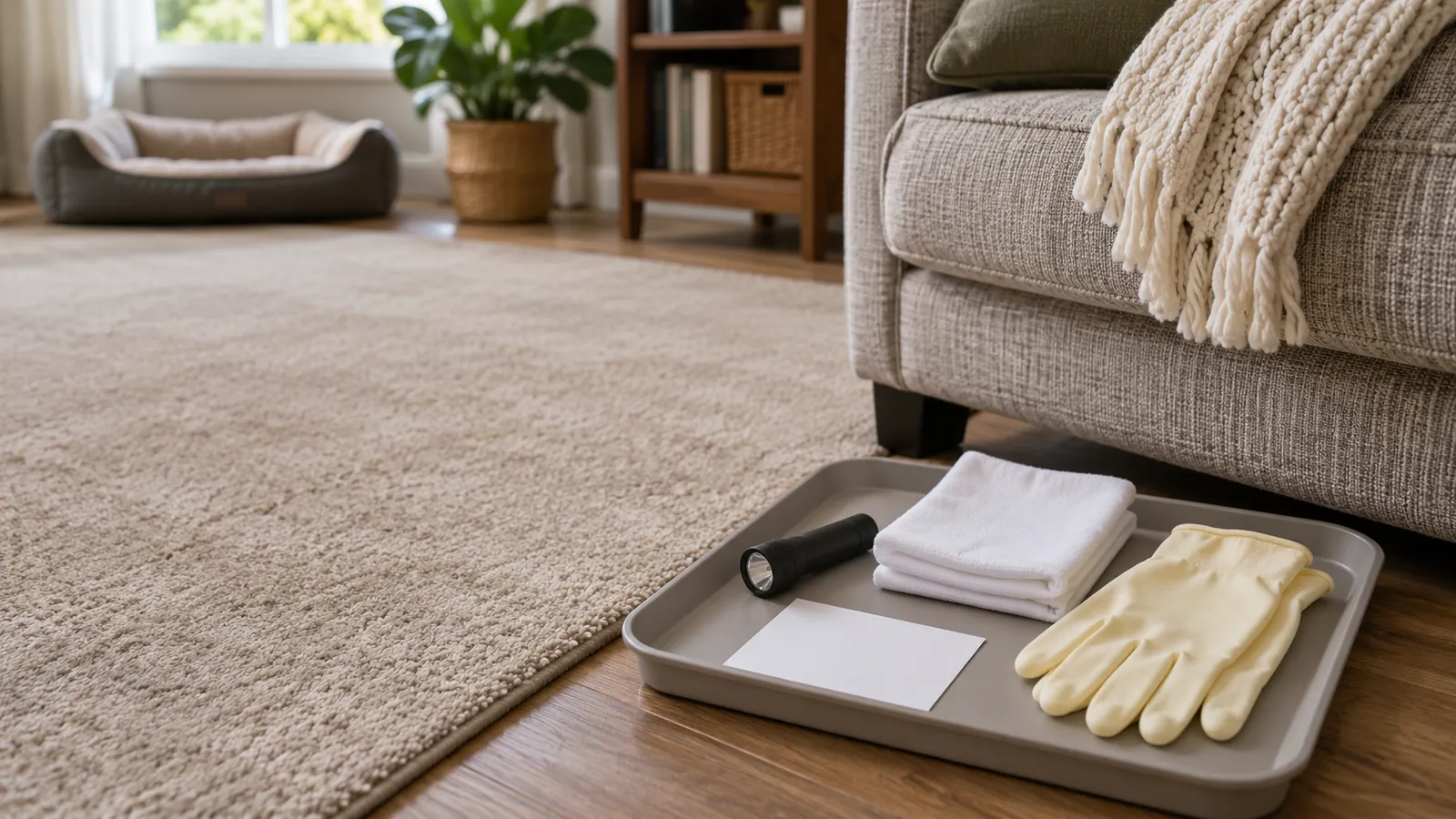
Gather the UV light, ordinary room lighting, clean white absorbent cloths and a way to make notes. Keep cleaning products separate until you know which carpet-care method applies. A simple room sketch is useful: identify the door, sofa and other fixed landmarks so you can find a possible spot again after the UV light is off.
Before reducing room light, identify the UV control on the exact flashlight. A multi-source light can include white light, UV and another function with a different purpose. Point the light away from faces while confirming the selected source. Keep enough ordinary illumination available to move safely between the places you inspect.
UV Fluorescence Locates Clues but Does Not Identify Dog Urine
Some materials fluoresce under suitable illumination, producing a visible response that can help locate residue. That response is not unique to urine. Scientific instrument maker HORIBA distinguishes visualization from identification and explains that cleaning fluids and background materials can also fluoresce. A visible patch therefore needs context before you decide what it means.
A known accident location, ordinary-light appearance and a relevant odor can support a household cleaning decision. They still do not turn the light into a chemical identification test. Avoid deciding that every glowing mark came from a dog, that it is recent, or that a particular person caused it. The same caution matters when inspecting a rental property or a room you have just moved into.
A weak or absent response also has limits. Background color, material and illumination can make a patch difficult to distinguish. HORIBA notes that dark materials can absorb both the illuminating light and the fluorescence, making stains harder to observe. A quiet-looking scan is not proof that the carpet, backing and cushion are free of contamination.
Olight recommends recording what you actually saw separately from what you suspect. “A contrasting patch beside the sofa leg” is an observation. “Dog urine from last week” adds an identity and a date that the glow cannot establish. Keeping those statements separate makes the next cleaning step more proportionate.
Scan Carpet in Zones and Keep the Location Clear
Reduce competing room light enough to see a useful contrast, while preserving safe access. Work from a familiar boundary such as the doorway and inspect one manageable section at a time. Move the beam across adjacent areas with some overlap so you do not rely on an isolated sweep across the whole room. Use the matching light's handling instructions rather than assuming one inspection distance suits every device and carpet.
Keep the light pointed toward the carpet and follow its handling instructions. Adjust your position within a comfortable, safe view if a surface reflection obscures the area. Do not put your face close to the emitter or increase exposure simply because a carpet does not produce a clear response. The objective is a usable observation, not the brightest possible photograph.
When a possible spot appears, stop and identify its location in ordinary light. Record nearby landmarks and whether the shape is localized or part of a broad background response. A note such as “between the chair's front legs” is more useful than “the bright spot,” especially after you move the furniture or return with cleaning supplies.
Use a sketch or a loose marker on a nearby hard surface rather than marking the carpet itself with ink, powder or adhesive. If a photograph helps, include enough room context to locate the area later. A tightly cropped glowing patch can be difficult to interpret once it is separated from its surroundings.
Finish one section before moving to the next. If another household member will clean the area, show them the location with ordinary lighting and explain what you observed. Do not ask them to reconstruct your scan from a collection of nearly identical close-up pictures.
Read Unexpected Glow Before Applying More Cleaner
A broad or repeated response can point to the material or its treatment rather than separate pet accidents. Cleaning products, optical brighteners and the background itself can affect what you see. Compare the suspect area with an adjacent part of the same carpet, recognizing that even the adjacent area may have an unknown cleaning history.
| UV observation | Question to ask | What the observation does not establish |
|---|---|---|
| Much of the carpet responds similarly | Is the background or a widespread treatment contributing? | That the whole room contains urine |
| A patch follows an earlier cleaning area | Which products were used there? | That the treatment failed or a new accident occurred |
| A small contrasting mark appears near a known accident | Does ordinary inspection support treating this location? | The exact identity, age or depth of the residue |
| Little contrast appears despite an odor | Is the material difficult to inspect, or is the source elsewhere? | That further checking is unnecessary |
Ask about previous products before adding another one. An area cleaned by a landlord, a former occupant or another family member may have a different background from untouched carpet. You do not need to identify the exact fluorescent ingredient to recognize that the treatment history matters.
Likewise, do not assign a substance from a color alone. A blue, green or yellow appearance is not a dependable household code for urine versus detergent. The light, material and viewing conditions all belong to the observation. A visible violet pool from a lamp is also different from a contrasting fluorescent feature in the carpet.
If the scan produces many ambiguous marks, pause the chemical treatment decision. Return to the area associated with a known accident or the strongest ordinary evidence. Cleaning every bright point aggressively can create a new carpet-care problem without resolving the original odor.
Choose a UV Flashlight You Can Identify and Control
For this job, access to the intended source matters more than a white-light maximum on the package. You need to recognize UV, inspect a nearby surface and switch back to ordinary lighting when checking a location. Olight recommends choosing a control arrangement you can understand without cycling unfamiliar functions around a pet or another person.
The Olight Arkfeld Pro combines white light, UV and a green laser with a central button and selector. Its flat body and selectable sources can suit someone who wants one handheld tool for ordinary illumination and occasional UV inspection. The laser is a separate function; it has no role in confirming a carpet stain or checking a cleaning result.
The Olight Oclip Ultra lists flood, spot and UV sources in a compact clip-light format. That gives a different carry arrangement for a household that also wants ordinary white-light tasks. For a carpet inspection, keep the selected source and beam direction under deliberate control. A clip does not make continuous UV exposure appropriate or remove the need to keep pets away.
The Olight ArkPro offers another multi-source format. Check the exact variant and its source selection before following a family illustration. ArkPro, Lite and Ultra do not have identical functions. A household interested mainly in a white-light and UV task should decide whether the additional controls suit the person who will actually use it.
None of these format choices creates a cleaning verdict. Do not compare their white-light lumen figures as if those figures measured urine-detection performance. Follow the matching UV instructions and choose from the useful source, controls and carry arrangement. If the existing light already lets you record the relevant area clearly, a new purchase is not a necessary step in treating the carpet.
Blot a Fresh Accident Before Planning a UV Recheck
If the accident is fresh, prioritize the carpet's spill response. Shaw Floors' carpet-care guidance recommends prompt blotting with a clean, white absorbent cloth or paper towel and warns against abrasive rubbing or scrubbing. Use the instructions for your own carpet rather than assuming that every fiber and backing accepts the same treatment.
Prepare the cloths and the cleaning route before starting. Keep used materials separate from clean ones, and avoid walking liquid into another part of the room. A record of where you started can help if the visible area changes as moisture is removed. The photograph is optional; delaying the initial response to obtain one is not useful.
The purpose of blotting is to take up accessible liquid without turning the task into aggressive rubbing. It is not a way to establish how much remains beneath the pile. Once the immediate response is complete, check the permitted next step in the carpet-care instructions and the selected cleaner's directions.
For a rented home, do not start lifting fitted carpet or opening seams to investigate the underside. Report the location and what has already been done if the problem may extend beyond routine spot care. A landlord or property manager can help identify the installed carpet and arrange the appropriate service.
Match the Cleaner and Its Directions to the Carpet
Choose a product intended for the material and the type of spot you are treating. An enzyme-based pet-stain product may be an option, but the word enzyme does not establish that every bottle is suitable for your carpet. Check the carpet manufacturer's guidance and the product label together, including any limitations for the fiber, backing or previous treatment.
Read the instructions before applying the product. Look for the required amount or dilution, any hidden-area check, contact time, removal or rinsing procedure, drying instructions and conditions for pets to return. Follow those directions as a complete sequence. Selecting a familiar bottle but using another product's waiting time can leave you with an uncertain result.
Avoid combining several remedies because the first application did not immediately change the UV image. Do not make a homemade mixture from unrelated internet instructions or add a stronger chemical to chase a remaining glow. If the carpet guidance and cleaner directions do not give you a compatible method, ask the manufacturer or a qualified cleaner before proceeding.
Use only the moisture and treatment the applicable procedure permits. More liquid is not automatically a better response to a deeper suspected problem. The Carpet and Rug Institute's pet-urine guidance explains that moisture can affect carpet backing and that some staining can become permanent. Those possibilities favor a considered method rather than repeated, progressively heavier applications.
If the label calls for equipment or a process you do not have, resolve that before starting. A product that needs a particular removal step is a poor match for a household unable to perform it. The useful purchase is a compatible care method you can complete, not simply another bottle placed beside the UV light.
Recheck After the Specified Treatment and Drying
Plan the recheck around the care procedure. Complete the cleaner's required contact, removal and drying steps before assessing the treated area. A fixed two-day wait is not a universal endpoint: the product, application and carpet conditions determine the instructions you need to follow. Record what those instructions required instead of substituting a calendar rule.
Begin the review under ordinary light. Check the visible appearance and whether the area has reached the condition specified by the treatment instructions. Consider the odor from a normal position rather than placing your face against the carpet. An unfinished drying or removal step is a reason to complete the procedure, not to declare success or failure from the UV image.
Then return to the same recorded location with the same light and selected source. Keep the room lighting, general viewing position and framing as similar as practical. These choices make a household comparison easier to understand; they do not turn it into a measured fluorescence experiment or establish a percentage of material removed.
Record the findings separately: visible condition, odor and UV response. “Odor remains but the glow is weaker” and “the glow remains without an obvious odor” lead to different questions. Do not reduce them to a single pass/fail photograph. If a cleaner has a recommended follow-up procedure, use that guidance rather than inventing a new threshold.
Turn the UV light off after the check and restore normal room lighting. Let pets return only under the care product's stated conditions. A carpet that looks acceptable in a photograph is not, by itself, confirmation that all product-use and household-access instructions have been satisfied.
Remaining Glow, Odor and Carpet Damage Need Different Answers
A remaining fluorescent response does not automatically mean that cleaning was incomplete. The Institute of Inspection, Cleaning and Restoration Certification (IICRC), in its consumer carpet-care information on animal stains, explains that an area can still fluoresce after professional cleaning. That is a reason to interpret the result carefully, not a reason to keep treating the carpet until every trace of glow disappears.
Odor is a separate concern. If it persists after the prescribed treatment is complete, record when and where it is noticeable and explain the previous products and procedures to a qualified cleaner. A pleasant fragrance or a weaker UV response does not establish that the original source has been addressed. Further treatment needs a reason tied to the problem that remains.
Visible discoloration can also have a different explanation from removable residue. Pet urine can affect carpet dyes and fibers, and cleaning cannot be assumed to reverse every change. If you see color loss, texture damage or a spot that returns, stop interpreting more forceful scrubbing as the inevitable next step.
The light does not inspect the condition of a fitted carpet's backing, cushion or subfloor. Persistent problems may require a professional assessment of those layers. Do not pull the carpet up, flood the area to reach them or assume that a surface scan establishes their condition. Tell the cleaner what you observed and let the appropriate inspection determine the next action.
Keep a Rental Record That Describes the Observation
For a tenant, a useful record is specific without claiming more than the evidence shows. Keep an ordinary-light overview, the location, the date you noticed the issue and the care instructions or service record relevant to the work. A UV photograph can accompany that material, but it should not replace the normal view of the room.
If you take a UV picture, record the light used and whether the image was captured before or after treatment. Avoid comparing an unframed close-up from one visit with a wider picture from another as if they showed an identical view. Keep the original files rather than adjusting the colors to make a point more dramatic.
Use neutral language when sharing the record. Explain that you observed a fluorescent patch or an odor at a particular location. Do not claim that the image proves which animal caused it, when it happened or whether a previous occupant cleaned the room. The optical observation does not answer those questions.
Before work beyond routine spot care, check the relevant property instructions and seek the required agreement. Ask who can identify the carpet and approve a treatment or professional visit. These records support a clear conversation; they do not guarantee a deposit outcome or substitute for the terms that apply to the property.
Make the Process Manageable in a Pet Household
Agree on one person or one shared note to track cleaning. If household members each apply a different product, the treatment history becomes harder to interpret. Record the location and the product already used so the next person can continue the permitted process without adding another layer by mistake.
Keep the inspection separate from the dog's access to the room. Do not encourage the dog to chase a laser or investigate the UV emitter while you look for a spot. Store the light and care supplies securely after use, and follow their instructions for handling, drying and return to normal access.
When accidents recur, locating and cleaning old spots is only one part of household care. Review the practical routine with the people caring for the dog, and seek appropriate professional help for persistent concerns. A UV map of the room cannot explain an animal's behavior or replace that conversation.
Stop the UV Search Before It Becomes Unsafe or Damaging
Read the matching flashlight's UV warnings before use. Keep the emitter away from eyes and skin, keep other people and animals out of the beam, and do not look into it to check whether the light is on. Visible brightness is not a reason to disregard the instructions. Olight's UV flashlight eye-safety guide covers the broader precautions.
A UV inspection is not a disinfection procedure or a hygiene certificate. Neither a glow nor its disappearance establishes that a surface is free of microorganisms. Keep cleaning decisions tied to the carpet and care product, and do not add prolonged exposure as a supposed final sanitizing step.
Seek help when the source remains unclear, odor persists, the affected area is extensive or previous treatment has changed the carpet. Give the professional the location notes and product history. A useful stopping point is the limit of what you can observe and treat safely under the applicable instructions, not a demand for a perfectly dark UV image.
FAQ
Changelog
- November 5, 2026: Product information and buying guidance reviewed.