Olight makes the Oclip Ultra discussed here. Olight specs, regular prices and manual quotes come from its US product page and user manual as of October 2026. The exposure times below are calculations from published limits and Olight's rated output, not measurements.
⚡ TL;DR
A UV flashlight is bad for your eyes only when enough UV-A reaches them. That takes a direct look into the emitter, a beam held on a face, or long close sessions. A U.S. Army evaluation found that the UV-A lights it evaluated would not cause injury in normal use. Time, distance and where you point the beam matter more than whether the light is 365 or 395 nm.
If you use UV to find pet stains, check bills or spot scorpions, the worry is reasonable. You can't see most of the beam, and the box rarely says how risky it is. This guide explains the IEC 62471 risk groups, turns the international UV exposure limit into minutes, and shows how to pick and check UV-blocking glasses.
This table compares the two common wavelengths on the factors that decide whether a UV flashlight is bad for your eyes.
| Factor | 365 nm light | 395 nm light | Which carries more eye risk | By how much |
|---|---|---|---|---|
| Counted toward the 10,000 J/m² UV-A eye limit | All of its UV-A output | All of its UV-A output | Equal per milliwatt of UV-A | None; ICNIRP counts 315–400 nm unweighted |
| Spectrally weighted UV limit at the peak | 2.7×10⁵ J/m² | 8.3×10⁵ J/m² | 365 nm | About 3.1 times stricter, yet still 27 times looser than the UV-A limit |
| Visible warning cue | Dim, bluish beam | Bright violet beam | 365 nm, because it looks weaker than it is | Not quantifiable from spec sheets |
📋 Table of Contents
- 1. Is a UV Flashlight Bad for Your Eyes? The Short Answer
- 2. UVA, UVB and UVC: Where Each Band Hits the Eye
- 3. What Are the IEC 62471 Photobiological Risk Groups?
- 4. Why Don't Flashlight Makers List a Risk Group?
- 5. How Long Does It Take for UV Light to Damage Eyes?
- 6. Can UV Light Damage Your Eyes?
- 7. How Safe Are UV Flashlights?
- 8. UV Flashlight Uses, Working Distance and Protection
- 9. Why Does Invisible Light Need More Care?
- 10. UV-Blocking Glasses: What Z87.1 and Z80.3 Labels Mean
- 11. Using a UV Flashlight Around Children and Pets
- 12. Common Myth: A UV Flashlight Can Disinfect
- 13. Olight Oclip Ultra: Where It Fits for Safe UV Checks
- 14. Your UV Flashlight Eye-Safety Checklist
- 15. FAQ
Is a UV Flashlight Bad for Your Eyes? The Short Answer
A consumer UV flashlight is not bad for your eyes in normal use, but it can become harmful with prolonged or repeated direct exposure. The U.S. Army Public Health Center found that the UV-A flashlights it evaluated "would not cause injury during normal use," and that safety limits "would only be exceeded if prolonged or many repeated exposures occurred." Keep the beam off faces and keep sessions short.
The Army fact sheet, Hazard Alert for Ultraviolet-A Flashlights and Black Lights Used for Inspections (Fact Sheet 24-014-0815), names the main hazard: "Sufficiently intense UV-A and blue radiation can cause chemically-induced lesions in the retina." Its controls are simple: "avoid prolonged or repeated exposure to the beam," and do "not point the beam at the faces of bystanders."
So is black light bad for your eyes? A black light works in the same UV-A band, so the same answer applies. Olight's 365 nm UV flashlights in the ArkPro series state their wavelength on the spec sheet, which helps if you want to know what you are pointing.
This guide is the safety deep dive. For what a UV flashlight reveals and how 365 nm compares with 395 nm for detection, start with our explainer. For carrying UV in a pocket light, our EDC flashlight with UV guide compares Olight's UV-equipped EDC lights and their lockouts.
UVA, UVB and UVC: Where Each Band Hits the Eye
Consumer UV flashlights emit UV-A, the 315 to 400 nm band, while UV-B (280 to 315 nm) and UV-C sit at shorter, more energetic wavelengths. The bands differ in where the eye absorbs them. Short wavelengths stop at the cornea, while UV-A passes deeper, into the lens, and a small share reaches the retina. That depth makes the lens and retina, not the cornea, the main UV-A concern.
The International Commission on Non-Ionizing Radiation Protection (ICNIRP) covers this in its Guidelines on Limits of Exposure to Ultraviolet Radiation (Health Physics, August 2004). This table summarizes what they say about each part of the eye.
| Eye tissue | What ICNIRP says reaches it | Effect of too much UV | Relevance to a UV-A flashlight |
|---|---|---|---|
| Cornea and conjunctiva | Short-wavelength UV below about 300 nm is "strongly absorbed" here | Photokeratoconjunctivitis, the painful "welder's flash" | UV-A needs far higher doses: "Corneal injury from UVA wavelengths requires levels exceeding 10 J cm⁻²" |
| Lens | "Wavelengths above 295 nm can be transmitted through the cornea and are absorbed by the lens" | Cataract in animal studies in the 295–320 nm band | ICNIRP notes "it has been difficult to link UVA radiation with cataract either epidemiologically or experimentally" |
| Retina | "Normally, less than 1% of UVA reaches the retina" | Photoretinitis when the lens is removed | Higher concern for people whose natural lens was removed, see below |
So a UV-A flashlight is unlikely to burn the cornea the way a welding arc can. The retina is the tissue the Army flags, and the natural lens is its main shield.
What Are the IEC 62471 Photobiological Risk Groups?
IEC 62471 sorts lamps and LEDs into four photobiological risk groups: Exempt, Risk Group 1 (low risk), Risk Group 2 (moderate risk) and Risk Group 3 (high risk). Each group reflects how long exposure takes to reach a limit. Higher groups get there sooner, so they rely more on short exposure or the eye's avoidance reflex.
According to the IEC webstore listing, IEC 62471:2006, Edition 1.0, published July 26, 2006, "specifies the exposure limits, reference measurement technique and classification scheme" for photobiological hazards from incoherent sources, including LEDs but excluding lasers, from 200 nm to 3000 nm. The listing says it "was prepared as Standard CIE S 009:2002 by the International Commission on Illumination."
The full standard is paid, so the group descriptions below are quoted secondhand from LED maker ams OSRAM's application note AN002, Details on Photobiological Safety of LED Light Sources (2025-09-16), not from IEC 62471 itself. The note covers only visible LEDs from 380 to 780 nm. Its time bases don't apply to UV, and IEC 62471's separate UV limits are not restated here.
| Risk group | Safety message, per ams OSRAM's summary of IEC 62471 | Retinal photochemical time basis (visible LEDs only) | What it means for you |
|---|---|---|---|
| Exempt (RG 0) | "No photobiological hazard" | 10,000 s | No precautions beyond common sense |
| Risk Group 1, low risk | "No hazard due to normal behavioral limitations on exposure" | 100 s | Safe as long as you don't stare for long |
| Risk Group 2, moderate risk | "No hazard due to the aversion response to very bright light sources or due to thermal discomfort" | 0.25 s | Safe because you look away; don't override that reflex |
| Risk Group 3, high risk | Can be hazardous "even with short exposure times" | Not listed in the note | Needs controls; ams OSRAM says current LEDs "generally do not fall into Risk Group 3" |
Two details matter for a flashlight. First, ams OSRAM says that for its LEDs a risk group means the limit "must not be exceeded over the specified exposure period subject to a minimum distance of 200 mm," and calls that distance "a worst-case assumption." A flashlight a few centimeters from a curious face is closer than that. Second, the note lists ANSI/IESNA RP-27 as the U.S. counterpart to IEC 62471.
The RG 2 message relies on the aversion response to very bright visible light. Don't count on that reflex with UV: a 365 nm beam looks dim, so the urge to look away is weak or absent.
Why Don't Flashlight Makers List a Risk Group?
Most flashlight product pages list no IEC 62471 risk group because the standard is a classification method, not a labeling rule. IEC's own guidance says the standard "does not include manufacturing or user safety requirements" tied to a risk group, and leaves those to product standards. Without a risk group, the manual's warnings are your best guide.
That sentence comes from IEC TR 62471-2:2009, which continues: "The safety requirements for lamp systems necessarily vary and are best dealt with in vertical standards." The report also noted a planned revision as IEC 62471-1, but as of October 2026 the IEC webstore still lists IEC 62471:2006 as the base standard.
Olight is a typical example. The Oclip Ultra product page and user manual list no IEC 62471 risk group. The manual gives a direct warning instead: "Do not look directly at the light source or shine it into your eyes, as this may cause temporary blindness or permanent damage to your eyes."
Use this checklist when you read any UV flashlight page or manual:
- Find the wavelength. A missing figure, or one outside 315–400 nm, means you don't know the band.
- Find the UV output in milliwatts. More milliwatts at the same distance and beam size means more exposure per second.
- Look for an IEC 62471 or EN 62471 risk group, and read it with the table above. If none is listed, assume nothing.
- Read the manual's warnings word for word, and check that UV sits behind a selector position and a lockout.
How Long Does It Take for UV Light to Damage Eyes?
There is no single time, because damage depends on how much UV-A energy reaches the eye. ICNIRP sets the limit for UV-A on the unprotected eye at 10,000 J/m² within an 8-hour period. At 1 mW/cm² at the eye, that budget runs out in about 1,000 seconds, roughly 17 minutes.
ICNIRP's wording is that "the total (unweighted) ultraviolet radiant exposure in the spectral region 315 to 400 nm should not exceed 10⁴ J m⁻²." Converting units gives a rule for any UV meter:
- 10,000 J/m² ÷ 10,000 cm² per m² = 1 J/cm², which is 1,000 mJ/cm².
- Allowed time in seconds = 1,000 ÷ irradiance at the eye in mW/cm².
This table applies that rule to example irradiance levels, based on the ICNIRP limit, not on readings from any flashlight.
| Irradiance at the eye (example) | Equal in W/m² | Time to reach the 8-hour UV-A eye limit |
|---|---|---|
| 0.1 mW/cm² | 1 W/m² | 1,000 ÷ 0.1 = 10,000 s, about 2.8 hours |
| 1 mW/cm² | 10 W/m² | 1,000 s, about 16.7 minutes |
| 5 mW/cm² | 50 W/m² | 200 s, about 3.3 minutes |
| 10 mW/cm² | 100 W/m² | 100 s, about 1.7 minutes |
| 50 mW/cm² | 500 W/m² | 20 s |
The limit sits well below injury: ICNIRP puts corneal injury from UV-A above 10 J/cm², ten times the 1 J/cm² limit. It also counts every exposure within the 8 hours, so ten 10-second glances add up the same as one 100-second stare.
ICNIRP also sets a spectrally weighted limit of 30 J/m². Its Table 1 lists the matching single-wavelength limit as 2.7×10⁵ J/m² at 365 nm (relative effectiveness 0.00011) and 8.3×10⁵ J/m² at 395 nm (0.000036), since 30 ÷ 0.00011 ≈ 2.7×10⁵. Both are far looser than 10,000 J/m², so the unweighted UV-A limit decides the time at either wavelength, and 365 and 395 nm lights rate equal per milliwatt.
Symptoms are delayed. For photokeratitis, ICNIRP says the latent period ranges "from ½ to 24 h but usually occurs within 6–12 h," and that "discomfort usually disappears within 48 h." If your eyes feel gritty, watery or light-sensitive hours after a session, see an eye doctor.
Can UV Light Damage Your Eyes?
Yes. UV light can damage your eyes, and the American Academy of Ophthalmology says anyone's eyes can be harmed by it. For UV-A from a flashlight, the main concern named by the U.S. Army is retinal injury from intense, prolonged exposure. Corneal burns need far higher doses. Some people face higher risk, especially after cataract surgery with an older lens implant.
The AAO's page "How Can UV Light Damage Your Eyes?" explains the cataract surgery risk. Surgery removes the natural lens and usually replaces it with an intraocular lens (IOL), and the AAO notes that "Older intraocular lenses absorb far less UV light than ordinary glass or plastic eyeglass lenses." Since the natural lens blocks most UV-A from the retina, a person with an older IOL has lost much of that shield.
This table shows who should take extra care, based on the AAO and ICNIRP sources above.
| Person | Why the risk is higher | What to do with a UV flashlight |
|---|---|---|
| Had cataract surgery years ago | Older IOLs absorb far less UV, per the AAO | Wear lenses labeled UV absorption up to 400 nm; ask your eye doctor which IOL you have |
| Takes photosensitizing drugs | The AAO lists some antibiotics, birth control and estrogen pills, phenothiazine and psoralens | Ask your doctor; keep sessions short and wear UV-blocking lenses |
| Everyone else | Exposure adds up over an 8-hour period | Beam down, short sessions, no faces |
How Safe Are UV Flashlights?
Is it safe to use a UV flashlight at home? Yes, when you keep the beam off eyes and limit long close sessions. The Army fact sheet says the UV-A lights it evaluated "pose some risk, but would not cause injury during normal use," and that personal protective equipment "may be worn, but is not necessary to prevent injury." The danger zone is a direct look from close range.
A household light can still reach the limit fast at close range. The Oclip Ultra manual says, "Power is 800mW with sufficient battery and 300mW when low." Olight publishes no UV beam angle, so any spot size is an assumption. As an illustration only, suppose all 800 mW landed evenly on a 10 cm circle on a face:
- Spot area = π × (0.05 m)² ≈ 0.0079 m²
- Average irradiance = 0.8 W ÷ 0.0079 m² ≈ 102 W/m², about 10 mW/cm²
- Time to the 10,000 J/m² limit ≈ 10,000 ÷ 102 ≈ 98 seconds
Read that as an order of magnitude, not a safe time. A real beam is brighter at the center than at the edge, so the center can reach the limit sooner, and a tighter spot or closer face shortens it further. The practical conclusion: a small, intense spot held on a face can use up the 8-hour budget in minutes, not hours, while a beam pointed at the floor sends far less UV toward your eyes. To see your own light's spot, aim it at white printer paper in a dark room; the paper glows under UV because of optical brighteners.
UV Flashlight Uses, Working Distance and Protection
The safest way to use a UV flashlight is to match your habits to the job. Floor and wall searches keep the beam well below your eyes, while close inspection of small objects brings the emitter near your face. Leaning in to read a faint glow is the habit to watch.
This table lists where the beam usually points in each job, the main risk and the habit that controls it.
| Use | Where the beam points | Main eye-exposure risk | Protective habit |
|---|---|---|---|
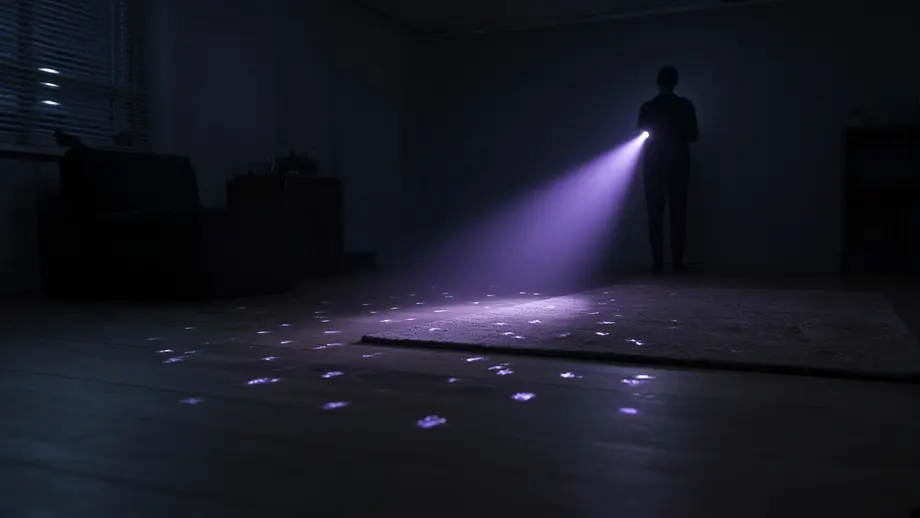
| Pet stains on carpet | Floor, at a low angle | Pets at floor level walk into the beam | Put pets in another room; sweep the beam away from you |
| Checking bills and cards | Small object on a counter | Leaning in close to read the glow | Keep the light below eye level and angled away; glance, don't study |
| Scorpions at night | Walls, ground, boots | Long sessions, people walking toward you | Lower the beam when anyone approaches; wear UV-blocking lenses for long sweeps |
| A/C leak dye in a dark engine bay | Close, tight spaces | Reflections off metal and glass | Use lenses labeled UV absorption up to 400 nm |
For what each material shows under UV, see our guide to what glows under a black light. Tile, mirrors and windows reflect part of the beam, so keep the angle low.
Why Does Invisible Light Need More Care?
Invisible light needs more care because your eyes can't warn you about it. A bright white beam makes you squint and turn away, and the moderate-risk group for visible LEDs relies on that reaction. The Army notes that human vision has "only some sensitivity to UV-A radiation," so you can look toward a strong UV beam without the discomfort that would make you stop.
That gap explains a common self-inflicted exposure: looking into the emitter to check that the light is on. Tonic water and phone tricks are covered in our guide on whether you can use a phone flashlight as a UV light.
Warning: Never look into a UV emitter to see whether it is on. Check the glow on white paper, and switch to UV only with the emitter already pointing at the target.
UV-Blocking Glasses: What Z87.1 and Z80.3 Labels Mean
The best glasses for UV flashlight work are clear safety lenses marked under ANSI/ISEA Z87.1 with a UV filter rating, or lenses labeled "UV absorption up to 400nm." Sunglasses made to ANSI Z80.3 are a weaker choice: that standard says its lenses are not intended for low light, and tinted lenses make faint fluorescence harder to see.
This table compares the two U.S. standards, based on ANSI's summaries of each.
| Standard (current edition) | What it covers | UV-related marking or claim | Fit for dark-room UV work |
|---|---|---|---|
| ANSI/ISEA Z87.1-2025 | Occupational and educational eye and face protection | "U" followed by a scale number marks a UV filter lens; "Z87+" is the impact mark | Good choice when the lens is clear and carries a U marking |
| ANSI Z80.3-2025 | Nonprescription sunglasses and fashion eyewear | Transmittance requirements; the 2025 edition adds rules for some UV attenuation claims | Weak choice: lenses are "not intended for use under conditions of reduced illumination" |
The ANSI Blog post on Z87.1-2025 lists the markings, including "U scale number: UV filter lens," so check the maker's spec sheet for the UV transmittance behind the number. For sunglasses, the AAO page "How to Choose the Best Sunglasses to Avoid Sun Damage" advises: "Look for a sticker or tag that promises 100% UV protection from all types of UV light. Some labels say 'UV absorption up to 400nm,' which is also acceptable." The AAO adds that darker lenses don't mean more protection, and that "Polarization itself does not provide UV protection."
The Army says protective equipment is not necessary in normal use. Glasses make sense for long sessions, reflective spaces, people with older IOLs, and helpers who might look toward the beam.
You can check whether a lens blocks your own light. We have not measured any glasses, and this method is untested by us:
- In a dark room, shine the UV light on white printer paper from about 30 cm.
- Hold the lens between the light and half of the paper, close to the paper.
- If the covered half goes dark while the open half glows, the lens absorbs most of that light's UV.
- If both halves glow about the same, the lens passes UV and won't protect you.
Prefer a 365 nm light for this check, since a 395 nm light's visible violet passes clear lenses and can make the covered half look lit. The test shows a difference, not a percentage; the AAO notes that an optical shop can test your glasses' UV protection.
Using a UV Flashlight Around Children and Pets
Around children and pets, an adult should hold the UV flashlight and keep the beam below face height. A child may look straight into a light to see where it comes from, and a pet can walk right into a floor-level beam. If a child wants to hold a light, hand over white light, not UV.
- Close the pet in another room during a urine search. The beam sits at a dog's or cat's eye height.
- Store the light locked and out of reach. The Oclip Ultra manual says, "If the product is carried, transported, please lock the product."
- Mind the battery. The same manual warns, "Keep new and used batteries away from children," and notes "Non-pet toys," so it is not a toy for pets.
Safety note: The Oclip Ultra uses a magnet. Its manual says, "If you have an ICD or pacemaker, avoid close or prolonged contact with this product to prevent possible interference." Keep that in mind before clipping it to a chest pocket.
Common Myth: A UV Flashlight Can Disinfect
A UV flashlight can't disinfect surfaces. In its consumer update "Beware of Ultraviolet Wands That Give Off Unsafe Levels of UV Radiation," the FDA calls UV-C "a known disinfectant for air, water, and nonporous surfaces." A 365 or 395 nm flashlight emits UV-A, which the Army fact sheet lists for detection jobs: finding forgeries, oil leaks, crime scene evidence and rodent urine. Holding the beam on a phone or a hand for minutes adds exposure with no benefit.
The myth can also push buyers toward UV wands, and the same update warns that certain ones "may cause injury to the skin, eyes, or both after a few seconds of use." Our black light flashlight guide covers other black-light myths.
Olight Oclip Ultra: Where It Fits for Safe UV Checks
The Olight Oclip Ultra clip-on EDC light suits short household UV checks for pet stains or leaks where you also want white light. Olight describes "an 800mW UV light to check for leaks or detect hidden stains," paired with a 530-lumen floodlight and a 450-lumen spotlight in a 55 g body. A side selector keeps UV in its own position, and the user manual's spec table lists the UV wavelength as "365-370nm" (typical). Its regular price is $49.99 for the default Olive Green (October 2026).
How its published features map to the concerns above:
- Surprise UV exposure. The manual says to "Rotate the selector to choose between flood, spot, and UV lights," and a lockout stops pocket presses. Leave the selector on flood when you put it away.
- Using UV only as long as needed. Olight lists the floodlight's Medium at 100 lumens for 3.5 hours. Find the area with white light, switch to UV for the check, then switch back to see what glowed.
- Keeping the beam steady and pointed down. Olight lists a clip, an N52 neodymium magnet and a hanging loop, so the light can stay fixed on a cabinet or car body instead of wandering toward faces.
Its limits matter here. The manual lists UV "Max Runtime: 3+130min" and says output is 800 mW with sufficient battery and 300 mW "when low." For hour-long scorpion sweeps, a larger dedicated UV light is the better fit. It is rated IPX6, and the manual says, "Do not immerse the product in water or other liquid as it will damage the product." It also says, "Don't place, charge or use this light in a car where the temperature inside may exceed 60°C or in similar environments."
The box holds the light, a USB-C charging cable and a user manual. For other clip lights, see Olight's clip-on flashlights.
Your UV Flashlight Eye-Safety Checklist
Use this checklist so a UV flashlight is never bad for your eyes, at home or outdoors. It turns the risk groups, the ICNIRP limit and the manual warnings above into habits that keep everyone's eyes far from the exposure limit.
- Read the manual's eye warning and the wavelength before first use.
- Switch to UV only with the emitter pointing at the target, and keep the beam below face height.
- Treat exposure as a budget: about 1,000 seconds at 1 mW/cm², and much less up close.
- Check that the light works on white paper, never by looking at the lens.
- Wear clear lenses with a Z87.1 U marking or "UV absorption up to 400nm" for long or close sessions.
- Take extra care after cataract surgery or while on photosensitizing drugs.
- Lock the light when you carry it, and keep it and its battery away from children.
- See an eye doctor if your eyes feel gritty or sore within a day of a session.
FAQ
Changelog
- October 31, 2026: First published.