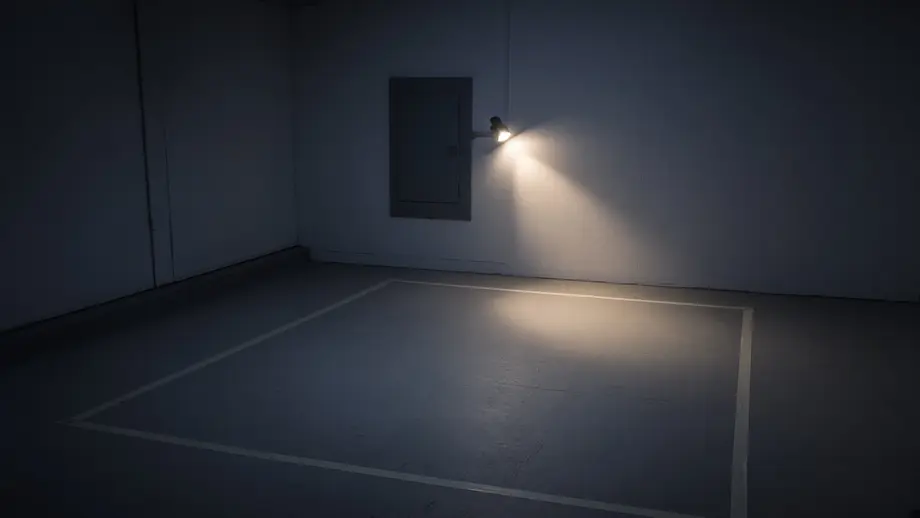
Olight makes the lights discussed here. Olight specs and regular prices come from its US product pages and user manuals as of October 2026; code text comes from the eCFR and the sources linked below. Clearance and runtime figures are calculations, not measurements.
⚡ TL;DR
Electrical panel working space requirements come down to one habit: keep the floor in front of your breaker panel empty. For panels at 150 volts or less to ground, federal OSHA rules set the clear zone at 30 inches wide (or the panel width), 3 feet deep and 6.5 feet high. Homes follow the NEC Section 110.26 edition your town adopted. Park a flashlight beside the zone, never in it.
The trouble usually starts in a basement or garage. A chest freezer slides in front of the panel because that wall has an outlet. A steel shelf follows. Then a home inspector flags the panel as blocked, or the power goes out and you are moving boxes in the dark to find the main breaker. This guide shows what the official rules say, how much room a freezer really takes, and how to keep one of Olight's small EDC flashlights ready at the panel without touching anything inside it.
This table lists the gear a homeowner needs to meet electrical panel working space requirements and keep the panel lit, with the minimum spec this guide uses for each job.
| Job | Recommended type | Minimum spec (this guide) | Recommended model |
|---|---|---|---|
| Finding the panel in a blackout | Pocket flashlight with a lockout | A 50+ lumen steady mode that runs 3+ hours | Olight Baton 4 (60 lm Med, 8 hours) |
| Reading the breaker directory hands-free | Headlamp | A low mode of 20 lumens or less, plus a 100 lumen mode | Olight Perun 3 Mini (10 lm Low for 30 hours; 100 lm Med for 4.5 hours) |
| Keeping the light at the panel | Magnetic wall dock outside the working space | Steel plate with adhesive backing | Olight L-Stand with the Baton 4 |
| Checking the clear zone | Tape measure and painter's tape | Reads 36 in and 78 in | Any |
📋 Table of Contents
- 1. Quick Answer: What Are the Electrical Panel Working Space Requirements?
- 2. Which Official Rules Should You Check, and What Does Each Cover?
- 3. Why Must the Space in Front of a Breaker Panel Stay Clear?
- 4. How Big Is the Electrical Panel Working Space? Clear-Zone Math
- 5. Electrical Panel Working Clearance Problems in Basements and Garages
- 6. How Should You Light a Breaker Panel During a Power Outage?
- 7. Safety Boundary: What a Homeowner Should and Should Not Do at the Panel
- 8. Common Mistake: "A Panel in a Closet Is Fine"
- 9. What Are the OSHA Rules for Working on Electrical Panels?
- 10. What Is the 80% Rule for Electrical Panels?
- 11. What Is the 120 Rule for Electrical Panels?
- 12. When Must You Call a Licensed Electrician?
- 13. Your 15-Minute Electrical Panel Clearance Audit
- 14. FAQ
Quick Answer: What Are the Electrical Panel Working Space Requirements?
For equipment at 150 volts or less to ground, OSHA's 29 CFR 1910.303(g)(1) requires a clear working space at least 3.0 feet deep, as wide as the equipment or 30 inches, whichever is greater, and 6.5 feet high for installations built on or after August 13, 2007. The space may not be used for storage, and the panel door must open at least 90 degrees.
Those figures come from the OSHA electrical installation rule, 29 CFR 1910.303. It says the width "shall be the width of the equipment or 762 mm (30 in.), whichever is greater." Its Table S-1 lists 0.9 m (3.0 ft) of depth for 0 to 150 volts to ground under all three conditions, measured "from the enclosure front or opening if they are enclosed."
Which row fits your panel is an inference, not something OSHA states for homes. Michigan State University's tech note on 120/240-volt systems explains that codes require the center wire to be grounded and that "there is 120 volts from the center tap wire to either of the other wires." On a service wired that way, each hot leg sits about 120 volts from ground, which points to the 0 to 150 volt row. Have an electrician confirm your own service.
OSHA writes rules for employers, not homeowners. Your house follows the electrical code your city or county enforces, usually the National Electrical Code (NFPA 70), where Section 110.26 holds the working space rules; read it in NFPA's free-access library. This guide names the NEC edition wherever it quotes NEC wording, and your jurisdiction may enforce another edition with amendments.
Which Official Rules Should You Check, and What Does Each Cover?
Check four sources in this order: OSHA 29 CFR 1910.303 for the federal working space numbers, NEC Section 110.26 in the edition your jurisdiction adopted, any local amendments from your building department, and the panel maker's label. For a home, the local code wins.
This table turns each rule into the one thing a homeowner can do about it. Numbers appear only where the official text was read directly.
| Rule (source) | What the text says | What you do at home |
|---|---|---|
| OSHA 1910.303(g)(1)(i) | Depth per Table S-1: 3.0 ft at 0 to 150 V; width 30 in or the equipment width; 90° door opening | Mark a 30 by 36 in rectangle on the floor in front of the panel |
| OSHA 1910.303(g)(1)(ii) | "may not be used for storage" | Move every box, bin and appliance out of the rectangle |
| OSHA 1910.303(g)(1)(v) | "Illumination shall be provided" for indoor panelboard working spaces | Keep the ceiling light working and stage a backup light |
| OSHA 1910.303(g)(1)(vi) | Headroom 6.25 ft before August 13, 2007; 6.5 ft on or after | Keep shelves and hooks above 78 in inside the zone |
| OSHA 1910.303(g)(1)(vii)(A) | Dedicated space the width and depth of the equipment, floor to 6 ft above it or the structural ceiling; no foreign piping, ducts or equipment | Add no pipes, ducts or shelves in the column above or below the panel |
| OSHA 1910.304(f)(1)(iv) | Overcurrent devices may not be "in the vicinity of easily ignitable material" | Keep clothes, paper and cardboard away from the panel |
| NEC 110.26 (NFPA 70) | The model code's working space section | Ask your building department which edition and amendments apply |
Why Must the Space in Front of a Breaker Panel Stay Clear?
The space in front of a breaker panel stays clear for two jobs: shutting power off fast in an emergency, and giving a qualified electrician room to work with the door fully open. A freezer or shelf in that space blocks both.
The emergency job is yours. The MSU tech note says the main service disconnect "is usually the main circuit breaker in the electrical panel of the building." OSHA's wiring design and protection rule, 29 CFR 1910.304, adds that it "shall plainly indicate whether it is in the open or closed position." You need to reach it, see it and read it. Newer homes may also have an outdoor switch: an IAEI Magazine column by John Wiles notes, "New to the 2020 and 2023 editions of the NEC is the requirement in Section 230.85 for an Emergency Disconnect on one- and two-family dwellings."
The service job belongs to an electrician. The SLAC National Accelerator Laboratory summary of NFPA 70 working space rules says the 30-inch width "provides room to avoid body contact with grounded parts while working with energized components of the equipment."
How Big Is the Electrical Panel Working Space? Clear-Zone Math
At 0 to 150 volts, the minimum electrical panel working space is a box 30 inches wide, 36 inches deep and 78 inches high: 1,080 square inches of floor (7.5 sq ft) and 84,240 cubic inches of air (48.75 cu ft). A small 7.0 cu ft chest freezer has a footprint equal to 76% of that floor, and set against the panel wall it fills the full 30-inch width.
For a panel narrower than 30 inches: 30 x 36 = 1,080 sq in, / 144 = 7.5 sq ft; 1,080 x 78 = 84,240 cu in, / 1,728 = 48.75 cu ft.
Freezer sizes come from GE Appliances' published dimensions for its 7.0 cu ft chest freezer, FCM7SHWW (33 1/2 H x 37 1/2 W x 21 3/4 D) and its 15.7 cu ft chest freezer, FCM16SLWW (33.375 H x 65 W x 28.5 D). The shelf rows are example inputs; swap in your own numbers.
This table shows how much of the electrical panel working space each common basement item takes.
| Item (size source) | Depth used of 36 in | Width used of 30 in | Footprint vs 7.5 sq ft zone | Verdict |
|---|---|---|---|---|
| GE 7.0 cu ft chest freezer (GE) | 21.75 / 36 = 60% | 37.5 / 30 = 125% | 815.6 sq in = 5.66 sq ft, 76% | Blocks the zone |
| GE 15.7 cu ft chest freezer (GE) | 28.5 / 36 = 79% | 65 / 30 = 217% | 1,852.5 sq in = 12.86 sq ft, 172% | Larger than the zone |
| 18 in deep steel shelf (example) | 18 / 36 = 50% | Any overlap | Depends on width | Blocks the zone |
| 12 in deep wall shelf at 72 in (example) | 12 / 36 = 33% | Any overlap | Off the floor | Breaks the 78 in headroom |
Read the verdict column as a rule: OSHA allows no storage in the space, so even 10% is too much.
If a freezer must share the room, put it on the opposite wall. That wall must sit at least 36 inches plus the freezer depth from the panel face: 36 + 21.75 = 57.75 in (4 ft 9.75 in) for the 7.0 cu ft model, and 36 + 28.5 = 64.5 in (5 ft 4.5 in) for the 15.7.
Electrical Panel Working Clearance Problems in Basements and Garages
Most basement and garage panel problems fall into four patterns: something stored in front of it, something mounted above it, something built around it, or no light to see it by. Each has a homeowner fix, and a few also need a licensed electrician or your building department.
This table compares common basement and garage setups with the rule each one conflicts with.
| What you find | Rule it conflicts with | What you can do | When to call a pro |
|---|---|---|---|
| Chest freezer or fridge in front | No storage; 36 in depth | Unplug, empty and move it out of the zone | Moving the outlet it plugs into |
| Shelving unit across the panel | No storage; 30 in width | Relocate the shelf | Never needed |
| Bikes, bins or a parked car bumper | No storage | Store them elsewhere; tape a parking stop | Never needed |
| Workbench built under the panel | Working space must be clear to the floor | Clear the top; plan to move the bench | If the bench is wired in |
| Pipe or duct run added above the panel | Dedicated space, 1910.303(g)(1)(vii)(A) | Do not add more | Rerouting pipes or ducts |
| Drywall or a cabinet built around the panel | Width, depth and door swing | Stop the remodel at the panel | Before you close anything in |
| Burned-out or missing light | Illumination, 1910.303(g)(1)(v) | Replace the bulb; stage a flashlight | Adding a new fixture or switch |
| Panel inside a clothes closet | Ignitable material, 1910.304(f)(1)(iv) | Empty the space in front | Any question of relocating it |
How inspectors word such findings is covered in our guide to thermal camera for home inspector reports.
How Should You Light a Breaker Panel During a Power Outage?
Light a breaker panel in an outage with a flashlight that already lives next to it: docked on the wall beside the panel, outside the 30-inch zone, at shoulder height. A headlamp is the better second light, because it frees both hands to hold the door and read the directory. Never stick a light to the panel door or inside the enclosure.
OSHA's illumination rule assumes the room light works. In a blackout it does not, so your backup has to be at the panel before you are. Ready.gov's power outage guidance also says to "Turn off or disconnect appliances, equipment, or electronics. Power may return with momentary surges or spikes that can cause damage." Do that at the appliances themselves, not by working inside the panel.
Mounting a work light on an open panel for a contractor's job is a different problem, covered in our electrician flashlight guide.
This table sets out what each part of an outage trip to the panel asks of a light. The thresholds are this guide's planning numbers.
| Sub-scene | What the light does | Output to plan for | Runtime to plan for | Water |
|---|---|---|---|---|
| Stairs and basement path | Shows steps and floor clutter | 50 to 100 lm | 10 minutes per trip | Not needed |
| Reading the breaker directory | Lights small print without glare | 10 to 60 lm | 5 minutes per trip | Not needed |
| Detached garage panel in rain | Same, with wet hands | 50 to 100 lm | 10 minutes per trip | IPX8 |
| Waiting for power to return | Stays ready, not on | Moon or off | Hours to days | Not needed |
Olight Baton 4: the light that stays at the panel
The Olight Baton 4 EDC flashlight is 63 mm long, weighs 52.5 g and is rated IPX8. It peaks at 1,300 lumens; the modes that matter here are Med 60 lumens for 8 hours, Low 12 lumens for 35 hours and Moon 0.5 lumens for 30 days. The product page lists $54.99 for the standard flashlight and $94.99 for the Premium Edition with a charging case (regular prices, October 2026).
Its manual adds two features that suit a light parked by a panel. To lock it, "when the flashlight is off, press and hold the button (for about 2 seconds) until the Moonlight mode turns on and off." The manual also describes an Auto Shut-Off timer of 3 or 9 minutes that you switch on after turning the light on, by double-pressing and holding the button; it reuses the last period you chose.
The dock is the Olight L-Stand magnetic mount ($5.99, regular price, October 2026). Olight describes it as "Made of magnetic stainless steel with a powerful adhesive backing" and lists it as compatible with the Baton 4. Stick it to the wall beside the panel, outside the taped rectangle.
Limits: the standard Baton 4 charges with its MCC magnetic cable (the Premium charging case can also recharge it), so keep that cable near the dock. It has no headband, so reading labels takes one hand.
Olight Perun 3 Mini: the hands-free second light
The Olight Perun 3 Mini headlamp (CW version) is rated at 1,250 lumens, 6,000 candela and 155 m, IPX8, at 54 g. Its close-work modes: Med 100 lumens for 4.5 hours, Low 10 lumens for 30 hours, Moon 2 lumens for 10 days, and red light at 5 lumens for 19 hours. The standard kit, with headband, lists at $64.99 (regular price, October 2026).
Olight lists a "pocket clip, magnetic tailcap, and lanyard hole" and a quick-release bracket; on the headband, both hands stay free.
Limits: Med lasts 4.5 hours, a little over half the Baton 4's 8 hours. If the headlamp lives in a hot garage, note the manual's warning: "Leaving a battery in an extremely high temperature surrounding environment can result in an explosion or the leakage of flammable liquid or gas." Store it indoors in summer.
Runtime math: how many panel trips per charge?
This table divides each rated runtime by a 10-minute trip to the panel. These are estimates from Olight's ratings, not measurements.
| Light and mode | Rated runtime | Minutes | 10-minute trips per charge |
|---|---|---|---|
| Baton 4 Med, 60 lm | 8 hours | 480 | 48 |
| Baton 4 Low, 12 lm | 35 hours | 2,100 | 210 |
| Perun 3 Mini Med, 100 lm | 4.5 hours | 270 | 27 |
| Perun 3 Mini Low, 10 lm | 30 hours | 1,800 | 180 |
The bigger risk is a light left on. Without a timer, a Baton 4 forgotten on Med runs flat in 8 hours and a Perun 3 Mini in 4.5 hours. Both manuals describe the same 3 or 9 minute Auto Shut-Off. Switch it on at the start of each trip, and a forgotten light loses at most 9 / 480 = 1.9% of the Baton 4's Med runtime, or 9 / 270 = 3.3% of the Perun 3 Mini's. Pick 9 minutes: the 3-minute period would cut a 10-minute trip off three times. Our guide to flashlight runtime explains why cold and battery age shorten rated numbers.
Safety Boundary: What a Homeowner Should and Should Not Do at the Panel
A homeowner's job at the panel is preparation: clear the space, light it, keep the directory readable, and know where the main is. Opening the inner cover, touching anything behind it, or adding, moving or replacing breakers is electrical work. The U.S. Fire Administration's home electrical fire flyer says: "Electrical work should only be done by a qualified electrician."
Outside your boundary: the inner cover (often called the dead front), anything behind it, tracing circuits with the cover off, and moving or boxing in the panel.
Safety note: OSHA's work practice rule, 29 CFR 1910.333, at (c)(4)(ii) bars workers from tasks near exposed energized parts when poor light or an obstruction keeps them from seeing the work. It is written for employers, but the logic holds at home: if the space is dark or blocked, fix the light or the clutter before you open the door.
Common Mistake: "A Panel in a Closet Is Fine"
A panel in a closet is not automatically fine. The working space rules still apply inside the closet: 30 inches wide, 36 inches deep and clear to the floor, with room for the door to open 90 degrees. Many reach-in closets are shallower than 36 inches, and a closet full of clothes puts ignitable material next to the breakers.
OSHA's 1910.304(f)(1)(iv) says overcurrent devices "shall be readily accessible" and "may not be located where they will be exposed to physical damage or in the vicinity of easily ignitable material." Clothing, paper and cardboard are what most closets hold.
Measure from the panel face to the closed closet door. Under 36 inches, the depth rule cannot be met however empty you keep it. Do not move the panel yourself; ask a licensed electrician and your building department.
What Are the OSHA Rules for Working on Electrical Panels?
OSHA's rules for working on electrical panels sit in 29 CFR 1910 Subpart S. Section 1910.303 covers working space and illumination, 1910.333 requires de-energizing live parts unless the employer shows it is infeasible or adds hazards, and only "qualified persons" may work on parts that are not de-energized. These rules bind employers, not homeowners working on their own house.
The de-energizing rule is 1910.333(a)(1); the employer carries the burden of showing that shutting off power would add hazards or is not feasible. The OSHA definitions section, 29 CFR 1910.399, defines a qualified person as "One who has received training in and has demonstrated skills and knowledge in the construction and operation of electric equipment and installations and the hazards involved."
NFPA 70E, Standard for Electrical Safety in the Workplace, is the consensus standard paired with these rules. Occupational Health & Safety, reporting on the 2024 edition, calls it "still a voluntary standard issued by the National Fire Protection Association" that "helps companies and employees comply with OSHA 1910 Subpart S and OSHA 1926 Subpart K."
OSHA does not even cover household help hired privately: its domestic household policy, 29 CFR 1975.6, says people who privately employ others for "ordinary domestic household tasks, such as house cleaning, cooking, and caring for children, shall not be subject to the requirements of the Act with respect to such employment." How a qualified worker scans a live panel under these rules is covered in our guide to the best thermal imaging camera for electricians.
What Is the 80% Rule for Electrical Panels?
The 80% rule is shorthand for an NEC sizing rule, not a panel limit. NEC 210.20(A), quoted here from the 2014 edition, requires a branch-circuit breaker rated at least the noncontinuous load plus 125% of the continuous load, one that runs at maximum current for 3 hours or more. Because 1 / 1.25 = 0.8, a standard breaker carries a continuous load of up to 80% of its rating.
The 2014 text, as quoted in an IAEI Magazine article by Thomas A. Domitrovich: "Where a branch circuit supplies continuous loads or any combination of continuous and noncontinuous loads, the rating of the overcurrent device shall not be less than the noncontinuous load plus 125 percent of the continuous load." The same article quotes the 2014 definition of a continuous load as "a load where the maximum current is expected to continue for 3 hours or more" and notes an exception for assemblies listed for 100 percent operation. Check the wording in the edition your jurisdiction enforces through NFPA's free-access library.
A worked example, as arithmetic only: a 20 A breaker x 0.8 = 16 A of continuous load, and 16 A x 120 V = 1,920 W on a 120-volt circuit. Check: 16 A x 1.25 = 20 A.
Warning: Do not use this math to add a breaker, upsize one or plug in a new long-running load such as an EV charger. The IAEI article explains that breaker selection runs through the load calculation and "ends with the right OCPD to protect the conductor," so the wire behind the cover decides the answer. That is a licensed electrician's job.
What Is the 120 Rule for Electrical Panels?
The 120% rule limits how much solar or other power-source current can feed a panel's busbar from a breaker at the opposite end from the main. As described for the 2023 NEC, Section 705.12(B)(2) caps 125% of the source's output current plus the main breaker rating at 120% of the busbar rating. On a 200 A panel with a 200 A main, that leaves room for 32 A of inverter output.
Wiles, writing in December 2023 about the 2020 and 2023 NEC, states it: "the sum of 125% of the power source output circuit current and the rating of the overcurrent device protecting the busbar shall not exceed 120% with the busbar ampere rating [705.12(B)(2)]." His examples: "With a 100-amp load center, the maximum back-fed PV current that could be connected would be 16 A," and "For a 200-amp load center, the maximum back-fed PV current is 32 A."
Step by step: busbar rating x 1.2, minus the main breaker, is the room left for the back-fed breaker; that x 0.8 (the same as / 1.25) is the continuous output current.
- 100 A x 1.2 = 120 A; 120 - 100 A main = 20 A; 20 A x 0.8 = 16 A.
- 200 A x 1.2 = 240 A; 240 - 200 A main = 40 A; 40 A x 0.8 = 32 A.
- 32 A x 240 V = 7,680 W of inverter output at 240 volts, as arithmetic only.
Wiles adds that the rule "applies to any busbar located throughout the system," including subpanels, and that it is one of several connection options under 705.11 and 705.12. A solar contractor and a licensed electrician choose the method, and the permit office and utility approve it. A homeowner should never use this math to add a backfeed breaker.
When Must You Call a Licensed Electrician?
Call a licensed electrician for anything behind the panel cover and for any change to what the panel feeds: new circuits, an EV charger, solar, a generator connection, moving the panel, or closing it in during a remodel. Also call when the clear zone cannot be made to fit, such as a closet shallower than 36 inches.
Add a breaker that will not stay on after one reset, water or scorch marks on or near the door, and any inspection note about panel access.
Your 15-Minute Electrical Panel Clearance Audit
You can check the electrical panel working space requirements yourself in about 15 minutes with a tape measure, painter's tape, a phone and your backup light. You never open the panel: every step happens on the floor and on the outside of the door.
- Measure the panel width. Under 30 inches, the zone is 30 inches wide; otherwise it matches the panel.
- Tape a rectangle 36 inches out from the panel face and at least 30 inches across, including the panel.
- Hold the tape up to 78 inches. Nothing inside the rectangle should hang below that line.
- Open the door to 90 degrees. It must not hit anything.
- Look up. Note any new pipe, duct or shelf in the column above the panel.
- Photograph the directory on the door until every label is readable.
- Dock a locked Baton 4 on an L-Stand beside the zone, and practice switching on its 9-minute Auto Shut-Off. Keep a Perun 3 Mini in the house.
- Find the main breaker and any outdoor emergency disconnect in daylight, and recharge both lights each season.
Note: A self-test plan, not a result from this guide: at night, switch off the room lights, stand at the 36-inch tape line, and note the dimmest mode that still lets you read the smallest breaker label.
FAQ
Changelog
- October 1, 2026: First published.