⚡ TL;DR
A pocket knife cleaning kit should help you remove ordinary surface dirt, keep care supplies organized and recognize when a tool needs service. Start by identifying the exact knife and the problem. Visible pocket lint, sticky residue, an unreliable lock and a charging fault require different decisions; adding oil is not a diagnosis.
We recommend building the kit around the tool you actually carry. A plain mechanical folder and a rechargeable knife-and-light combination do not share every cleaning method. Begin with a clear work surface, clean cloths, good separate lighting and the correct instructions. Add a cleaner or pocket knife lubricant only when its intended application matches those instructions.
| What you notice | What the observation establishes | Sensible next decision |
|---|---|---|
| Loose lint on an accessible exterior surface | There is visible surface debris | Remove loose exterior dirt without pushing it into openings |
| A sticky patch after opening packages | Residue remains on the surface | Identify an approved cleaning method before choosing a chemical |
| Unexpected resistance during normal operation | Operation has changed; the cause is not established | Stop if safe operation is uncertain; record the symptom for support |
| A blade lock that does not secure normally | The tool is not ready for ordinary use | Take it out of use and arrange service |
| An issue with a rechargeable light or its charging port | There is an electrical function to evaluate separately | Follow the exact light instructions; do not put knife oil into the port |
📋 Table of Contents
- 1. A Pocket Knife Cleaning Kit Built Around Useful Jobs
- 2. Blade, Pivot and Lock Care Are Different Tasks
- 3. Pocket Lint, Tape Residue and Moisture Need Separate Decisions
- 4. An Exterior-Care Session Without Disassembly
- 5. Pocket Knife Lubricant: Choose the Application Before the Bottle
- 6. OKNIFE LK Care Includes Its Rechargeable Light
- 7. Charging and Storage Belong in the LK Care Kit
- 8. Unreliable Locks and Persistent Resistance Need Service
- 9. A Care Routine for Packages, Food Tasks and Shared Tools
- 10. FAQ
A Pocket Knife Cleaning Kit Built Around Useful Jobs
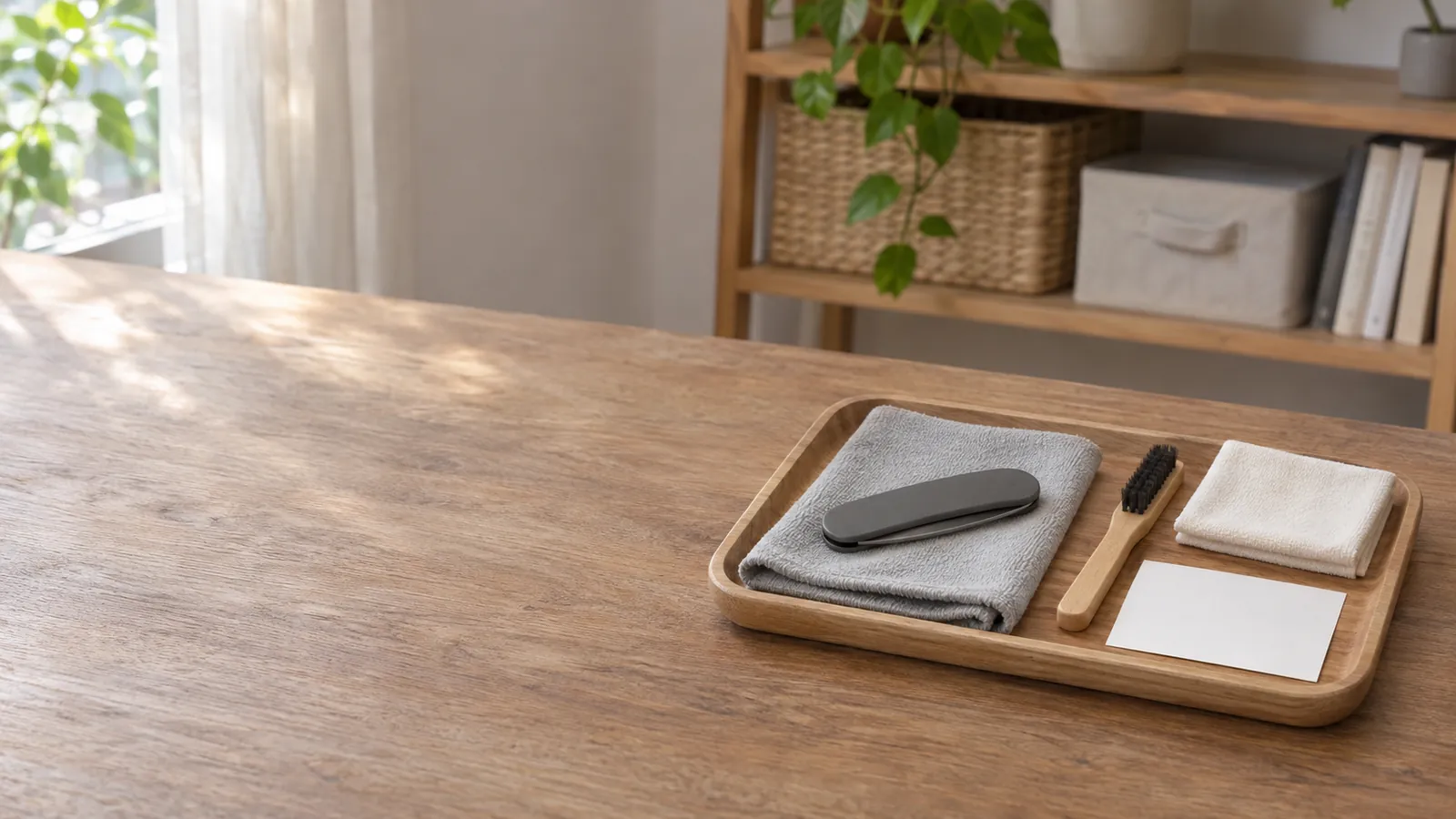
Start with a small tray and two clean, soft cloths. One cloth is for accessible exterior dirt; the other stays clean for the final exterior wipe. This separation makes it easier to see what you have removed instead of immediately spreading it back. Replace a cloth that has collected grit or sticky residue rather than working the same dirty area across the rest of the tool.
A soft brush can help collect loose dirt from an accessible outside surface. Keep its job limited: it is not a probe for reaching a lock, a substitute for disassembly or a way to force debris through a charging opening. Put a brush that has contacted unknown residue aside for cleaning or replacement. Sharing one dirty brush across a collection defeats the purpose of keeping separate cloths.
Use separate room or task lighting so that inspecting the tool does not depend on switching on a light built into its handle. Choose a stable place where the tool and cloths remain visible. Clear away packaging scraps and unrelated tools before starting. A crowded workbench can hide a small part or leave a cutting tool within an unsuspecting person's reach even when no repair was intended.
Keep the model instructions and a short care card with the kit. Record the model, the date, the observed problem and any product already applied. These details become useful if someone else maintains the same tool or if support needs its history. A card reading “sticky patch after opening taped boxes; no cleaner applied” tells more than “needs oil.”
| Kit item | Intended job | Boundary |
|---|---|---|
| Clean soft cloths | Accessible exterior wiping and a separate final wipe | Retire a dirty cloth from the clean side of the task |
| Soft brush | Collect loose exterior debris | Do not force bristles or dirt into mechanisms or ports |
| Small stable tray | Keep the closed tool and care supplies together | Do not turn it into a soaking bath |
| Separate task light | Make ordinary visual inspection easier | Do not inspect by looking into the tool's emitter |
| Model instructions and care card | Preserve permitted methods and treatment history | Instructions for another model do not establish compatibility |
| Specifically approved cleaner or lubricant | The exact application stated for the tool | Leave it out of the kit until that application is established |
Blade, Pivot and Lock Care Are Different Tasks
The blade surface, pivot and locking mechanism belong on the same care checklist, but they answer different questions. Surface appearance concerns what is visible on the blade or handle. Pivot operation concerns movement. Lock engagement concerns whether the blade is secured as intended. A clean-looking blade does not establish the condition of either moving system.
Observe the tool in its normal, safe state before deciding what to clean. Do not repeatedly open and close a questionable knife to demonstrate resistance. Avoid testing the lock with force or improvised loads. If the tool cannot be handled with confidence, stop the care session and describe what happened during normal use. A useful maintenance record does not require reproducing a failure.
For a normally functioning tool, keep exterior work within surfaces you can reach safely under its instructions. Do not wrap a cloth around an edge or put fingers into a closing path to reach a patch of dirt. If reaching a deposit requires holding the mechanism in an uncertain position, the job has exceeded simple exterior care. Set the tool aside for an appropriate service decision.
Manufacturer guidance illustrates why these distinctions matter. Buck's knife-care instructions address cleanliness around moving parts and locking devices, dry storage and lubrication for its knives. Buck also directs owners to send damaged knives for repair. Those are Buck's instructions for its products; they do not authorize its cleaners, oiling schedule or repair methods for a rechargeable OKNIFE combination.
When browsing our Oknife pocket tools, check how the individual model is constructed and powered before building a care routine. Category membership alone does not establish a common washing method. A knife with an integrated light brings charging and storage requirements into the decision alongside ordinary blade and handle care.
Pocket Lint, Tape Residue and Moisture Need Separate Decisions
Loose exterior lint is a collection problem. Remove what is accessible without driving it deeper, then check the place the tool was carried. A pocket full of loose fibers or an unclean storage pouch can return the same visible debris immediately. Cleaning the storage space is often a more useful next task than buying an additional bottle for the tool.
Tape residue is an identification and compatibility problem. Note where the patch is, what packaging it came from and whether it is confined to an accessible exterior surface. Do not assume that a cleaner suitable for a bare metal blade is suitable for the handle finish, switch, printed markings or nearby electronics. More soaking time or stronger rubbing does not resolve uncertainty about the product being applied.
Choose the treatment before opening a chemical container. The tool's instructions must permit the intended method, and the care product's directions must cover the application. If those conditions are unclear, keep the tool out of the affected task and ask support for a specific recommendation. Provide the residue description and location so the question can be answered without guessing what “clean my knife” means.
Moisture calls for attention to the whole product, including its storage and any charging system. Do not place a damp tool straight into a closed kit with the clean cloths and care card. Keep it separate while following the exact drying and service instructions. If liquid has entered an electronic opening, do not treat a dry-looking exterior as evidence that the inside is ready for charging.
A new mark also needs description before treatment. Record its location and appearance without deciding from color alone whether it is removable residue, a finish change or corrosion. Avoid starting with abrasive pads or polishing compounds to see what happens. Removing material can obscure the original condition and may change a surface that was not meant to be polished.
An Exterior-Care Session Without Disassembly
For a tool that is functioning normally and can be handled safely, organize a limited exterior-care session before considering additional treatments. Keep the blade closed for accessible handle work. Stop if the tool's condition makes even that handling uncertain. The following sequence organizes the task; it does not authorize a particular liquid, an internal cleaning procedure or a repair.
- Identify the model and read its care restrictions. For a combination tool, include the lighting and charging instructions in this first check. Move the charging cable away from the work area while caring for the exterior.
- Look over accessible surfaces under separate lighting. Note the location of dirt or residue before touching it. Decide which areas are ordinary exterior surfaces and which involve a mechanism, opening or uncertain condition.
- Use a clean soft cloth for loose exterior dirt. If using a soft brush on an accessible outside area, collect the debris rather than sweeping it toward a gap. Leave inaccessible deposits for a model-specific support decision.
- Reassess the cloth and surface. Switch to a clean cloth if the first has collected debris. If a sticky patch remains, pause to identify a permitted treatment instead of rubbing harder or reaching for an unrelated cleaner.
- Put the tool in the appropriate state for storage according to its instructions. Keep an item with unresolved contamination or abnormal operation separate from tools that are ready for use. Record any further action needed on the care card.
The useful endpoint is a clear decision about the tool, not a requirement to remove every mark in one sitting. A cosmetic patch may need a specific cleaning recommendation. A movement or lock problem needs a service decision. Returning either one to the tray with an accurate note is preferable to obscuring its history with several different products.
| Condition at the end of the session | Status to record | Next action |
|---|---|---|
| Accessible exterior dirt removed; no abnormal operation reported | Routine exterior care completed | Store under the model's instructions |
| Residue remains; an approved treatment is not established | Cleaning question unresolved | Ask about the exact residue, location and proposed product |
| Lock, movement or structure is abnormal | Out of use for service assessment | Preserve the symptom and treatment history |
| Liquid exposure or an electrical fault needs assessment | Combination tool requires model-specific advice | Keep charging separate from the cleaning task |
Pocket Knife Lubricant: Choose the Application Before the Bottle
A pocket knife lubricant is a maintenance product for a specified application. It is not the first response to every stiff, noisy or unreliable tool. Before purchasing one, identify which location is approved for lubrication and whether the product is intended for that location. A recommendation for a blade surface does not automatically cover a pivot, lock, switch or charging port.
Keep three questions separate when reading a label: what the product is intended to do, where it may be applied and what cleanup is required afterward. A cleaner, a lubricant and a protective treatment can have different purposes even when they appear in the same shopping category. Do not transfer directions from one bottle to another because both are described casually as pocket knife oil.
Material names help identify the tool but do not settle compatibility. A listing that names blade steel and handle aluminum does not describe every finish, internal component or electronic part. A broad claim about use on metal therefore cannot replace the model's care directions. For a combination tool, the permitted application must also respect the light and charging system.
Buy the smallest practical quantity for a known, approved job rather than stocking several products in anticipation of an unspecified problem. Keep each product in its original labeled container, with its directions available. An unmarked dropper may be convenient on the bench but makes later identification difficult. Another household member or a support technician should not have to infer what was used from its color or smell.
When instructions authorize lubrication, follow their stated placement, amount and removal of excess. Do not convert an online “one drop” tip into a universal dose. Do not add repeated applications while waiting for an uncertain mechanical symptom to disappear. An unresolved change in movement or lock behavior remains a reason to seek service, even if the tool has been cleaned or treated already.
OKNIFE LK Care Includes Its Rechargeable Light
The Olight OKNIFE LK folding pocket knife with rechargeable flashlight combines a folding blade and lighting in one carry item. Our US listing identifies a Bohler M390 blade, a 6061-T6 aluminum handle, a 2.48-inch blade and USB-C charging. The package includes the battery and pocket clip, a USB-C-to-C cable and the user manual.
That arrangement can suit an adult who wants ordinary package-opening and portable lighting functions in one item. It also means the care routine must account for electronics. If your usual maintenance habit involves washing an entire mechanical folder, do not transfer it to this combination. Decide whether you want that shared care boundary before choosing a combined tool for your everyday tasks.
The LK user manual supplied through our US page expressly prohibits disassembly and immersion in water or other liquids. It also warns against dusty environments because dust entering the switch can cause a functional failure. Do not remove handle parts to reach debris, submerge the tool, flush its openings or use the charging port as an outlet for a cleaning liquid.
The manual lists IPX5, but its separate immersion prohibition still applies. An ingress rating is not an instruction for a cleaning bath or a dishwasher cycle. Keep care decisions tied to the manual's actual handling requirements instead of treating a specification as permission to use any water-based method.
Keep blade condition and light condition separate on the care card. A working light does not verify blade-lock function, and a clean blade does not explain a charging fault. Record which function changed, the circumstances and any visible exterior contamination. This makes the combination easier to discuss with support without trying unrelated treatments across both systems.
Our guide to a knife with a flashlight built in covers that combined-carry choice. Here the relevant tradeoff is maintenance: one item brings two functions together, while each function retains its own operating limits. Owners who prefer separate tools can organize the knife supplies independently from their lighting and charging accessories. Our broader unique everyday carry (EDC) gear for men guide provides carry context; select care supplies for the individual tool rather than treating a carry collection as one washable set.
Charging and Storage Belong in the LK Care Kit
Keep the supplied charging cable with the LK's instructions rather than among unidentified maintenance liquids. The manual specifies USB-C charging and approximately 60 minutes for charging, with a 5 V, 1 A input specification. Those are published figures, not a deadline for deciding that a particular unit is healthy. A changed or abnormal charging condition calls for the model's support guidance.
Charging temperature is a separate check from the room simply feeling comfortable. The manual prohibits charging below 0°C or above 40°C. If the tool has been left in an unsuitable location, do not immediately connect it because the cable is available. Bring the storage and charging arrangement back within the instructions before planning the next session, and seek advice if there is evidence of damage.
Before extended storage, the manual directs owners to charge the product completely. It also requires lockout during carrying or transport. Keep the light's electronic lockout distinct from the blade's mechanical lock: one instruction does not establish the state of the other. Use the LK's own control diagram rather than a button sequence remembered from a different flashlight.
The manual warns against putting a hot light into a fabric bag or a fusible plastic container and against repeated successive Turbo activation. Give the care area a clear place for the tool instead of immediately wrapping a recently operated light in a cloth. A tidy kit should not encourage covering a hot light simply to put everything away quickly.
For ordinary storage, choose a place that keeps the closed tool separate from loose clutter and beyond children's reach, as required by the manual. Keep the care card and charging directions nearby. The most useful storage arrangement lets the next adult owner identify the tool, find its cable and read its restrictions without opening several unmarked containers.
Unreliable Locks and Persistent Resistance Need Service
Take a tool out of use when its lock does not secure normally, its movement has changed in a way that makes handling uncertain, or visible damage is present. Do not treat maintenance as a requirement to restore every tool at home. A damaged or unreliable cutting tool needs an appropriate assessment before it returns to daily carry.
Prepare a concise service note. Include the model, where it was purchased if known, the symptom, when it appeared and the ordinary task underway. Add a clear exterior photograph only if it can be taken safely without manipulating the questionable mechanism. Photographing the closed tool, the affected surface or its packaging may provide enough initial identification.
List everything already applied, including cleaners, oils and unknown products used by a previous owner. Keep the original containers available so support can identify the treatment. State whether liquid exposure, a drop or charging trouble occurred. These observations help define the question; they are not a home diagnosis of a spring, bearing, battery or other internal part.
Ask support what handling, packaging and service route are appropriate before shipping or returning the tool. Do not disassemble it to make the problem easier to photograph or to fit it into a smaller box. For the LK, the no-disassembly instruction applies throughout this process. Leave adjustments to an authorized service decision rather than experimenting with screws or lock parts.
A Care Routine for Packages, Food Tasks and Shared Tools
For a package-opening tool, base the check on what happened during the task. Look for exterior tape residue, scraps left in the carry pocket and a change in normal operation. Keep packaging debris away from the clean side of the kit. Record a persistent adhesive patch before choosing treatment, particularly when it is near a moving part or an electronic opening.
If food preparation is a separate need, choose a tool with a clearly supported food-cleaning routine for that job. Do not move a package-opening knife straight from unknown adhesive or maintenance products to food. A lubricant described as food-grade does not establish that the entire knife, its prior contamination or every applied product is suitable for food contact.
For a shared household tool, agree who maintains it and where the instructions live. Leave a short note when a problem takes it out of use so that someone else does not put it back into a pocket. Keep a tool awaiting service separate from the ready-to-use group. A visible status card avoids making another person discover the same uncertain lock or residue during a task.
For an older knife with an unknown history, start with identification and condition rather than restoration products. Find the model and its applicable instructions, then establish whether it can be handled normally. Unknown previous treatments, missing parts or abnormal locking behavior change the decision. A fresh surface wipe cannot establish the condition of a tool that has not yet been assessed.
There is no need to invent a weekly or monthly chemical-treatment schedule for every user. Use ordinary events as prompts: visible contamination after a task, moisture exposure, a changed function or preparation for storage. Keep any actual manufacturer interval with the model's instructions. Our everyday carry selection can help you choose separate or combined tools; the maintenance routine should then follow the exact items selected.
FAQ
Changelog
- November 5, 2026: Product information and buying guidance reviewed.