Olight makes some of the optics discussed here. Olight specs and prices come from its product pages as of September 2026; footprint, screw and plate details for other brands come from those makers' own manuals and product pages, linked in each section.
⚡ TL;DR
A red dot footprint is the pattern of recoil posts, screw holes and pocket size on the bottom of an optic, and it decides whether that optic bolts straight onto your slide or needs an adapter plate. Before you buy, check three things: the footprint name, the screw thread, and whether the optic's body width fits your slide cut.
This quick table covers the four footprints most pistol buyers run into, with where each one usually shows up.
| Footprint | What locates the optic | Screws | Size class | Where you usually see it |
|---|---|---|---|---|
| RMR | 2 front recoil lugs plus 2 screws (Safariland guide) | 6-32 UNC on the Trijicon Glock plate (Glock) | Compact and full-size pistols | Trijicon RMR and SRO, Holosun 407C and 507C, Osight C, Osight XE AMRS, Osight XR |
| Shield RMSc | 4 round posts, 3.90 mm diameter, plus 2 screws (Shield drawing) | M4 or M3 (Shield drawing) | Slim single-stack pistols | Shield RMSc, SIG Romeo Zero, SIG ROMEO-X Compact, Vortex Defender, Osight K, Osight SE |
| DPP (DeltaPoint Pro) | 4 short posts plus 2 screws (Leupold manual) | M4 (Leupold manual, Glock plate 04) | Larger window, full-size pistols | Leupold DeltaPoint Pro, SIG Romeo-X Pro, Osight SE DPP |
| Glock MOS | A plate system: the slide takes numbered Glock plates, each with its own optic pattern | Plate to slide: M3x6 Torx (Glock) | Gen4 and Gen5 MOS Glocks | Any optic on the right plate; Holosun SCS-M and Osight SE MOS mount direct |
The usual pain point is simple. A product page lists "RMR" or "RMSc" and never explains it, the optic arrives, and the holes don't line up. Then you either send it back or buy a plate you didn't plan for. The sections below give you the numbers makers actually publish, a three-minute way to identify your own slide cut, and the plate and screw details that cause most failed installs.
📋 Table of Contents
- 1. What Is a Red Dot Footprint, and What Does It Decide?
- 2. Red Dot Footprint Comparison: RMR, RMSc, DPP and MOS Side by Side
- 3. RMR vs RMSc: What Is the Difference, and Why Can't You Swap Them?
- 4. Where Did the DPP Footprint Come From, and Which Optics Use It?
- 5. Is MOS a Footprint or a System? Why MOS Glocks Need Plates
- 6. How Do You Check Your Slide's Footprint in Three Minutes?
- 7. Do Adapter Plates Raise the Dot or Break Co-Witness?
- 8. Which Red Dots Use the RMSc Footprint?
- 9. What Footprint Does SIG Red Dot Use?
- 10. What Distance Do You Zero a Red Dot?
- 11. Olight Osight Footprint Chart: SE, SE DPP, SE MOS, XE AMRS and the Adapter Plate
- 12. Common Red Dot Footprint Myths
- 13. Before You Order: A Red Dot Footprint Checklist
- 14. FAQ
What Is a Red Dot Footprint, and What Does It Decide?
A red dot footprint is the mounting interface between the bottom of an optic and the top of a slide or plate. It defines where the recoil posts sit, where the screws go and how big the pocket is. If the optic's footprint matches the slide cut, it mounts directly. If not, you need an adapter plate, and some combinations can't be joined at all.
Safariland's guide to red dot footprints puts the rule plainly: "Both the cutout on the slide and the bottom of the optic must match. If they do not, it will not work unless an adaptor plate is used." The same guide warns that matching hole spacing is only part of the job. "Using an imperial screw in a metric plate (or vice versa) won't just fail to seat properly," it says, because forcing the wrong thread pitch "will cross-thread and strip the hole."
A footprint is really three separate specs that must all agree:
- Location features. Posts or lugs that stop the optic from shifting under recoil. They carry the recoil load, not the screws.
- Screw pattern and thread. Two screws in most pistol footprints, in metric (M3, M4) or imperial (6-32 UNC, 8-32 UNC) threads.
- Pocket size. The length and width of the cut. A small optic can sit in a big pocket on a plate; a big optic can't fit a small pocket.
The table below turns those specs into the checks you can run before you order. Each value comes from the maker document named in the row.
| Spec | Unit | Published values | How to judge whether it fits |
|---|---|---|---|
| Location posts or lugs | Count and diameter | RMSc: 4 posts, 3.90 mm, up to 1 mm high (Shield); DPP: 4 short posts (Leupold); RMR: 2 front lugs (Safariland) | The holes under the optic must drop over every post with no filing |
| Screw thread | Metric or UNC | M3 or M4 (RMSc, Shield); M4 (DPP, Leupold); 6-32 UNC (Trijicon plate, Glock); 8-32 UNC (C-More plate, Glock) | Use the thread the slide or plate is cut for, never "close enough" |
| Screw length | mm past the optic base | Glock MOS-K: no more than 4 mm protruding from the bottom of the optic | Too long can hit parts inside the slide |
| Screw torque | in-lbs | Olight Osight SE: 15 to 17 in-lbs; Shield M4: 17.7 in-lbs; SIG ROMEO-X: 24 in-lbs (M3, P365 slide) or 28 in-lbs (M4, steel slide); Glock plate screws: 13.3 lbf.inch | Follow the optic maker's value and use blue threadlocker |
| Slide width | in | Glock MOS set 01: 1.00 in; set 02: 1.12 in | Pick the plate set that matches your slide width |
| Optic body width | mm or in | RMSc interface: 22.00 mm (Shield); Osight SE: 0.98 in; Holosun 507C X2: 1.15 in; DeltaPoint Pro: 1.31 in | A wide body on a slim slide can overhang the cut |
Red Dot Footprint Comparison: RMR, RMSc, DPP and MOS Side by Side
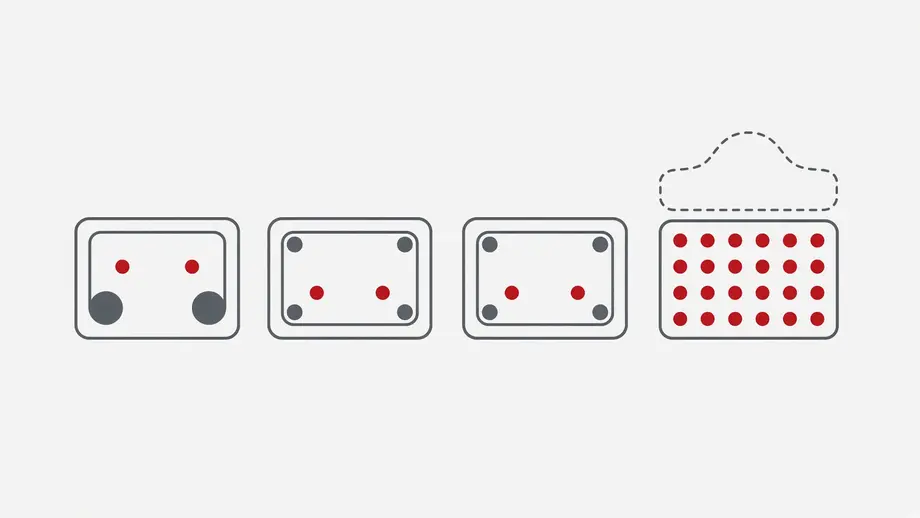
The four footprints differ in how they locate the optic. RMR uses two larger front lugs and two screws. Shield RMSc uses four small round posts and two screws. DPP uses four short corner posts with two screws in front of the rear posts. MOS is not one pattern at all: it is Glock's slide system that takes numbered adapter plates.
Here is what each maker's own paperwork says. Only Shield publishes a full interface drawing inside its user manual; the others describe the pattern in words or in plate charts.
- RMR. Safariland describes it as "two screw holes and two front bolts (recoil lug holes on the optic) in the corners." Glock's MOS instructions list Trijicon on plate 02 with a 6-32 UNC thread, and Holosun ships its RMR-footprint 407C X2 with 6-32 screws in 9.5 mm and 7.4 mm lengths.
- Shield RMSc. The Shield Sights user manual includes the interface drawing: four location posts of 3.90 mm diameter, no more than 1 mm high, on centers 17.00 mm apart across the slide and 33.00 mm apart along it. The drawing lists the RMSc body width as 22.00 mm and allows either M4 or M3 screws.
- DPP. Leupold's DeltaPoint Pro manual says "the four holes in the bottom of the DeltaPoint Pro will align with the four short posts on the mount base," secured with two M4x.7x15.8mm Torx screws.
- MOS. Glock's MOS adapter plate instructions list four plates per set, each numbered for an optic family, and fix every plate with M3x6 Torx screws.
Body size is the easiest way to see why these footprints are not interchangeable. This table compares one optic from each family using the makers' published dimensions.
| Optic (footprint) | Body dimensions, L x W x H | Window | Source |
|---|---|---|---|
| Shield RMSc (RMSc) | 1.6 x 0.9 x 0.89 in (40.8 x 23 x 22.8 mm) | Not listed | Shield product page |
| Olight Osight SE (RMSc) | 1.59 x 0.98 x 0.97 in | 0.83 x 0.55 in | Olight |
| Holosun HS507C-X2 (RMR) | 1.78 x 1.15 x 1.15 in | 0.91 x 0.63 in | Holosun |
| Olight Osight C (RMR, 407c/507c) | 1.77 x 1.18 x 1.18 in | 0.95 x 0.75 in | Olight |
| Olight Osight SE DPP (DPP) | 1.83 x 1.12 x 1.11 in | 0.91 x 0.71 in | Olight user manual |
| Leupold DeltaPoint Pro (DPP) | 1.82 x 1.31 x 1.30 in | 1.01 x 0.68 in | Leupold manual |
The pattern is clear: RMSc optics run about 0.9 to 1.0 inch wide, RMR optics about 1.15 to 1.18 inches, and DPP optics 1.12 to 1.31 inches. That width gap is why an RMR or DPP optic will not sit in a slimline RMSc pocket, even with a plate.
RMR vs RMSc: What Is the Difference, and Why Can't You Swap Them?
RMR and RMSc differ in size, in how they locate the optic, and often in screw thread. RMR is the larger pattern with two front recoil lugs, built for compact and full-size pistols. RMSc is a smaller pattern with four round posts, built for slim single-stack pistols. An RMSc optic can go on an RMR cut with a plate, but an RMR optic will not fit an RMSc cut.
Screw threads are the part people miss. On Glock's plate chart, the Trijicon (RMR) plate is threaded 6-32 UNC. Shield's drawing calls for M4 or M3 screws on the RMSc pattern. Glock's optic mounting page says the standard Slimline MOS cut "fits the Shield RMSc footprint and uses M4 screws," while its MOS-K cut takes "M3 screws provided by optics manufacturers." Three different threads can show up on optics that all get called "small red dots."
There is also a lookalike trap. Holosun calls the footprint on its HS507K-X2 micro red dot the "Holosun K footprint," and ships that optic with both M3x12 and M4x12 screws. Glock says its Slimline MOS-K cut "is modified to accept either Holosun K or RMSc footprints without the need for adapter plates." So K and RMSc overlap on some slides, but they are not the same drawing. Check the optic maker's fit list for your exact slide.
Trijicon's newer RMRcc is a separate footprint. Safariland notes that it "drops the RMR's front recoil-stop sockets entirely" and that "a slide milled for RMR will not accept an RMRcc without an adapter plate."
Where Did the DPP Footprint Come From, and Which Optics Use It?
The DPP footprint is named after the Leupold DeltaPoint Pro. It uses four short corner posts and two M4 screws, and it needs a larger pocket than RMSc because the optic is bigger. Leupold's manual lists the DeltaPoint Pro at 1.82 x 1.31 x 1.30 inches with a 1.01 x 0.68 inch window. Other optics built on DPP include the SIG Romeo-X Pro and Olight's Osight SE DPP.
Safariland's guide describes DPP as "similar to the RMSc footprint, but made for a larger optic, which requires a larger cut-out or 'pocket' area for it to sit in." It lists the Leupold DeltaPoint Pro, the SIG Sauer Romeo-X Pro, the Vortex Defender ST and SL, and the EOTech EFLX CE, which it says fits both DPP and RMR.
On Glock pistols, DPP optics use a dedicated plate. Glock's MOS chart assigns Leupold to plate 04 (M4 thread) in the 1.00-inch set and plate 08 (M4) in the 1.12-inch set. The Gen6 plate set assigns "Leupold, Eotech" to plate 04, also M4.
Leupold's manual gives a torque for its own dovetail base: secure the two screws "by applying 25 in-lbs of torque." It also notes that on a milled slide or Glock MOS, "the mount base & dovetail are not required." Use the torque value from whichever maker supplies the part you are screwing into, and never apply a dovetail-base value to a thin plate by habit.
Is MOS a Footprint or a System? Why MOS Glocks Need Plates
MOS, Glock's Modular Optic System, is a slide system, not a single optic footprint. A MOS slide has its own pattern that accepts numbered Glock adapter plates, and each plate carries a different optic footprint on top. That is why most optics need a plate on a MOS Glock. A few optics, such as the Holosun SCS-M and the Olight Osight SE MOS, are built to mount directly.
Safariland sums it up: "For the most part, you will need an MOS adaptor plate to mount any optic on a Glock handgun." Glock's own page says "certain Gen4 and Gen5 pistol models" use MOS, and that standard MOS models "now come with a single MOS adapter plate" that fits "Trijicon, Ameriglo, and Holosun (except 509)."
This table reproduces Glock's plate markings from the MOS adapter plate instructions. Use it to match your optic family to a plate number and thread.
| Plate | Set 01 (slide width 1.00 in) | Set 02 (slide width 1.12 in) | Thread | Optic families (Glock's wording) |
|---|---|---|---|---|
| Docter pattern | 01 | 05 | M3 | Docter, Meopta, Insight |
| Trijicon (RMR) pattern | 02 | 06 | 6-32 UNC | Trijicon |
| C-More pattern | 03 | 07 | 8-32 UNC | C-More |
| Leupold (DPP) pattern | 04 | 08 | M4 | Leupold |
Glock's same document says the plate screws are "2 units 6 mm / 0,24 inch (M3x6) Torx" with a drop of glue applied, and gives an optimum fit of "1.5 Nm / 13.3 lbf. inch." Notice what is missing from the chart: there is no RMSc plate. RMSc optics go on MOS slides through third-party plates, or on slimline Glocks whose cut is RMSc from the factory.
Glock's newest pistols changed again. Glock's page says "standard frame GLOCK Gen6 pistols come optic-ready with three optic plates that allow various optics to be screwed directly into the slide." Its Gen6 chart lists plate 02 for Trijicon, Holosun (except 509) and Ameriglo at 6-32 UNC, plate 03 for C-More at 8-32 UNC, and plate 04 for Leupold and EOTech at M4. A MOS direct-mount optic is designed for MOS slides, so confirm fit before you put one on a Gen6.
How Do You Check Your Slide's Footprint in Three Minutes?
Start with the paperwork, then look at the slide. Your pistol's box label, manual or maker's page usually names the cut or plate system. If it doesn't, count the posts and screw holes in the cut, measure the pocket width, and compare them with the maker charts in this guide. A cover plate stamped with a number or a MOS-K item code also tells you the answer.
Work through this sequence with the pistol unloaded, magazine out and chamber checked empty.
- Read the label (30 seconds). Glock says you can identify the slimline cut "by checking the item number sticker on the handle of your pistol case": the standard cut shows "MOS" and the MOS-K cut shows "MOSK" near the end of the item number.
- Check the maker's page (30 seconds). Look for words like "RMSc cut," "RMR cut," "MOS" or "optic ready with plates." Write down the exact model and generation.
- Remove the cover plate (60 seconds). Glock's instructions say to field strip the slide and remove the cover plate before fitting anything. Keep the cover plate screws separate; Glock says they are not to be used with the optic.
- Count and measure (60 seconds). Four small round posts on a narrow cut point to RMSc. Two larger lugs at the front of a wider cut point to RMR. A pattern of holes with no posts, meant for a plate, points to a plate system such as MOS. Measure the pocket width with calipers and compare it with the body widths listed above.
Tip: If your count and measurements don't match any chart, stop there. Email the pistol maker with the exact model name and clear photos of the cut, or ask a gunsmith. Shield, for example, says it supplies footprint drawings on request to people getting a slide cut.
Do Adapter Plates Raise the Dot or Break Co-Witness?
Yes, an adapter plate adds height, because it is an extra layer between the slide and the optic. The extra height rarely matters for accuracy once you re-zero, but it can push the dot above your iron sights and break co-witness. It also adds a second set of screws that can loosen. Direct-mount optics avoid both issues where your slide supports them.
The makers say this directly. Shield says that with its "matching low-profile Glock MOS plate, the RMS sits so low that the sight will co-witness without the need for suppressor sights." Holosun says the SCS-M-GR direct MOS sight is built so its "ultra-low deck height allows the optic to co-witness with standard GLOCK iron sights." Leupold notes that "a taller front sight is required when using the Rear Iron Sight" accessory on the DeltaPoint Pro. Safariland adds that "adaptor plates create a weak point for the optic and place a lot of pressure on the screws."
Olight does not list the thickness of its Osight RMR to RMSc Adapter Plate, so measure your own stack with calipers after mounting. To see why a little extra height hardly moves your hits, use the standard sight-geometry approximation: extra height x (1 minus distance divided by zero distance). This table applies it to an illustrative 0.10 inch of extra height. It is a worked example, not a measurement.
| Zero distance | Shot distance | Extra height added | How much lower the hit lands |
|---|---|---|---|
| 10 yards | 3 yards | 0.10 in | About 0.07 in |
| 15 yards | 3 yards | 0.10 in | About 0.08 in |
| 15 yards | 7 yards | 0.10 in | About 0.05 in |
| 25 yards | 7 yards | 0.10 in | About 0.07 in |
Those shifts are smaller than most dots. A 2 MOA dot covers about 0.15 inch at 7 yards. So judge a plate by co-witness and screw security, not by accuracy loss.
Warning: Screw length matters as much as thread. Glock's MOS-K sheet warns that "if the screw protrudes more than 4 mm from the bottom of the optic, it may cause damage to the weapon and/or cause malfunction." When a plate changes your stack height, check screw length again before you torque anything.
Which Red Dots Use the RMSc Footprint?
The RMSc footprint started with Shield Sights' RMSc and is now used by many compact carry optics. Makers and guides list the SIG Romeo Zero, Vortex Defender, Swampfox Sentinel II, Primary Arms Classic 21mm Micro Reflex, JP Enterprises JPoint and Holosun 507K and EPS Carry. Olight's Osight K and Osight SE are also RMSc. Always confirm the exact model, because K-footprint and RMSc optics can differ.
Shield says in its manual that "since 1996, the SHIELD RMSc footprint has remained unchanged." The Safariland guide supplies the list of RMSc optics above and describes the pattern as "two screw holes and four recoil lugs." It also notes that Crimson Trace's CT Rad Micro footprint "is compatible with the Shield RMS footprint."
Here is the part the product pages often blur. Shield warns in the same manual that "some gunsmiths and OEM manufacturers choose to remove or modify" the four round recoil lugs, and it "strongly" advises against it. Holosun describes the 507K X2 as a "K footprint" optic. Glock's MOS-K cut accepts both, but other slides may not. Read the fit list for your specific slide before you trust a "fits RMSc" label.
In Olight's line, the Olight Osight SE is the enclosed RMSc option: Olight lists an RMSc footprint, a 2 MOA Dot & 32 MOA Circle reticle, a CR1620 battery, IPX7 and 0.97 oz (27.5 g). The open-emitter Osight K also lists an RMSc footprint with a 6 MOA dot. Our red dot vs iron sights guide for concealed carry compares both on a slimline carry gun.
What Footprint Does SIG Red Dot Use?
SIG Sauer red dots do not share one footprint, and even one product name can cover several. SIG says its ROMEO-X COMPACT fits Shield RMSc footprints and its ROMEO-X PRO fits DeltaPoint Pro (DPP) footprints, while ROMEO-X SIG-LOC models fit only SIG-LOC optic-ready slides. The Romeo Zero is an RMSc optic. Match the exact optic variant to your slide cut.
SIG's ROMEO-X COMPACT and PRO operator's manual puts it plainly: "The COMPACT model fits all Shield RMS-c footprints and the PRO model fits all Delta Point PRO footprints." The COMPACT ships with M3 and M4 Torx screws and the PRO with M4 screws. SIG lists 24 inch-pounds for the M3x0.5-11.75mm screw, which is for a SIG P365 optic-ready slide only, and 28 inch-pounds for the M4x0.7-9.75mm screw into a steel slide. For an aluminum mount or adapter plate, it points you to the plate maker's value.
SIG-LOC is a different idea. SIG describes the ROMEO-X SIG-LOC PRO as designed exclusively for SIG-LOC PRO optic-ready slides, with a bottom-mount system that creates five points of contact. Safariland's guide explains that SIG-LOC "allows an optic to sit directly on the slide and is secured by screws from underneath the slide," and that "Sig provides adaptor plates so other popular footprints can be used on their handguns." The same guide lists the "Sig Sauer Romeo Zero" under RMSc.
Some SIG pistols need model-specific plates. Olight sells Adapter Plates for Osight X that it lists for the SIG SAUER P320 XFive Legion series, the P226/P229 RX, Pro and AXG Scorpion series, and the P226 XFive Legion series, and it marks some plate versions as sold out. That tells you the same thing SIG owners already know: identify your exact model and slide variant first, then pick the footprint.
What Distance Do You Zero a Red Dot?
There is no single industry zero for a pistol red dot. Common references run from 10 to 25 yards, and the optic makers' own documents show that spread. Olight's step-by-step guide uses 10 yards, Shield calibrates its adjustment dial to a 20-yard zero, and Leupold quotes DeltaPoint Pro adjustments at 25 yards. Choose a distance where you can shoot tight groups, then confirm at longer range.
Olight's guide on how to zero a pistol red dot at 10 yards walks through the process on a short indoor lane. Shield's manual says "all measurements on the dial are based on a 20 yard zero," with "1 Division on the mini dial" equal to "¼ inch at 20 yards." Leupold says its windage and elevation screws move impact "40 MOA (10" @ 25 yds) per revolution of the dial (1 MOA per click)."
Footprint matters here too, because every time you remount an optic or add a plate, you should confirm your zero. This table converts a 1 MOA click (Olight lists 1 MOA per Click on the Osight SE, K and C) into inches at common distances, using 1 MOA of about 1.047 inches at 100 yards.
| Zero distance | One 1 MOA click moves impact | Clicks to move 1 inch |
|---|---|---|
| 10 yards | About 0.10 in | About 10 |
| 15 yards | About 0.16 in | About 6 |
| 20 yards | About 0.21 in | About 5 |
| 25 yards | About 0.26 in | About 4 |
Safety note: Zero only at a range or other place where shooting is legal, with a proper backstop. Check your state and local laws on transport, ranges and carry before you set up a new pistol.
Olight Osight Footprint Chart: SE, SE DPP, SE MOS, XE AMRS and the Adapter Plate
Olight builds its current Osight pistol optics on four mounting patterns: RMSc for the Osight SE and K, RMR for the Osight C, XE AMRS and XR, DPP for the Osight SE DPP, and direct MOS for the Osight SE MOS. The Osight RMR to RMSc Adapter Plate lets an RMSc Osight sit on an RMR-cut slide. Match the model to your slide cut first, then compare features.
This chart lists each model's footprint and key specs as Olight publishes them on its product pages and user manuals, checked on September 24, 2026. The window sizes for the SE MOS and XE AMRS come from their user manuals. The full lineup is on Olight's Osight red dot sights page.
| Model (Olight) | Footprint | Emitter | Battery | Reticle | Window | Price |
|---|---|---|---|---|---|---|
| Osight SE | RMSc | Enclosed | CR1620, side-loading | 2 MOA Dot & 32 MOA Circle | 0.83 x 0.55 in | $219.99 |
| Osight K | RMSc | Open | CR1620, side-loading | 6 MOA Dot | 0.83 × 0.55 in | $169.99 |
| Osight SE DPP | DPP | Enclosed | CR1620, side-loading | 2 MOA Dot & 32 MOA Circle | 0.91" × 0.71" | $239.99 |
| Osight SE MOS | Direct MOS (compatible full-size GLOCK MOS slides) | Enclosed | CR1632, side-loading | 2 MOA Dot & 32 MOA Circle | 0.83 x 0.55 in | $249.99 |
| Osight XE AMRS | RMR (Ruggedized Miniature Reflex) | Enclosed | CR1632, side-loading | 2/6+32 MOA Multi-Reticle System | 0.91 x 0.71 in | $249.99 |
| Osight XR | RMR (Ruggedized Miniature Reflex) | Enclosed | Built-in rechargeable, magnetic charging cover | 2/6 MOA Dot & 32 MOA Circle | 0.91 × 0.71 in | $299.99 |
| Osight C | RMR (407c/507c) | Open | CR1632, side-loading | 3 MOA Dot & 32 MOA Circle | 0.95 × 0.75 in | $199.99 |
| Osight RMR to RMSc Adapter Plate | Converts RMR footprint to RMSc footprint | Not applicable | Not applicable | Not applicable | Not applicable | $19.99 |
For a DPP-cut slide. The hard part with a DPP pocket is finding an enclosed optic that fills it without a plate. The Olight Osight SE DPP enclosed red dot uses the DPP footprint, which Olight says needs "no adapters or modifications," with a 0.91" × 0.71" window. Its user manual lists 1.34 oz (38.0 g) with the battery, an IPX7 rating to 1.0 m, and 1.83 x 1.12 x 1.11 in. The limit: at 1.12 inches wide it is a full-size optic, so it suits DPP-cut duty and competition slides rather than slim carry guns. If your DPP pistol is a Glock with a MOS slide, you would still need plate 04 or 08.
For a full-size Glock MOS slide. A plate adds a layer and a second set of screws. The Olight Osight SE MOS direct-mount red dot removes that layer: Olight describes it as the industry's first enclosed emitter optic with a direct MOS footprint, "eliminating the need for adapter plates on compatible full-size GLOCK® MOS slides." It powers down after 3 minutes of inactivity, and its user manual lists 1.59 oz (45.0 g) with the battery and IPX7 to 1.0 m. The limit is fit: Olight names only compatible full-size GLOCK MOS slides, so it is not for slimline Glocks, and Glock's Gen6 pistols use a different optic-ready system. For any other model, including a Gen6, go by the compatibility list linked from the Osight SE MOS product page. Olight's article inside the Osight SE MOS explains the design.
For an RMR-cut duty or compact pistol. RMR cuts are common on compact and full-size slides, and a dead battery is the big worry on duty. The Olight Osight XE AMRS enclosed RMR red dot uses the RMR footprint and adds what Olight calls a Collapsible Backup Rear Sight (CBRS) for when "the optic is powered off." The limit: an RMR-size optic will not fit an RMSc slimline cut. If you want an open emitter at a lower price, the Osight C is also RMR (407c/507c). If you would rather recharge than swap coin cells, the Osight XR is RMR too, with a built-in rechargeable battery and a magnetic charging cover, at a higher price of $299.99.
For an RMR slide with an RMSc optic. Sometimes you own a small optic and a bigger slide. The Olight Osight RMR to RMSc Adapter Plate "converts RMR footprint to RMSc footprint" and is made from SUS420 stainless steel. Olight lists it as compatible with the Osight SE, Osight S and 407K/507K/EPS Carry. The limit: it adds height and a second screw set, so check co-witness and screw length again.
Common Red Dot Footprint Myths
Most failed installs trace back to one of a few assumptions: that RMSc and K are identical, that any plate works both ways, or that matching hole spacing means the screws fit. Each one has a published fact that corrects it, and the fix usually costs nothing but a few minutes with the maker's manual and a set of calipers.
This table pairs each common myth with the fact and the source it comes from.
| Myth | Fact | Source |
|---|---|---|
| "RMR" means any small red dot | RMR is one footprint with two front recoil lugs; RMSc and DPP are different | Safariland guide |
| RMRcc fits an RMR cut | A slide milled for RMR will not accept an RMRcc without an adapter plate | Safariland guide |
| Holosun K and RMSc are the same | Glock's MOS-K cut is "modified to accept either," which shows they are different patterns | Glock optic mounting page |
| If the holes line up, the screws will hold | Thread pitch must match; imperial in metric (or reverse) will cross-thread and strip | Safariland guide |
| Every Glock MOS optic needs a plate | Most do, but the Holosun SCS-M and Osight SE MOS mount directly to compatible full-size MOS slides | Holosun, Olight |
| MOS is on every new Glock | Glock lists MOS for certain Gen4 and Gen5 models; Gen6 uses a three-plate optic-ready system | Glock optic mounting page |
| Longer screws are stronger | Glock warns against more than 4 mm protruding from the optic base on MOS-K slides | Glock MOS-K sheet |
| A plate converts both ways | The Olight plate converts an RMR cut to an RMSc optic, not the reverse | Olight product page |
Before You Order: A Red Dot Footprint Checklist
Before you order a red dot, confirm the footprint of your exact pistol model and generation, the screw thread and length the optic ships with, and whether you need a plate. Then check that your holster fits the optic. Doing this in order avoids the most common returns: wrong footprint, wrong screws and a plate you didn't plan for.
Use this list with the pistol unloaded:
- Name the cut. Pistol model, generation and cut from the box label or maker page (RMR, RMSc, DPP, MOS, MOS-K, SIG-LOC or Gen6 plates).
- Match the optic. Pick an optic whose maker lists that exact cut, or a plate whose maker lists both your slide and your optic.
- Match the thread. Use the screws for the part they thread into: M3, M4, 6-32 UNC or 8-32 UNC.
- Check screw length. No protrusion past the maker's limit, such as Glock's 4 mm on MOS-K slides.
- Torque and lock. Follow the optic maker's torque value. Olight says to apply non-permanent (medium/blue) threadlocker and torque Osight SE screws to 15-17 in-lbs, and to follow the plate maker's instructions if a plate is required.
- Check co-witness. Look through the window and note whether your iron sights are visible. Taller sights may be needed with a plate.
- Zero and confirm. Zero at your chosen distance, then confirm after the first range session and after any remount.
- Holster last. Buy an optic-cut holster listed for your exact pistol, optic and any mounted light. If you run a weapon light, check fit charts for Olight's PL series weapon lights too.
For step-by-step mounting on Osight models, see Olight's guide on how to mount your Osight.
Safety note: Always confirm the pistol is unloaded, with the magazine removed and the chamber empty, before you remove a cover plate or install an optic. Glock's MOS-K and Gen6 instructions say to fire those pistols only with the cover plate or a correctly installed optic in place.
FAQ
Changelog
- September 22, 2026: First published. Olight specs and prices checked September 24, 2026.