Olight makes the lights and the thermal monocular discussed here. Olight specs and regular prices come from its US product pages and user manuals as of October 2026. Beam widths, aim angles and scan counts are idealized geometry from those ratings, not measurements.
⚡ TL;DR
A good spotlight for backyard checks gives you two beams: a wide flood for the 15 to 40 m inside your fence and a tight spot for the tree line past it. Check from the back step, not the lawn. For most yards that means the dual-beam Olight Marauder Mini 2 ($219.99), with a lighter Seeker 4 Pro for small lots.
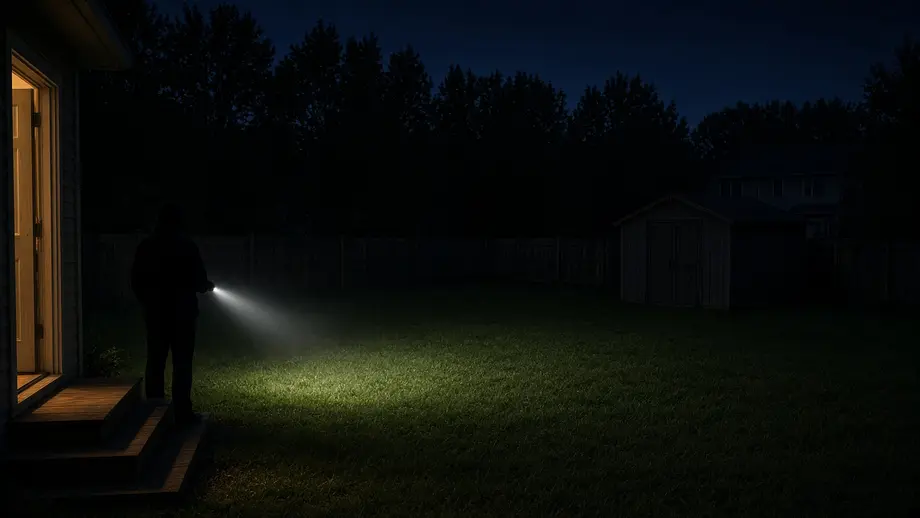
It is 1 a.m., the dog is going off at the back door, and the motion light covers one corner of the yard. Your phone light dies past the patio. Is it a raccoon at the trash, a coyote on the fence line, or a person by the shed? This guide shows which light answers that from the doorway, how to sweep in order, and how to keep the beam out of the neighbor's bedroom.
This gear list matches each backyard job to a light type, the lowest spec worth buying, and the Olight model that fits.
| Use | Recommended type | Key spec minimum | Recommended model (regular price, October 2026) |
|---|---|---|---|
| See the whole yard inside the fence, 15 to 40 m | Wide floodlight, or a dual-beam light on flood | A wide beam with a dimmable 50 to 300 lumen range | Olight Marauder Mini 2, floodlight ($219.99) |
| Pick out the fence line, tree line or shed door, 30 to 100 m | Spotlight beam | High candela; the two picks here list 140,000 and 99,310 cd | Marauder Mini 2 spotlight, or Olight Warrior X 4 ($129.99) |
| A light that lives by the back door | Compact wide-beam light with a wall mount | Holster or bracket, auto lockout, low moon mode | Olight Seeker 4 Pro ($139.99) |
| Check without putting light on anything | Thermal monocular | Own battery, a narrow lens for distance | OSelect TS004 ($499.00) |
| Keep your own eyes adjusted after the check | Red light or very low white | Under 10 lumens | Marauder Mini 2 red light, or Seeker 4 Pro Moon |
📋 Table of Contents
- 1. Quick Answer: What Kind of Spotlight for Backyard Checks Works?
- 2. What Are the Best Spotlights for My Backyard?
- 3. Match the Light to Your Yard Depth: 20 m, 50 m and 100 m Plus
- 4. What Is Better, a Spotlight or a Floodlight?
- 5. A Scan Plan From the Back Step: Order, Stops and Dwell Time
- 6. Aim Low: How Beam Angle Decides Whether You Light the Neighbor's Window
- 7. Spotlight vs Thermal Imaging for a Backyard Check
- 8. What Can I Use to Light Up My Backyard?
- 9. You Found an Animal: What State Wildlife Agencies Say
- 10. If It Is a Person: Stay Behind the Door and Call 911
- 11. Common Mistake: Walking Into the Middle of the Yard With the Light On
- 12. Test Your Own Yard Before the Next Bark
- 13. Backyard Check Checklist
- 14. FAQ
Quick Answer: What Kind of Spotlight for Backyard Checks Works?
A spotlight for backyard checks should light the far edge of your yard and also have a wide beam, because the patio, lawn and shed need width more than reach. Stand in the doorway, flood the near yard first, then spot the fence and tree line. Decide only after you see it whether anyone needs to step outside, and if it is a person, the answer is no.
A spot alone shows a bright disc about 3 m wide at 30 m and leaves the rest dark; a flood alone fades before the back hedge on a deep lot. Olight's Marauder spotlight flashlights put both beams in one body, which is why the Marauder Mini 2 is the main pick here.
Our best spotlight for camping guide also picks the Marauder Mini 2. This guide adds backyard geometry: beam width at your fence, stops per sweep, and where the beam's top edge lands.
What Are the Best Spotlights for My Backyard?
The best spotlights for a backyard are the Olight Marauder Mini 2 for most homes, the Seeker 4 Pro for small lots and a light kept by the door, and the Warrior X 4 for deep rural lots. Add the TS004 thermal monocular to check without lighting the animal or the neighbors.
Olight Marauder Mini 2: best overall spotlight for backyard checks
The Olight Marauder Mini 2 has a floodlight rated at up to 10,000 lumens, a spotlight with a 750 m rated reach, a combined spot and flood mode, red light and a side light. Olight lists 140,000 candela, IPX8, a 7,500 mAh battery and 465 g with battery. On its product page, Olight says the floodlight gives "a wide field of view" with "a range of 270 meters."
The user manual says that when it is off and untouched, "within 10 seconds, the lockout mode will be activated automatically," so it is safe on a shelf. Price: $219.99 (regular price, October 2026); the Roadster edition is $229.99. The MCC cable is not included. The limit: 465 g is heavy, and the full flood is far more than a yard needs.
Olight Seeker 4 Pro: best for small lots and the hook by the door
The Olight Seeker 4 Pro ships with a vertical holster, a holster fixing bracket and screws, and charges by USB-C in the holster. Olight says that "When the flashlight is inserted in the holster, it intelligently lowers the brightness to below 600 lumens." It is rated at 4,600 lumens, 16,895 candela, 260 m and IPX8, at 205 g for most finishes. Moon mode, 5 lumens, runs 15 days. Price: $139.99 (regular price, October 2026). The limit: a wide single beam lights a small yard well but will not separate a coyote from a stump at 80 m.
Olight Warrior X 4: reach for deep rural lots
On a lot that runs 100 m or more to a field or woodlot, the Olight Warrior X 4 puts its 2,600 lumens into a tight beam. Olight lists 99,310 candela and 630 m, says it "balances the spot and spill well," and includes a holster, USB-C and MCC3 charging and a strobe. Price: $129.99 (regular price, October 2026). The limit: it has one beam, so it is the wrong single light for a 20 m yard with a neighbor's house right behind the fence.
OSelect TS004: checking without a beam
The OSelect TS004 thermal monocular shows warm bodies with no light at all. Olight lists a 256 x 192 sensor, a 13 mm lens, IP67 and 330g, at $499.00 (regular price, October 2026). It is one of Olight's thermal imaging cameras. The limit: price, and it cannot see through glass, so you must open the door.
Match the Light to Your Yard Depth: 20 m, 50 m and 100 m Plus
Pick the beam by the depth of your yard. Under 20 m, a wide 50 to 300 lumen flood shows everything and a spotlight is overkill. From 20 to 50 m, you want flood for the lawn plus a spot for the back fence and shed. Past 50 m, and above all past 100 m, a high-candela spot or a thermal monocular is the only way to see the tree line from the step.
This scene table shows how backyard checks change with distance, with the Olight setting that fits each one.
| Sub-scene | Typical distance from the step | Suggested starting level (Olight rating) | Runtime need | Weather need |
|---|---|---|---|---|
| Patio, steps, trash cans | 0 to 10 m | Marauder Mini 2 Floodlight Level 1-1, 50 lm, 83 h; Seeker 4 Pro Low, 50 lm, 60 h | Seconds per check | Marauder Mini 2 and Seeker 4 Pro: IPX8 |
| Lawn, play set, garden beds | 10 to 25 m | Marauder Mini 2 Floodlight Level 1-2, 150 lm, 27 h; Seeker 4 Pro Med, 300 lm, 11 h | Under a minute | IPX8 |
| Back fence, shed, big tree | 25 to 50 m | Marauder Mini 2 Floodlight+Spotlight Level 1-2, 300 lm, 14 h | About a minute | IPX8 |
| Tree line, woodlot edge | 50 to 100 m | Marauder Mini 2 Spotlight Level 2-2, 400~100 lm, 6+4 h | A minute or two | IPX8 |
| Pasture or field past the yard | 100 m plus | Marauder Mini 2 Spotlight 1,350~600~400 lm, 4+170+50 min; Warrior X 4, 99,310 cd; TS004, detection 410m | A few minutes | TS004: IP67 |
What Is Better, a Spotlight or a Floodlight?
For a backyard, a floodlight is better inside 30 m and a spotlight is better past it. Worked from Olight's rated lumens and candela, not measured, the Marauder Mini 2's spotlight packs its light into a circle about 3.3 m across at 30 m, while the Seeker 4 Pro's wide beam spreads over about 18 m. Most yards need both, which is the case for a dual-beam light.
Olight does not publish beam angles for these lights, so this guide works out an equivalent cone from two numbers it does publish. HyperPhysics at Georgia State University explains on its luminous flux page that "The unit lumen is then equal to cd x sr," so lumens equal candela times solid angle. A cone with aperture angle θ covers a solid angle of 2π(1 − cos θ/2), per the LibreTexts angular measure appendix.
The idealized model: assume every rated lumen leaves inside one cone at the rated peak candela. Then lumens ÷ candela is the cone's solid angle, and the half-angle is arccos(1 − lumens ÷ (2π × candela)). A real beam fades from its center outward, so its light always covers more than this cone. Read each result as the narrowest the beam could be, not its true edge.
For the Marauder Mini 2 this needs one assumption. Olight lists a single 140,000 cd peak for the whole light and ties its 750 m reach to the spotlight, but it does not publish candela per level. This guide assumes the 140,000 cd belongs to the top spotlight level, 1,350 lumens. Then 1,350 ÷ (2π × 140,000) = 0.00153, and the half-angle is arccos(0.99847) = 3.17°. For the Warrior X 4, Olight gives 2,600 lumens and 99,310 cd in the same sentence; for the Seeker 4 Pro, the pair is its listed maximums. The beam's width at distance d is 2 × d × tan(half-angle).
This table shows the equivalent beam width at backyard distances. It is an idealized estimate from Olight's ratings, not a measurement.
| Light and beam | Inputs (Olight rating) | Equivalent full angle | Width at 10 m | At 20 m | At 30 m | At 40 m |
|---|---|---|---|---|---|---|
| Marauder Mini 2 spotlight | 1,350 lm, 140,000 cd (pairing assumed) | 6.3° | 1.1 m | 2.2 m | 3.3 m | 4.4 m |
| Warrior X 4 | 2,600 lm, 99,310 cd | 10.5° | 1.8 m | 3.7 m | 5.5 m | 7.3 m |
| Seeker 4 Pro | 4,600 lm, 16,895 cd | 33.9° | 6.1 m | 12.2 m | 18.3 m | 24.3 m |
Real spill reaches wider than every figure here. Olight publishes no floodlight candela, so the flood is not worked out. At 20 m the spot's equivalent beam is about 2.2 m wide: enough for a raccoon on the fence rail, not the coyote 5 m to its left. Find movement with flood, then look with the spot.
A Scan Plan From the Back Step: Order, Stops and Dwell Time
Scan in a fixed order from the doorway: near yard on flood, then the back fence in overlapping spot stops, then each side fence, then up into trees and roofs. With a narrow spot, a 25 m wide back fence 30 m away takes at least 8 stops; with a wide beam, 2.
From a step centered on the back of the house, a fence 25 m wide and 30 m away spans 2 × arctan(12.5 ÷ 30) = 45.2° of your view. Divide that by each beam's equivalent full angle and round up. That is a minimum with edge-to-edge stops; overlap adds one or two.
This table turns the idealized widths into a scan plan for one example yard.
| Light | Equivalent full angle | Stops to cross a 45.2° back fence | Time at 2 seconds per stop |
|---|---|---|---|
| Marauder Mini 2 spotlight | 6.3° | 45.2 ÷ 6.35 = 7.1, so 8 | About 16 seconds |
| Warrior X 4 | 10.5° | 45.2 ÷ 10.46 = 4.3, so 5 | About 10 seconds |
| Seeker 4 Pro | 33.9° | 45.2 ÷ 33.86 = 1.3, so 2 | About 4 seconds |
The 2-second pause is a starting pace; slow down where the dog was looking. Use this order:
- Before you open the door, turn off the porch light behind you and your phone screen.
- Flood the near yard at 50 to 150 lumens: patio, trash cans, under the deck steps.
- Spot the back fence left to right in overlapping stops, then the shed door and the gap under it.
- Spot each side fence, starting at the house corners, where animals squeeze through.
- Lift the beam to trees, the shed roof and the fence rail, where raccoons and cats sit.
- Drop to red light or moon mode and listen for a minute.
Where you hold the light matters too: our guide to how to find a lost pet at night explains why eye level catches eyeshine.
Aim Low: How Beam Angle Decides Whether You Light the Neighbor's Window
Aim the beam center at the base of what you want to see, not at its middle. Aimed at the base of a fence 30 m away, a narrow spot's equivalent beam tops out near the height of a 6-ft privacy fence. A wide beam aimed the same way sends its top edge about 9 m up at the fence line, into second-floor windows. These figures assume a 1.5 m light height and Olight's ratings.
Hold the light 1.5 m up and aim at the base of a target d meters away: you tilt down by arctan(1.5 ÷ d). The top edge sits at the half-angle minus that tilt; if positive, it climbs as it travels.
This table shows where the top edge of each equivalent cone ends up on flat ground, aimed at a shed 15 m away or a back fence 30 m away. It is idealized geometry, not a measurement.
| Aim point | Light | Tilt down | Top edge vs horizontal | Top edge height at 30 m | Top edge height at 45 m (a house past the fence) |
|---|---|---|---|---|---|
| Shed base, 15 m | Marauder Mini 2 spotlight | 5.71° | 2.54° down | 0.2 m | Hits the lawn at about 34 m |
| Shed base, 15 m | Warrior X 4 | 5.71° | 0.48° down | 1.3 m | 1.1 m |
| Shed base, 15 m | Seeker 4 Pro | 5.71° | 11.22° up | 7.5 m | 10.4 m |
| Fence base, 30 m | Marauder Mini 2 spotlight | 2.86° | 0.31° up | 1.7 m | 1.8 m |
| Fence base, 30 m | Warrior X 4 | 2.86° | 2.37° up | 2.7 m | 3.4 m |
| Fence base, 30 m | Seeker 4 Pro | 2.86° | 14.07° up | 9.0 m | 12.8 m |
A 6-ft privacy fence is 1.83 m tall. The Marauder Mini 2's equivalent cone tops out at 1.7 m there, while the Warrior X 4's clears the fence by about 0.9 m and the Seeker 4 Pro's by far more. Every top edge here is a lower bound: real spill reaches higher, so some light from any of these beams will cross the fence. Tip the light farther down, use the lowest level that works, and switch off between looks.
DarkSky and the Illuminating Engineering Society give the same advice for fixed outdoor lights. Their Five Principles for Responsible Outdoor Lighting say to "Use shielding and careful aiming to target the direction of the light beam so that it points downward and does not spill beyond where it is needed," and to "Use the lowest light level required." DarkSky defines light trespass as "light falling where it is not intended or needed."
Local codes turn that into limits. This table shows how two adopted local codes treat light that crosses a property line. Both are written mainly for installed lighting, so check your own city or county code before assuming how it applies.
| Source | Status | What it says | What it means for a yard check |
|---|---|---|---|
| Bayside, Texas, Ordinance #94, Sec. 42-102(b) | Town lighting nuisance ordinance, adopted December 9, 2014 | "The post-curfew luminance level measured on the property line at eye height on a plane perpendicular to the line of sight shall be no greater than one lux." Curfew in residential areas is 10:30 p.m. | A late-night beam held on a neighbor's wall is the kind of light such limits measure |
| Baltimore, Maryland, City Code Art. 32, § 15-505(b)(1) | Zoning code rule for exterior lighting on private property | "No exterior lighting may glare into, or upon, the surrounding area or any residential premises." The light level "may not be greater than one-half footcandle at a residential property line." | Glare onto a neighbor's home is the problem codes name; keep the beam inside your own line |
Warning: Never hold a spotlight on a person, a window or a passing car. The Marauder Mini 2 user manual carries the caution "Do not stare at operating light source."
Spotlight vs Thermal Imaging for a Backyard Check
A spotlight shows you what something is once it is in the beam; a thermal monocular shows you where every warm body is without lighting anything. Olight rates the TS004 to detect at 410m and identify at 91m, deeper than most yards. Use thermal to find, then a low white beam to confirm if needed.
This table compares the two tools on the three questions that matter at the back door.
| Question | Spotlight (Marauder Mini 2 or Warrior X 4) | Thermal monocular (TS004) |
|---|---|---|
| How far can it find something? | Rated beam distance 750 m or 630 m, not how far you can name an animal | Detection distance 410m (Olight rating) |
| Can it tell you what it is? | Yes, in color and detail, once the beam is on it | Shape, size and gait; Olight lists identification at 91m |
| Does it disturb the animal or neighbors? | Yes, it lights the animal and anything behind it | No beam; the TS004's built-in LED flashlight stays off unless you switch it on |
| Through window glass? | Yes, with glare off the pane | No: the TS004 manual answers "No" for objects "underwater, through glass or through a wall" |
Telling a raccoon from a fox by its heat shape is its own skill, covered in our guide to the thermal imaging camera for wildlife.
Note: The TS004 manual also says, "Do not point the thermal monocular at the sun or other strong energy sources for a long period of time." Keep it out of your own spotlight beam and away from the porch light.
What Can I Use to Light Up My Backyard?
To light up a backyard you can use two kinds of light: fixed, shielded, motion-activated fixtures that cover the doors and paths every night, and a handheld spotlight for the moments something is out there. A handheld light lets you look where the fixtures do not reach, so most homes need both.
For fixtures, DarkSky's principles say: "Use controls such as timers or motion detectors to ensure that light is available when it is needed, dimmed when possible, and turned off when not needed."
On the handheld side, the best spotlight for home use is the one you can reach in the dark, such as a Seeker 4 Pro in its wall-mounted holster by the back door. For a spotlight for house, boat or farm use, see our rechargeable spotlight guide; for what each extra dollar buys in reach, see our rechargeable spotlight price comparison.
You Found an Animal: What State Wildlife Agencies Say
If the beam finds a raccoon, coyote or other animal, do not walk out to it, do not feed it, and keep the dog inside. The two state agencies quoted below give the same short list: do not approach, remove food, and watch pets in the yard. Lower the beam and let the animal leave.
The Nebraska Game and Parks Commission's coyote guidance for pet owners notes, "Most interactions that people experience with coyotes are interactions between coyotes and dogs due to the territorial nature of both animals."
This table turns those texts, plus the Indiana Department of Natural Resources raccoon page, into backyard steps.
| What the beam shows | Agency text | Your move |
|---|---|---|
| A coyote on or near the fence line | Nebraska: "Do not approach or feed a coyote or other wildlife." | Stay on the step, keep the dog inside, lower the beam and let it leave |
| A coyote that does not leave | Nebraska: "In the rare instance that a coyote acts aggressively, get inside a building or vehicle, if possible." | Go inside; Nebraska asks residents to report a coyote "showing no fear of humans" to Game and Parks |
| A raccoon at the trash or feeder | Indiana DNR: "Keep bird feeders and garbage cans inside at night. Don't leave pet food outside." | Note what it was eating and remove it tomorrow |
If It Is a Person: Stay Behind the Door and Call 911
If the beam shows a person in your yard, step back inside, lock the door and call 911 from a safe spot. Do not go out to confront them, do not follow them past the fence, and do not stand in the open holding the light on them. Police crime-prevention guides say to stay safe and report.
The Wake Forest, North Carolina Police Department's page on reporting suspicious activity says that if you think you are seeing a crime in progress, "please call the police emergency number," and adds: "Avoid taking any risks. Your safety is most important." The Pleasanton, California Police Department's suspicious activity guide lists an "Unknown person going into back or side yard of a house" as "Almost always suspicious," and names "abnormally barking dogs" among the unusual noises worth a call.
Give the dispatcher the location, what is happening, any weapons and who is involved, as the Pleasanton guide lists: "Please don't exaggerate. Be factual and honest."
Safety note: A light shows you where something is, and shows them where you are. Keep a way back inside within one step.
Common Mistake: Walking Into the Middle of the Yard With the Light On
The most common mistake is carrying the spotlight out to the middle of the lawn. Out there you are lit up, with dark ground on every side, and the dog may follow you to whatever is by the fence. The doorway gives you a wall at your back, a lock within reach and the whole yard in view. Two related mistakes:
- Turbo first. A full-power beam glares off fences, siding and the shed roof. Start on flood at 50 to 150 lumens.
- Holding the beam on the animal. Once you know what it is, drop the beam to the ground in front of it so it can leave.
Long scans on cold nights are covered in our best rechargeable spotlight for hunting guide.
Test Your Own Yard Before the Next Bark
You can check this geometry in your own yard in about 20 minutes, on a clear evening, so you are not guessing at 1 a.m. The tests below are a plan for you to run, not measurements made for this guide; write down what worked.
- Pace the yard in daylight. Note the distance from the step to the patio, shed, back fence and tree line.
- Find your beam width. Stand 10 m from a garage door and turn the light on. Measure the bright circle's width W. Your half-angle is arctan(W ÷ 20). A 2.0 m circle at 10 m gives arctan(0.1) = 5.7°.
- Find your light height. Measure from the lawn to the light as you hold it on the step, then work out the tilt to your fence base as in the aim table.
- Check the top edge. At dusk, aim at the fence base and have a helper say whether light spills over it.
- Set your levels. Note the lowest flood and spot settings that show the patio and the fence rail.
Tip: Practice the unlock with your eyes shut. On the Marauder Mini 2, rotate the button more than 60°; on the Seeker 4 Pro, the manual says "Rotate the switch more than 90° in any direction within 1 second to unlock."
Backyard Check Checklist
For most yards, a spotlight for backyard checks means a Marauder Mini 2 on the shelf by the back door; a Seeker 4 Pro in its wall holster suits small lots, and a TS004 suits checks made with no light at all. Then follow these steps.
- Keep the dog inside. Nebraska Game and Parks says to keep pets close "even if just letting it out into the yard for a few minutes."
- Switch off the porch light and your phone screen, and stay in the doorway.
- Flood the near yard at 50 to 150 lumens, then spot the back fence in overlapping stops, then the side fences, then trees and roofs.
- Aim at the base of what you are checking, never at windows or faces.
- Animal: lower the beam and let it leave. Do not approach or feed it. Remove trash and pet food in the morning.
- Person: step back inside, lock up and call 911. Do not confront or follow.
- Put the light back on its hook or holster, locked and charging.
FAQ
Changelog
- October 1, 2026: First published.