Olight makes the portable lights discussed here. Olight specs and regular prices come from its US product pages and user manuals as of October 2026. All light levels, lumens, glare geometry and costs below are calculations from published sources, not measurements.
⚡ TL;DR
The best lumens for garage lighting depend on the zone: about 10 foot-candles on a parking bay and about 50 on a workbench. In a 20 × 20 ft two-car garage, that works out to roughly 10,400 fixture lumens for the bays plus 6,900 for bench lights hung at 7 ft, about a third of lighting the whole room to bench level.
Shop by total lumens alone and you buy the biggest 10,000 or 15,000 lumen panel and hang it mid-ceiling. The parking area turns harsh, the car roof throws light back into your eyes, and the bench still sits in your shadow. This guide gives each zone its own target and shows the math.
This table compares the best lumens for garage lighting in the parking bay and the workbench zone, using the targets and lumen math below.
| Dimension | Parking bay | Workbench zone | Which needs more | How much more |
|---|---|---|---|---|
| Light level target | About 10 fc (108 lux), IES parking-lane figure via Elite | About 50 fc (538 lux), IES fine bench work starts here | Workbench | 5 times the light level |
| Fixture lumens, 20 × 20 ft two-car garage | About 10,400 lm across the ceiling | About 6,900 lm extra, fixtures hung at 7 ft | Bays | 1.5 times the lumens of the bench |
| Main problem to design out | Mirror glare off hoods and roofs | Your own shadow on the work | Different problems | Layout fixes both, lumens fix neither |
| Color needs | Basic white light | CRI 90 helps with paint, wire and fluid colors | Workbench | California's JA8 bar is CRI 90 |
| Portable light role | Under-car and wheel-well checks | Spot fill on the part in your hands | Workbench | A clip light adds 118 to 381 lux to a spot |
📋 Table of Contents
- 1. Quick Answer: What Are the Best Lumens for Garage Lighting by Zone?
- 2. Which Light Levels Fit a Parking Bay and a Workbench?
- 3. How Does the Lumen Method Turn Foot-Candles Into Fixture Lumens?
- 4. Single, Double and Triple Garage: How Many Lumens for Each Zone?
- 5. How Much Light Does a Workbench Need, and Where Should It Come From?
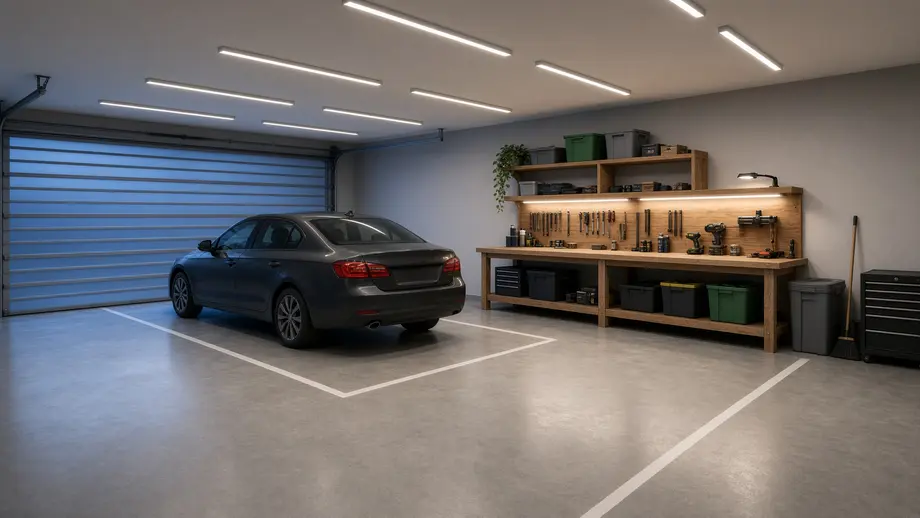
- 6. Where Should Garage Lights Go? Spacing, Height and the Lane Over the Car
- 7. Is 10,000 Lumens Too Bright for a Garage?
- 8. Is 4000 Lumens Bright Enough for a Garage?
- 9. Is Cool White or Daylight Better for a Garage?
- 10. What Does Garage Lighting Cost to Run?
- 11. Best Work Light for Garage Jobs: Why You Still Need a Portable Light
- 12. What Changes in a Cold Garage?
- 13. How Can You Check Your Garage Light Levels Yourself?
- 14. Which Garage Lighting Plan Fits How You Use Your Garage?
- 15. FAQ
Quick Answer: What Are the Best Lumens for Garage Lighting by Zone?
The best lumens for garage lighting are two numbers, not one. For parking, aim for about 10 foot-candles at the floor, which takes roughly 8,000 fixture lumens in a 12 × 22 ft single garage and 10,400 in a 20 × 20 ft double. For the bench, add fixtures over it to reach about 50 foot-candles. Spread both across several fixtures instead of one big panel.
Those figures come from the lumen method, shown below with inputs you can swap for your own. Portable lights fill a different gap: a few hundred lux on the part you hold. Olight's range of flashlights includes headlamps and magnetic clip lights for that job. They supplement overhead lighting; they do not replace it.
Which Light Levels Fit a Parking Bay and a Workbench?
A parking bay needs about 10 foot-candles (fc), and a workbench needs 30 to 100 fc depending on the detail. Elite Lighting's summary of IES recommendations lists 5 fc for vehicle storage, 10 fc for parking-garage traffic lanes, 10 to 20 fc for service garages, and 50 to 100 fc for repair areas and fine bench work. One foot-candle equals about 10.76 lux.
The IES handbook itself is sold, not posted, so both tables here are secondhand summaries. Elite Lighting's IES footcandle recommendations sheet opens: "The following footcandle ranges represent the Illuminating Engineering Society’s (IES) current illuminance (light level) recommendations." It names no handbook edition. The Canadian Centre for Occupational Health and Safety (CCOHS) publishes a lux table in its lighting survey guide, citing the IESNA Lighting Handbook, 9th edition (2000), among its sources.
This table lines up the garage-relevant rows from both sources and the target this guide uses for each zone.
| Garage activity | Elite / IES summary | CCOHS (cites IESNA 9th ed.) | Target used here |
|---|---|---|---|
| Storing a car, walking to the door | Storage: 5 fc | Inactive storage: 50 to 100 lux | Floor of storage corners: 5 fc |
| Parking and loading | Parking-garage traffic lanes: 10 fc; service garage: 10 to 20 fc | Parking lots: 20 to 50 lux | Parking bay: 10 fc (108 lux) |
| Rough bench work, sawing, gluing | Rough sawing and bench work: 20 to 50 fc | Benchwork: 200 to 500 lux | Bench minimum: 30 fc |
| Car repair, fine bench work | Repair area: 50 to 100 fc; fine bench work: 50 to 100 fc | Vehicle repair shops: 500 to 1,000 lux | Bench design: 50 fc (538 lux) |
| Fine finishing, small parts | Machine-shop fine bench: 200 to 500 fc | Difficult inspections: 1,000 to 2,000 lux | Add a task light to the spot |
A bench needs five times the light of a parking bay, which is the whole argument for zoning. Elite's sheet flags its highest bench levels with a note: "Obtained with a combination of general light plus specialized supplementary lighting." That is the layered plan used here.
How Does the Lumen Method Turn Foot-Candles Into Fixture Lumens?
The lumen method says average foot-candles equal fixture lumens times the coefficient of utilization (CU) times the light loss factor (LLF), divided by the area in square feet. Rearranged, fixture lumens equal target fc times area divided by CU times LLF.
CU, the share that reaches the work plane. CU comes from a fixture's photometric report and depends on room shape and surface reflectance. This guide uses the report for a 4-ft LED strip from Cooper Lighting Solutions, Metalux 4SLES-1-T8-2G-B835-U: 1,813 lumens, an 80 CRI 3500K tube, 151.1 lumens per watt. Its CU table runs from 1.05 in a huge, open room to 0.33 in a narrow, deep one at 50% ceiling, 50% wall and 20% floor reflectance.
Room shape enters through the room cavity ratio: RCR = 5 × fixture height above the work plane × (length + width) ÷ (length × width). For a 20 × 20 ft garage with fixtures on a 9-ft ceiling and the floor as the work plane, RCR = 5 × 9 × 40 ÷ 400 = 4.5, so CU sits halfway between 0.58 (RCR 4) and 0.52 (RCR 5): 0.55.
LLF, the allowance for aging. The Pacific Northwest National Laboratory's report on LED light loss factors explains, "In essence, a LLF is a multiplier that is used to predict future performance (maintained illuminance) based on the initial properties of a lighting system." For lamp lumen depreciation (LLD), one part of LLF, the 2013 report says "the IES recommends using an LLD of not greater than 0.70 for LEDs" when light quantity matters, and argues the cap is conservative for good products. This guide uses 0.70 as the whole LLF and ignores dirt, which a dusty garage adds on top.
So the double garage at 10 fc needs 10 × 400 ÷ (0.55 × 0.70) = 10,390 fixture lumens.
Note: These CU values belong to one bare strip fixture. A lensed wraparound, high bay or deformable bulb spreads light differently, so use its own photometric report if published.
Single, Double and Triple Garage: How Many Lumens for Each Zone?
At 10 fc, a 12 × 22 ft single garage needs about 8,000 fixture lumens, a 20 × 20 ft double about 10,400, and a 30 × 22 ft triple about 15,200. Small garages need more lumens per square foot, 30.4 against 23.0, because more of their light lands on walls. Painting walls and ceiling white cuts every figure by roughly a quarter.
This table applies the lumen method to three example garages with a 9-ft ceiling, based on the Cooper CU table (interpolated, rounded to two decimals) and an LLF of 0.70, not measured. The white-paint column uses the table's 80% ceiling, 70% wall column.
| Garage (example size) | RCR at the floor | CU (50/50/20) | Lumens for 10 fc | Lumens for 20 fc | Lumens for 10 fc, white paint (CU) | Lumens for 50 fc everywhere |
|---|---|---|---|---|---|---|
| Single, 12 × 22 ft (264 sq ft) | 5 × 9 × 34 ÷ 264 = 5.80 | 0.47 | 10 × 264 ÷ (0.47 × 0.70) = 8,024 | 16,049 | 5,714 (0.66) | 40,122 |
| Double, 20 × 20 ft (400 sq ft) | 5 × 9 × 40 ÷ 400 = 4.50 | 0.55 | 10,390 | 20,779 | 7,722 (0.74) | 51,948 |
| Triple, 30 × 22 ft (660 sq ft) | 5 × 9 × 52 ÷ 660 = 3.55 | 0.62 | 15,207 | 30,415 | 11,786 (0.80) | 76,037 |
The last column is the warning: 50 fc everywhere in a double takes about 52,000 lumens.
The workbench zone: why hanging height matters
Treat a 10-ft bench and the 6 ft of floor in front of it as a small room of 60 sq ft, with the bench top 3 ft up. With strips on the 9-ft ceiling, the fixture sits 6 ft above the work plane, RCR = 5 × 6 × 16 ÷ 60 = 8.0, and CU drops to 0.38. Hang the strips on chains at 7 ft and RCR falls to 5.33, CU rises to 0.50.
The bays already put about 10 fc on the bench, so the bench fixtures must add 40 fc. From the ceiling, that takes 40 × 60 ÷ (0.38 × 0.70) = 9,023 lumens. From 7 ft, it takes 40 × 60 ÷ (0.50 × 0.70) = 6,857 lumens, 24% less for the same result. This zone math is an approximation, because a bench usually has a real wall on one side only.
How Much Light Does a Workbench Need, and Where Should It Come From?
Plan about 50 foot-candles (538 lux) on a general workbench, from fixtures over the front edge of the bench, not behind you. Fine work such as reading small part numbers or sorting wire colors needs 1,000 lux or more on a small spot, and a portable light at short range is the cheap way to get it.
CCOHS notes that "adequate general lighting is usually between 500 and 1000 lux when measured 76 cm (30 inches) above the floor," close to the 50 fc bench target. It also warns that "workers sitting with their backs to windows, with light fixtures directly overhead or to the rear, cast shadows on their own work surfaces."
Run bench strips along the front edge of the bench. At 7 ft, a pair of 3,500-lumen strips covers the 6,900 lumens.
For the spot itself, a point-source estimate works: illuminance in lux equals candela divided by distance in meters squared. Olight's product page rates the Oclip Ultra floodlight at 505 candela at its 530-lumen top output only, so the figures assume candela scales with lumens. They are based on Olight's ratings, not measured.
This table shows what the Oclip Ultra floodlight adds to a spot on the bench.
| Light and mode (Olight rating) | Estimated candela | Distance to the part | Added light on the spot |
|---|---|---|---|
| Oclip Ultra floodlight, Medium 100 lm (3.5 hours) | 505 × 100 ÷ 530 = 95.3 cd | 0.9 m, clipped to a shelf above the bench | 95.3 ÷ 0.81 = 118 lux |
| Oclip Ultra floodlight, Medium 100 lm | 95.3 cd | 0.5 m, stuck to a steel bench leg or vise | 95.3 ÷ 0.25 = 381 lux |
| Oclip Ultra floodlight, High 300 lm (first 10 minutes) | 505 × 300 ÷ 530 = 285.8 cd | 0.9 m | 285.8 ÷ 0.81 = 353 lux |
Moving the clip light from 0.9 m to 0.5 m on Medium adds more light than tripling the output at 0.9 m, and it keeps the 3.5-hour runtime instead of a High mode that steps down from 300 to 180 lumens after 10 minutes. With the 538-lux bench design, the close Medium setting brings that spot to about 919 lux. For more on the unit math, see our lumens to lux chart.
Where Should Garage Lights Go? Spacing, Height and the Lane Over the Car
Space ceiling fixtures no farther apart than their spacing criterion times their height above the work plane, keep each wall gap to about half that spacing as a rule of thumb, and put a row over the space where you stand, not over the middle of the car.
Spacing criterion. The Cooper strip's report lists "Spacing Criteria (0/90/45): 1.23 / 1.35 / 1.44," meaning across the strip, along it, and diagonally. Multiply by the mounting height above the plane you care about:
- Parking bays, judged at the floor from a 9-ft ceiling: 1.23 × 9 = 11.1 ft across, 1.35 × 9 = 12.2 ft along.
- Bench strips hung 4 ft above the bench top: 1.23 × 4 = 4.9 ft across, 1.35 × 4 = 5.4 ft along.
For the 20 × 20 ft double garage, a 2 × 2 grid at 10 ft on center, 5 ft from each wall, stays inside both limits. Each of the four fixtures then needs about 10,390 ÷ 4 = 2,600 lumens. With the 1,813-lumen Cooper strip, four strips give 4 × 1,813 × 0.55 × 0.70 ÷ 400 = 7.0 fc, short of 10, so you would use six in two rows of three: 10.5 fc.
Mirror glare off the hood. HyperPhysics at Georgia State University states the law of reflection: "A light ray incident upon a reflective surface will be reflected at an angle equal to the incident angle." A waxed hood acts like a tilted mirror, so you see a fixture's reflection wherever the geometry lines up.
Here is a worked example with assumed dimensions, not measurements: eyes 5.5 ft up, a flat hood 3.5 ft up and 5 ft wide, you standing at its center line, fixtures at 9 ft. The reflection point sits at 2 ÷ (2 + 5.5) = 0.267 of the horizontal distance from your eyes to the fixture. If the hood spans 1.5 to 5.5 ft in front of your eyes, any fixture between 1.5 ÷ 0.267 = 5.6 ft and 5.5 ÷ 0.267 = 20.6 ft ahead of you, and within about 9.4 ft to either side, mirrors in the hood.
You can still choose which fixtures sit in that band. A panel over the middle of the car, 8 to 10 ft from you at the bumper, lands right in it. A row over the aisle where you stand, less than 5.6 ft ahead, reflects onto the bumper or floor instead.
Tip: Curved hoods shift the numbers, so use the CCOHS check: "Place a small mirror face up on the work surface. If the mirror reflects light from above, the light fixture is responsible for glare." Lay it on the hood where you work most and move or diffuse whichever fixture you see.
One fixture over the lane fails both tests: it sits in the glare band, and its 10-ft wall gaps leave dim corners. For aiming portable lights around a hood, see our engine bay light guide.
Is 10,000 Lumens Too Bright for a Garage?
No, 10,000 lumens is not too much in total for a 20 × 20 ft two-car garage. By the lumen method it delivers about 9.6 foot-candles (104 lux), right at the parking target. It is too much in one fixture. A single 10,000-lumen source creates a bright spot, mirror glare on every hood in front of it and dim corners.
The math, from the Cooper CU table and an LLF of 0.70: 10,000 × 0.55 × 0.70 ÷ 400 = 9.6 fc. The same lumens give 10,000 × 0.47 × 0.70 ÷ 264 = 12.5 fc in a 12 × 22 ft single and 6.6 fc in a 30 × 22 ft triple.
CCOHS lists "Using several small low-intensity light fixtures rather than one large high-intensity light fixture" as its first fix for glare, and notes that "light fixtures that are too widely spaced or wrongly positioned can create shadows." Split the same lumens across four to six fixtures: same average, less glare.
Is 4000 Lumens Bright Enough for a Garage?
Usually not for parking and working. In a 12 × 22 ft single garage, 4,000 fixture lumens give about 5.0 foot-candles, the IES storage level. In a 20 × 20 ft double they give 3.9 fc, below it. That is enough to walk to the car, but too dim to load, sweep or find a dropped socket comfortably.
The math, from the Cooper CU table and LLF 0.70, not measured: 4,000 × 0.47 × 0.70 ÷ 264 = 5.0 fc (54 lux) in the single, 4,000 × 0.55 × 0.70 ÷ 400 = 3.9 fc (41 lux) in the double and 4,000 × 0.62 × 0.70 ÷ 660 = 2.6 fc (28 lux) in the triple.
Is Cool White or Daylight Better for a Garage?
Neither is brighter. Color temperature, in kelvin, describes how warm or cool white light looks, not how much light there is, so pick it for comfort. At a bench where you match paint, read wire colors or check fluids, color rendering (CRI) matters more than kelvin, and a published bar exists for it.
The California Energy Commission's 2019 residential lighting summary lists the JA8-2019 requirements that many home light sources had to meet under section 150.0(k) of the 2019 Energy Code: a color rendering index of 90 or more, a correlated color temperature of 4000K or less, R9 above 50 and at least 45 lumens per watt. That edition covered California building permits from January 1, 2020, and newer editions have replaced it, so check the current code before a California remodel. Elsewhere, CRI 90 with R9 above 50 is simply a useful filter for bench fixtures.
Olight's portable lights sit at the cool end. The Perun 3 product page lists a "High Performance Cool White LED (5,700~6,700K)," and the Oclip Ultra floodlight is listed at 5,700 to 6,500K. Both user manuals list CRI 70, well under that bar, so judge final paint color under your bench lights or daylight, not under a headlamp.
What Does Garage Lighting Cost to Run?
About $15 a year for a zoned two-car garage. At 151.1 lumens per watt, the zoned two-car layout (10,390 lumens for the bays plus 6,857 for the bench) draws about 114 W. Run 2 hours a day at the August 2026 US average residential price of 18.16 cents per kWh, that is $15.13 a year.
The price comes from the U.S. Energy Information Administration's Electric Power Monthly Table 5.6.A, where 2026 values are preliminary; substitute your state's figure.
This table compares three layouts for the 20 × 20 ft double garage, based on the lumen figures above, the Cooper strip's 151.1 lm/W and 2 hours a day (730 hours a year), not measured. The last column uses California's 45 lm/W JA8 floor as a low-efficacy case.
| Layout | Fixture lumens | Watts at 151.1 lm/W | kWh a year | Cost a year at 18.16¢ | Cost a year at 45 lm/W |
|---|---|---|---|---|---|
| Parking bays at 10 fc | 10,390 | 10,390 ÷ 151.1 = 68.8 W | 68.8 × 730 ÷ 1,000 = 50.2 | $9.12 | $30.61 |
| Bench fixtures at 7 ft, +40 fc | 6,857 | 45.4 W | 33.1 | $6.02 | $20.20 |
| Zoned total | 17,247 | 114.1 W | 83.3 | $15.13 | $50.81 |
| Whole garage at 50 fc | 51,948 | 343.8 W | 251.0 | $45.58 | $153.04 |
Zoning cuts the running cost to about a third. Efficacy matters as much: the same zoned plan at 45 lm/W costs more than the 50 fc layout at 151.1 lm/W.
The same 2019 California summary lists a garage control rule: for "Bathrooms, garages, laundry rooms, and utility rooms," it says "At least one luminaire must be controlled by an occupant or vacancy sensor providing automatic-off functionality."
Best Work Light for Garage Jobs: Why You Still Need a Portable Light
The best work light for garage jobs is a portable one that goes where ceiling light cannot: under a car, inside a wheel well or behind an engine. A headlamp follows your eyes, and a magnetic clip light sticks next to the part. Neither replaces the ceiling layout; each covers one spot for a few hours.
Olight Perun 3: under the car and into the wheel well
The Olight Perun 3 headlamp ($89.99, regular price, October 2026, every listed color) aims wherever you look on a creeper. Olight rates it at 3,000 lumens, IP68 and 150 g, with Med at 120 lumens for 25 hours and Low at 30 lumens for 89 hours.
Limits: it lights the spot you face, not the room, so it backs up the ceiling layout rather than replacing it. Use Low or Med at the bench, not Turbo, and heed the manual's caution, "Do not stare at operating light source."
Olight Oclip Ultra: a light on the part
The Olight Oclip Ultra ($49.99, regular price, October 2026, Olive Green) has a 530-lumen floodlight rated at 505 candela plus spot and UV modes. Olight lists a clip, a hanging loop and "a powerful N52 neodymium magnet," at 55 g. Floodlight Medium gives 100 lumens for 3.5 hours.
Limits: it is rated IPX6, and the manual says, "Do not immerse the product in water or other liquid as it will damage the product," so keep it off a wet floor drain. It also warns against leaving it "in a car where the temperature inside may exceed 60°C."
Olight Oclip 2 Pro: the aimable clip light
The Olight Oclip 2 Pro ($49.99, regular price, October 2026, Black or Orange; Premium kit with a 1,000 mAh charging dock from $74.99) fits when the light must aim down from a hood edge or shelf. Olight says it "pairs a 115° head tilt with 360° clip rotation," grips objects "up to 14 mm thick," and that "Tail and clip magnets turn it into a magnetic work light." Its floodlight Medium gives 100 lumens: the product page lists 3 hours 45 minutes and the user manual at 3 h 30 min; plan on the shorter figure. It is rated IP66 with 2.0 m drop resistance at 75.5 g.
Limits: Olight does not publish the floodlight's candela, so the lux table leaves it out, and the manual says, "Do not immerse the product in water or other liquids, as it will damage the product."
Safety note: If you clip either Oclip to a shirt pocket or chest strap while you work, follow both manuals: "If you have an ICD or pacemaker, avoid close or prolonged contact with this product to prevent possible interference." The Oclip 2 manual also warns, "Do not obstruct the lens, or else the energy emitted from the light may cause the object to burn," so do not leave it face-down on a fender cover or rag.
What Changes in a Cold Garage?
Cold does not change the lumen math for the ceiling, but it limits battery lights. The Oclip 2 manual states, "In environments below 0°C (32°F), the white light is limited to Low and Medium modes," and "The product cannot be charged in environments below 0°C or above 45°C." Plan winter bench work around Medium, which is the right bench setting anyway.
The Oclip Ultra manual sets the same limit below 0°C and adds, "In 0°C to 10°C conditions, the white light Turbo will be unavailable." Keep portable lights indoors between jobs. Our cob work light guide covers cold-garage runtimes, and our work light stand guide covers lighting away from the bench.
How Can You Check Your Garage Light Levels Yourself?
Use a light meter or phone lux app to read three points per parking bay at the floor and three along the bench top, overhead lights on, portable lights off. Average the bay readings and the bench readings separately, then compare each with its target. This guide has not run that check in any garage.
This table is a self-check plan; the readings are yours to take.
| Point | Where to put the sensor | Height | What to record | Compare with |
|---|---|---|---|---|
| Bay A front, middle, rear | Center line of the first bay, 3 ft from each end and at mid-depth | Floor, sensor facing up | Three lux readings | Average about 108 lux (10 fc) |
| Bay B front, middle, rear | Same in the second bay | Floor | Three lux readings | Same |
| Darkest corner | Corner farthest from any fixture | Floor | One lux reading | At least 54 lux (5 fc) storage level |
| Bench left, center, right | 1 ft in from the front edge of the bench | Bench top | Three lux readings | Average about 538 lux (50 fc) |
| Task spot | Where your hands work, portable light on Medium | Bench top | One lux reading | 1,000 lux or more for fine work |
Uncalibrated phone apps can be far off, so compare your own points with each other rather than with the targets alone.
Which Garage Lighting Plan Fits How You Use Your Garage?
To settle the best lumens for garage lighting in your own space, match the plan to what you do most. Park-only garages need the bay layout alone. Weekend wrenching adds the bench zone and one portable light. Detailing and fine woodwork add CRI 90 fixtures and closer task light. Spend on layout and efficacy before raw lumens.
This table pairs each type of user with a plan for the 20 × 20 ft double garage.
| If you mostly | Plan the bays for | Add over the bench | Portable light | Watch out for |
|---|---|---|---|---|
| Park and store | 10 fc, about 10,400 lm in 4 to 6 fixtures | Nothing extra | A headlamp for the breaker panel and storage bins | One big center panel |
| Do oil changes and brake jobs | 10 fc | About 6,900 lm hung at 7 ft | Perun 3 for under the car | Fixtures over the car's middle |
| Do woodwork or small repairs | 10 fc | 6,900 lm, CRI 90 | Oclip 2 Pro or Oclip Ultra at 0.5 m | Bench lights behind your head |
| Detail or paint | 20 fc, about 20,800 lm | 50 fc or more, CRI 90, R9 above 50 | Clip light for inspection angles | Cool-looking light mistaken for accurate color |
Warning: Ceiling fixtures run on household wiring. Follow the fixture's installation instructions and your local electrical code, and turn off the circuit at the breaker before you work on it.
FAQ
Changelog
- October 1, 2026: First published.