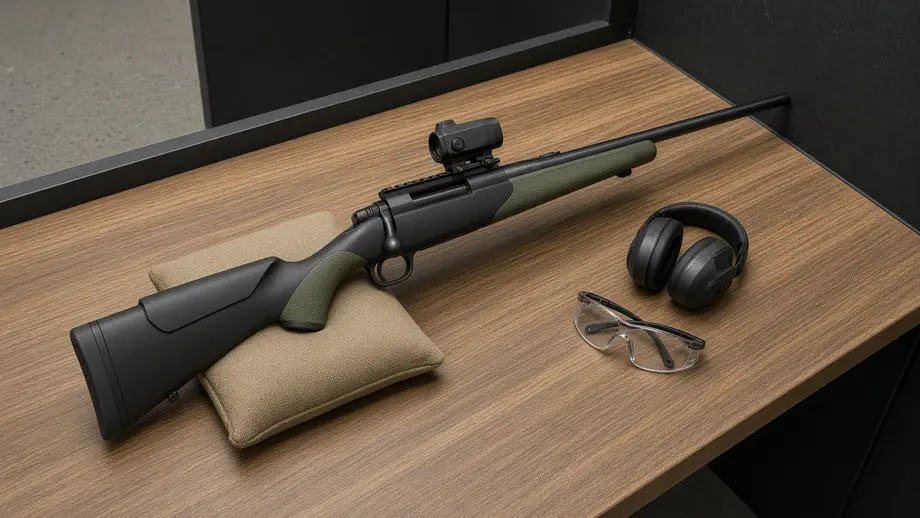
Olight makes three of the red dot sights discussed here. Olight specs and prices come from its US product pages and user manuals as of September 2026; other makers' specs come from their own sites. Nothing here replaces a certified instructor, your range's posted rules or your state's law.
⚡ TL;DR
A red dot sight for kids works because a young shooter only has to put one dot on the target instead of lining up two sights and a bull's-eye. Pair it with a light youth .22, a mount made for that sight, a 3 to 6 MOA dot, batteries stored where younger kids can't reach them, and an adult at the child's shoulder for every shot.
This red dot sight for kids equipment list sets the minimum spec for each part of a youth setup.
| Job | What to use | Minimum spec | Olight example |
|---|---|---|---|
| Aiming device | Open reflex sight, 1x | Parallax free, unlimited eye relief, 1 MOA per click | Osight 3 MOA (green dot) |
| Dot | Single dot, or dot inside a circle | 3 to 6 MOA dot; a 32 MOA circle helps a child find it | Osight C (3 MOA dot + 32 MOA circle) |
| Power | Built-in rechargeable cell, or a coin cell behind a screw | Auto-off within 10 minutes and a low-battery warning; batteries stored away from children | Osight 3 MOA (built-in 170 mAh cell) |
| Mount | Picatinny adapter listed for that sight | Screws torqued to the maker's spec | Rail Mount Adapter for Osight / Osight X |
| Rifle | Single-shot or bolt-action youth .22 | Length of pull that fits the child | Non-Olight item |
| Protection | Shooting glasses and hearing protection | Worn by the shooter and every spectator | Non-Olight item |
| Supervision | One adult beside each young shooter | Adult controls all ammunition | Not a product |
📋 Table of Contents
- 1. Is a Red Dot Sight Good for Kids?
- 2. What Are the Legal Age Rules for Youth Shooting?
- 3. Why Are Iron Sights Hard for Kids?
- 4. Dot Size, Brightness, and Batteries: Settings for a Young Shooter
- 5. Which Is Better, a Red or Green Dot Sight?
- 6. How Do You Mount a Red Dot on a Youth .22?
- 7. What Safety Rules Should Kids Follow on the Range?
- 8. Best Red Dot for Kids: Olight Options Compared
- 9. What Is the Best Red Dot Sight for Under $100?
- 10. What Is a Good Cheap Red Dot Sight?
- 11. Red Dot Sight for Kids: Your Range-Day Action Checklist
- 12. FAQ
Is a Red Dot Sight Good for Kids?
Yes. For most beginners, a red dot sight makes aiming simpler: the child keeps focus on the target and places one lit dot on it. Olight lists each Osight model in this guide as parallax free with unlimited eye relief, so the dot stays usable when a small head shifts on the stock. The sight only helps inside a supervised routine run by a certified instructor or a trained parent.
A red dot often comes up after a frustrating first session. The child can't hold the front post in the rear notch, the target blurs, and the groups wander across the paper. A dot removes the alignment step, so the first lessons can focus on the habits that matter more: muzzle direction, trigger finger discipline, breathing and follow-through.
Is a red dot good for a .22 LR rifle? For target practice at rimfire distances, yes. A .22 barely recoils, so a child can watch the dot through the shot and see exactly where it was when the rifle fired. That feedback is hard to get from iron sights, where a beginner is still fighting the sight picture when the shot breaks.
What a red dot won't fix: a jerked trigger, a canted rifle or a flinch. It also changes how some youth matches classify the rifle. Mississippi State University Extension's 4-H Shooting Sports District Event Handbook places reflex and holographic electro-optics in the Telescopic class for .22 rifle, separate from Open and Aperture sights. Check your state's 4-H rulebook before you mount an optic on a match rifle.
If you're shopping, start with open red dot sights that have a 3 MOA or larger dot, auto-off and no loose coin cells to manage. Leave laser aiming devices off a child's rifle; none of the sights in this guide has a laser.
What Are the Legal Age Rules for Youth Shooting?
No single national minimum age governs a child shooting a rifle at a range. Federal law, 18 U.S.C. 922, bars anyone under 18 from knowingly possessing a handgun, with exceptions such as target practice with a parent's prior written consent. Rifles are left mostly to state law, and states differ sharply, so read your own state's statute before the first range trip. Whatever the law allows, this guide assumes an adult stands beside the child for every shot.
The federal handgun exception has conditions. The juvenile must carry the parent's prior written consent at all times while holding the handgun, and the activity must follow state and local law. The same section also bars licensed dealers from selling any firearm to a person under 18, so the rifle a child shoots is normally bought, owned and stored by a parent.
State rules then add the detail. Two examples show how far they differ. Florida Statute 790.22 lets a minor under 16 take part in marksmanship practice only when supervised by an adult acting with a parent's consent. California Penal Code 29610 says that since July 1, 2023, "a minor shall not possess any firearm," and Section 29615 then lists exceptions, including competitive shooting with a parent or legal guardian present. Some of those exceptions reach older teens with written consent; the safer family rule is still an adult on the line with every minor.
Youth programs set their own floors. National 4-H Shooting Sports says local clubs are open to all youth ages 8 to 18. Scouting America's range FAQ says Cub Scouts of any rank may not shoot .22-caliber rifles in resident camps, day camps or unit activities.
This table turns the legal and program rules into what a parent should actually do. It summarizes statute text as of September 2026 and is not legal advice.
| Rule layer | Source | What it says | What you do |
|---|---|---|---|
| Federal handguns | 18 U.S.C. 922(x) | Under 18 may not knowingly possess a handgun; target practice exception needs prior written parental consent, carried at all times | Keep young kids on rifles; if a teen shoots a handgun, write and pack the consent and stay beside them |
| Federal sales | 18 U.S.C. 922(b)(1) | Licensed dealers may not sell any firearm to anyone under 18 | A parent buys, owns and locks up the youth rifle |
| State example | Florida 790.22(1) and (3) | Under 16: BB and air guns, and marksmanship practice with firearms, need adult supervision with parental consent | Apply the same adult-at-the-shoulder routine to air rifles |
| State example | California PC 29610 and 29615 | Minors may not possess any firearm unless an exception applies, such as a parent present at a lawful recreational sport | Attend in person, or send a responsible adult with written consent |
| Youth program | National 4-H Shooting Sports | Local clubs are open to youth ages 8 to 18 | Join a club for certified instruction and range access |
| Youth program | Scouting America | Cub Scouts of any rank may not shoot .22 rifles in camps or unit activities | Match the activity to the program's age chart |
| Range | Posted range rules and range officer | Local rules can be stricter than the law | Read the rules before you unpack the rifle |
State wildlife agencies set the rules for youth hunting and run hunter education. Texas Parks and Wildlife, for example, says on its hunter education page that the minimum age for certification is 9 years. A hunter education course is a strong next step for a child who has learned the basics at the range, and it teaches the same muzzle and trigger rules.
Note: Laws change and local ordinances add rules. Read your state's current statute, check your state wildlife agency's hunter education and youth hunting rules if a hunt is part of the plan, and ask the range for its minimum-age policy.
Why Are Iron Sights Hard for Kids?
Iron sights ask a child to line up three things at three distances: the rear notch or peep, the front post and the target. A young eye has to shift focus between them while the rifle wobbles, so beginners chase a blurry picture and lose patience. A red dot collapses that job into one step: put the dot on the target and press the trigger.
Kids also have shorter arms, less upper-body strength and less patience for slow sight alignment. A heavy rifle held off a bench sways more, and every sway breaks the sight picture a child just built. The dot doesn't stop the sway, but it shows the sway honestly, which helps a coach teach a steadier hold.
This table compares the most common beginner problems with each sight type, as a coaching framework rather than a rule.
| Beginner problem | With iron sights | With a red dot |
|---|---|---|
| Sight alignment | Front post must sit centered in the notch or peep | No alignment; place the dot on the target |
| Focus | Eye shifts between post and target | Focus stays on the target |
| Head position | A small shift moves the sight picture | Unlimited eye relief and parallax-free design keep the dot usable |
| Seeing the shot | Hard to tell where the sights were when it fired | The dot shows where the rifle pointed as the shot broke |
| Trigger jerk and flinch | Still happens | Still happens, but it's easier to see |
| Batteries | None needed | Needs charge or a working cell |
Iron sights still earn a place. They never need a battery, and some youth matches run separate open and aperture classes. A sensible sequence is a red dot for early confidence, then iron sight practice once the child groups well.
Dot Size, Brightness, and Batteries: Settings for a Young Shooter
Start a child with a 3 MOA dot, or a 6 MOA dot if they struggle to find it, and set brightness just high enough that the dot looks crisp against the target. Choose a sight that turns itself off and warns before the battery dies. If it uses a coin cell, treat both the spare and the used cell as a poison hazard around younger brothers and sisters.
MOA stands for minute of angle, 1/60 of a degree. One MOA covers about 1.047 inches at 100 yards, so it scales down in a straight line at shorter distances. That simple math tells you how much target a dot covers and how far one click moves the bullet.
This table shows how much a dot or circle covers at common youth distances, calculated from 1 MOA = 1.047 inches at 100 yards.
| Distance | One 1 MOA click | 3 MOA dot | 6 MOA dot | 32 MOA circle |
|---|---|---|---|---|
| 50 feet (16.7 yd) | 0.17 in | 0.52 in | 1.05 in | 5.6 in |
| 25 yards | 0.26 in | 0.79 in | 1.57 in | 8.4 in |
| 50 yards | 0.52 in | 1.57 in | 3.14 in | 16.8 in |
Read it like this: at 25 yards, a 3 MOA dot covers less than an inch, which suits a standard bull. A 6 MOA dot covers about 1.6 inches, easier to find but harder to center on a small bull. At 25 yards each click moves impact only about a quarter inch, so a 1-inch correction takes about four clicks.
Brightness settings that work for kids
The Olight Osight 3 MOA has 12 brightness levels in Manual Mode. Its user manual says levels 1 and 2 are night vision settings and levels 3 to 12 are daylight settings. Night vision levels look too dim for a daylight range, so skip them. An Auto Sensing Mode sets brightness from a light sensor.
For kids, the more useful setting is Lockout Mode. The manual says it disables all button operations except shutdown and switching to Auto Sensing Mode. Set brightness yourself, lock it, and curious fingers can't dial the dot to a smear between strings.
A practical starting point: outdoors on a sunny afternoon, begin near the top daylight levels; at a dim indoor rimfire range, drop several steps. If the dot looks fuzzy or bigger than the bull, lower it one step at a time until the edge looks sharp.
Battery math for a range day
Olight's manual lists the Osight's built-in battery as 170 mAh, with a current draw for each brightness level. Its runtime figures match capacity divided by current. The green-dot version at level 12 draws 395.3 microamps, which gives 170 ÷ 0.3953 = 430 hours, about 17.9 days of continuous use.
This table uses Olight's manual figures to show what a real range day costs the battery.
| Osight 3 MOA (green) setting | Current draw | Rated runtime | Battery used by a 4-hour range day |
|---|---|---|---|
| Level 12 (brightest) | 395.3 µA | 430.1 h | 1.58 mAh, about 0.9% |
| Level 8 | 15.1 µA | 11,258.3 h | 0.06 mAh, under 0.1% |
| Level 3 (dimmest daylight) | 3.5 µA | 48,571.4 h | 0.01 mAh |
Battery capacity isn't what fails on a youth range day. Forgetting to turn the sight off is. The Osight turns off after 10 minutes without motion, and the Osight C and Osight K turn off after 3 minutes, so a sight left in the truck overnight still works next weekend.
Warning: The Osight C runs on a CR1632 coin cell and the Osight K on a CR1620. Olight's Osight C manual warns that a swallowed button cell or coin battery "can cause Internal Chemical Burns in as little as 2 hours." The National Capital Poison Center says more than 3,500 people in the US swallow button batteries each year. The rechargeable Osight's manual carries the same instruction to keep new and used batteries away from children, and both manuals say that if the battery compartment does not close securely, stop using the product and keep it away from children. Tape used cells, lock spares in the range bag, and call the National Battery Ingestion Hotline at 1-800-498-8666 right away if you suspect a swallowed battery.
Which Is Better, a Red or Green Dot Sight?
Neither color wins for every child. Green often looks brighter in daylight because the human eye is most sensitive near 555 nm, and Olight's green dots sit at 520 to 525 nm, while its red dots sit at 650 to 660 nm. Red can suit a dim indoor range. Let the child look through both, because red-green color vision deficiency is common in boys.
The eye's daylight sensitivity curve explains why. Georgia State University's HyperPhysics luminous efficacy table gives relative daylight (photopic) sensitivity values of 1.000 at 555 nm, 0.710 at 520 nm, 0.107 at 650 nm and 0.061 at 660 nm.
This table applies those values to the wavelengths Olight lists for its dots.
| Olight optic | Green dot | Red dot | Eye sensitivity, green | Eye sensitivity, red | Green vs red, same light power |
|---|---|---|---|---|---|
| Osight 3 MOA | 525 nm | 650 nm | about 0.79 (between 520 and 530 nm) | 0.107 | about 7.3 times |
| Osight C | 520 nm | 660 nm | 0.710 | 0.061 | about 11.6 times |
| Osight K | 520 nm | Not offered | 0.710 | Not applicable | Not applicable |
That ratio compares equal light power, not the sights as sold. Makers tune each color's brightness levels separately, so a red dot on its top setting can still look bright. The math simply explains why green holds up well against a sunlit target.
The battery myth doesn't hold as a rule either. In Olight's Osight manual, the green version draws 395.3 microamps at level 12 against 333 microamps for red, so red runs longer at the top setting: 510.5 hours versus 430.1. Yet Olight rates the green Osight C at 130,000 hours and the red at 100,000 hours in Mode 3 with the dot only. Check the runtime for the exact model.
Color vision matters more for kids than most parents expect. The National Eye Institute says about 1 in 12 men have color vision deficiency, that most people with it are born with it, and that children may try to hide it. One type, protanomaly, makes certain shades of red look less bright. A child who says the red dot "looks dim" may be describing exactly that.
Astigmatism can also make a dot look like a comma, a starburst or a smear. The National Eye Institute describes astigmatism as a common eye problem that can make vision blurry or distorted, and says only an eye exam can confirm it. A quick check: rotate the rifle slightly. If the smear turns with the optic, clean the lens; if it stays put, book an eye exam. For Olight's own take on green dot optics, see its Osight GN series post.
How Do You Mount a Red Dot on a Youth .22?
Most youth .22 rifles need a Picatinny or Weaver rail before a red dot will fit, then a mount made for the sight's footprint. The Osight and Osight C use the RMR footprint, also called 407c/507c; the Osight K uses RMSc, a compact pistol-slide pattern. Torque every screw to Olight's figure, then fit the child's head position before you zero.
Footprint is the screw and recoil-boss pattern on the bottom of a sight. A mount built for one footprint won't fit another without an adapter plate. Our guide to red dot footprints compares RMR, RMSc, DPP and MOS in detail.
Follow these steps to mount a dot on a youth rifle:
- Unload the rifle, open the action and insert a chamber flag. Keep ammunition in another room.
- Confirm the rifle has a rail or a receiver drilled and tapped for a base. Many youth rifles ship with iron sights only; Savage lists its Rascal youth .22 as "Scope Mounted and Sighted: No."
- Choose a mount the sight maker lists as compatible. Olight's Osight Picatinny rail mount adapter says it is only suitable for the Osight and Osight X.
- Torque the screws to spec. Olight lists 17 in-lbs per screw for the Osight 3 MOA, and 15 in-lbs for M3 or 4-40 screws on the Osight C.
- Set fore-aft position with the child in a normal hold. With unlimited eye relief, place the sight where the child sees the whole window with a relaxed cheek on the stock.
- Draw witness marks across the screw heads and mount with a paint pen, so anyone can spot a loose screw at a glance.
Olight's post on how to mount your Osight covers its own mounting hardware.
Why close shots hit low: height over bore
A red dot sits above the barrel, so the bullet starts below the line of sight and rises to meet it at the zero distance. Inside that distance, shots land low. Kids notice this first at close targets and assume the sight is broken.
This table estimates the gap for a 25-yard zero. It assumes the dot sits 1.5 inches above the bore centerline and the bullet travels a steady 1,200 feet per second with no air drag, so treat it as an approximation and measure your own rifle.
| Target distance | Gravity drop from the bore line | Impact vs the dot |
|---|---|---|
| 5 yards | 0.03 in | about 1.1 in low |
| 10 yards | 0.12 in | about 0.7 in low |
| 15 yards | 0.27 in | about 0.4 in low |
| 25 yards (zero) | 0.75 in | on the dot |
The practical fix: shoot close-range games at the zero distance, or teach the child to hold the dot about an inch high at 5 yards. Olight's Osight adjusters move 1 MOA per click. At 25 yards, a group centered 1.5 inches low and 1 inch left needs about six clicks up and four clicks right, turned in the directions marked on the sight. For the full zeroing sequence, see how to zero a red dot.
What Safety Rules Should Kids Follow on the Range?
Every youth range day runs on a few habits: muzzle in a safe direction, finger off the trigger until on target, the rifle unloaded until the line is hot, and eye and ear protection on everyone. These come from the NSSF and NRA safety rules. 4-H events add single loading, chamber flags and adult control of all ammunition.
The NSSF's 10 rules of firearms safety start with "Always Keep the Muzzle Pointed in a Safe Direction." Rule 7 reads "Always Wear Eye and Ear Protection When Shooting." The NRA gun safety rules add "ALWAYS Keep Your Finger Off The Trigger Until Ready To Shoot." NSSF also reminds owners: "It is your responsibility to prevent children and unauthorized adults from gaining access to firearms or ammunition."
Youth programs make those rules concrete. The Mississippi State 4-H handbook requires a breech safety flag in every firearm and single loading unless the range officer says otherwise. It also requires eye and ear protection on the firing line and an adult accompanying each individual at the line. It also sets a minimum of one adult per five youths at a contest.
This table sets red dot and supervision choices for the most common youth range scenarios.
| Scenario | Typical distance | Dot and brightness | Power and weather | Adult coverage |
|---|---|---|---|---|
| Indoor rimfire range | 50 feet to 25 yards | 3 MOA dot, lower daylight levels | Charge before leaving; rain isn't a factor | One adult beside each child on the line |
| Outdoor bench, sunny day | 25 to 50 yards | Green dot or 32 MOA circle, upper daylight levels | IPX6-rated Osight models handle rain; carry the charging cover or a spare cell | One adult per child; adult holds the ammo |
| 4-H club practice or match | Set by the program | Check whether an optic moves the child into a scope class | Charged the night before | Certified instructor plus the program's adult ratio |
| Supervised youth hunt | Short, known distances | Auto Sensing Mode for changing light | Check the sight's rated working temperature before a cold dawn | An adult beside the child, plus whatever your state wildlife agency's youth hunting and hunter education rules require |
A supervised range-day routine
- At home: store the rifle and ammunition locked and apart. Charge the sight and check the battery indicator.
- At the car: transport the rifle unloaded and cased, with a chamber flag in.
- At the line: the adult opens the case, confirms the chamber is empty and hands over one round at a time.
- Before each string: eye and ear protection on, muzzle downrange, finger off the trigger until the dot is on the target.
- At cease-fire: action open, flag in, step back from the line. Nobody touches a firearm while people are downrange.
- Before leaving: turn the sight off, cap it, and count every loose battery.
- After shooting: wash hands and face before eating. The California Department of Public Health notes that volunteers and customers can be exposed to lead while visiting shooting ranges.
Safety note: Stay within arm's reach of the rifle every time a child shoots, not just in the first few sessions. A dot makes aiming easier, and it can also make a child less careful about where the muzzle points between shots. A child never handles the rifle or ammunition without an adult present.
Best Red Dot for Kids: Olight Options Compared
For a youth .22, the Olight Osight 3 MOA with its magnetic charging cover is the easiest fit: a built-in rechargeable battery with no coin cell to swap, Lockout Mode, the largest window of the three and an Olight rail adapter listed for it. The Osight C adds a 32 MOA circle that helps kids find the dot. The Osight K is the wrong first choice for most youth rifles.
This table compares the three on dot size, battery, weight and mounting, with each sight's weight as a share of the 2.71-pound (1.23 kg) Savage Rascal youth rifle.
| Spec | Osight 3 MOA | Osight C | Osight K |
|---|---|---|---|
| Reticle | 3 MOA dot | 3 MOA dot + 32 MOA circle, three modes | 6 MOA dot |
| Dot color | Red (650 nm) or green (525 nm) | Red (660 nm) or green (520 nm) | Green (520 nm) |
| Power | Built-in 170 mAh rechargeable; 800 mAh charging cover | CR1632 coin cell, side-loading | CR1620 coin cell, side-loading |
| Auto-off | 10 minutes without motion | 3 minutes without motion | 3 minutes without motion |
| Window | 0.94 × 0.85 in | 0.95 × 0.75 in | 0.83 × 0.55 in |
| Weight | 2.12 oz (60 g) with battery | 1.48 oz (42 g) | 1.02 oz (29 g) |
| Share of a 2.71 lb Rascal | about 4.9% | about 3.4% | about 2.4% |
| Footprint | RMR (407c/507c) | RMR (407c/507c) | RMSc |
| Waterproof | IPX6 | IPX6 | IPX6 |
| Regular price (September 2026) | $229.99 | $199.99 | $169.99 |
Weights exclude the mount, because Olight doesn't list the rail adapter's weight.
Olight Osight 3 MOA: easiest for a family rifle
The problem in a house with young kids is loose batteries and fiddled buttons. The Olight Osight 3 MOA red dot sight addresses both. Its 170 mAh battery is built in and charges through a magnetic cover, so there is no coin cell to swap, and Lockout Mode freezes the brightness. Its manual still tells owners to keep batteries away from children, so the optic and cover live in the locked case with the rifle. The cover also shows battery levels for both the cover and the optic, and the reticle turns off whenever the cover sits on the sight.
Olight rates it at 70,000+ hours on the lowest mode and 17+ days on the brightest, extended to 70+ days with the charging cover. It says the Osight held zero through a 10,000-round field test. The limits: it costs $229.99 (regular price, September 2026), plus $24.99 for the rail adapter, which brings the setup to $254.98. On September 24, 2026, Olight's US store listed the red-dot versions and the green Flat Dark Earth version as sold out; the green dot in black was available.
Olight Osight C: best for kids who lose the dot
A beginner who can't find a small dot quickly gets discouraged. The Olight Osight C surrounds its 3 MOA dot with a 32 MOA circle. At 25 yards that circle spans about 8.4 inches, so the child puts the circle on the target, then the dot on the bull. The Osight C manual says a long press on the "-" button cycles between dot and circle, dot only, and circle only, so the child can graduate to the dot alone.
The side-loading CR1632 means you replace the battery without removing the sight or losing zero, and a triple flash warns when the cell runs low. The trade-off is the coin cell itself, which needs the storage discipline described above. Olight's product page says its Osight Picatinny mounts come in high and low options for rifles, while the rail adapter listing names only the Osight and Osight X. Confirm the exact mount lists the Osight C before ordering.
Olight Osight K: better on a parent's pistol
The Olight Osight K is the lightest of the three at 29 grams, with a bold 6 MOA green dot. It is built for the RMSc footprint on optics-ready compact pistol slides. Olight lists its uses as training, concealed carry, self-defense, home protection and everyday carry.
That makes it a poor first pick for a child's rifle. Its 0.83 × 0.55-inch window is the smallest here, which makes the dot harder for a beginner to find. None of the Picatinny mounts in Olight's US store names the Osight K as compatible. Pick the Osight 3 MOA or Osight C for the youth .22, and keep the Osight K for an adult's optics-ready pistol.
What Is the Best Red Dot Sight for Under $100?
Olight's red dots all cost more than $100 at regular price, so under $100 means another brand. Bushnell's Trophy TRS-25 lists at $79.95 with a 3 MOA red dot, 1 MOA clicks, a CR2032 battery rated for up to 5,000 hours and a Picatinny mount. For kids, its trade-offs are a coin cell and no auto shutoff.
Run the numbers before you buy. At 3.7 ounces, about 105 grams, the TRS-25 would be about 8.5% of a 2.71-pound Rascal, heavier than any Osight in the table above. Bushnell lists a minimum parallax distance of 50 yards, so it makes no parallax-free claim for the closer targets most kids shoot. The Osight models are listed as parallax free.
Auto-off matters more than the rated hours suggest. A sight with no auto shutoff drains all the time it stays on. At the TRS-25's rated 5,000 hours, a sight left on after a Saturday session would run about 208 days before the cell dies. Still, a child's sight is rarely shot at the rated setting, and a dead dot always shows up on the one morning you have range time.
If budget decides it, a sub-$100 dot on a supervised youth .22 is a sound start. Buy one with published specs, lock the spare CR2032 away, and make "sight off" part of the cease-fire routine.
What Is a Good Cheap Red Dot Sight?
A good cheap red dot sight holds zero, lets you recharge or change the battery without removing it, shows a round, crisp dot and publishes real specs: click value, adjustment range, battery life at a named setting and a water rating. If a listing hides those numbers, skip it. Price alone doesn't show which budget dots hold zero.
Use this checklist at the counter or on the maker's product page, then confirm the last two items at the range.
| Check | Pass | Why it matters for a kid |
|---|---|---|
| Click value | 1 MOA per click, stated | Easy corrections: about four clicks per inch at 25 yards |
| Adjustment range | Stated, such as ±35 MOA or more | Enough travel to zero on a rail that isn't perfectly aligned |
| Battery access | Side-loading, top-loading or built-in rechargeable | No removing the sight, so no rezeroing after a battery change |
| Auto-off | Stated timeout | Protects against a sight left on in the truck |
| Water rating | IPX6 or better stated | A rain shower shouldn't end the session |
| Mount | Named rail or footprint, screws included | No guessing and no mismatched screws |
| Dot shape | Round and crisp at the brightness you use | A smeared dot confuses beginners (check your eyes too) |
| Holds zero (box drill) | Four clicks each way in a square returns shots to the start | Proves the clicks track and return |
The box drill takes about 20 rounds. Shoot a group at zero, dial four clicks up and shoot, four right and shoot, four down and shoot, four left and shoot. The last group should land on the first. An adult should make the adjustments while the rifle sits unloaded with the action open.
Red Dot Sight for Kids: Your Range-Day Action Checklist
Use this red dot sight for kids checklist the week before the first range day. It pulls together the law, the equipment and the settings from this guide, in the order a parent needs them. Each step takes minutes, and together they turn a new sight into a session your child can enjoy.
- Read your state's youth firearm statute and the range's minimum-age rules; write a signed consent note if your state or activity needs one.
- Contact your county Cooperative Extension office about a 4-H Shooting Sports club for certified instruction.
- Choose a 3 MOA dot, or a dot with a circle, with auto-off and no laser; store the sight, its charging cover and any coin cells where your youngest child can't reach them.
- Confirm the rifle has a rail and the mount lists your sight's footprint; torque to spec and add witness marks.
- Charge the sight or install a fresh cell; lock spare coin cells away from younger kids.
- Zero at 25 yards from a bench, with the adult turning the adjusters and each click worth about 0.26 inch.
- Set brightness, then use Lockout Mode or equivalent so the child can't change it between strings.
- Pack glasses and hearing protection for everyone, plus a chamber flag and hand wipes.
- Keep one adult beside each young shooter, in control of all ammunition.
- After shooting, turn the sight off, wash hands, and store the rifle and ammunition apart.
FAQ
Changelog
- September 22, 2026: First published.